When Should You Replace Your Car Battery Before Winter?
Car batteries do not die conveniently. They die at 6 a.m. in a dark driveway when it is -5°F, twenty minutes before you need to be at work, usually about a month after they first hinted at trouble. The cruel pattern of battery failure is that the warning signs appear in fall — slightly slow cranking, dimming lights — and drivers ignore them until winter’s cold finishes the job. Replacing your battery before winter, on your schedule, costs the same as replacing it after a tow truck ride. One of those experiences is dramatically better.
This guide explains when to replace your car battery before winter: the age rule, the tests that reveal weakness, and how to choose the right replacement.
The Age Rule: 3–5 Years, Then Test Annually
The standard lifespan of a conventional car battery is 3–5 years, with heat (not cold) being the primary killer — summer heat degrades the internal chemistry, and winter cold merely exposes the damage. In Michigan’s climate of hot summers and brutal winters, plan on the shorter end: start annual testing at year 3, and replace proactively by year 4–5 regardless of how the car seems to start.
“Seems fine” is the trap. Batteries lose capacity gradually, and modern cars mask the decline — until the first deep cold snap, when a battery at 60% capacity that started the car fine in October cannot turn over thick cold oil in January. The AAA reports that battery failure is among the top winter roadside assistance calls every year, and the vast majority involve batteries past their prime. Check the battery’s date sticker (a code on the case shows manufacture month/year) — if you do not know its age, assume it is old.
Warning Signs Your Battery Is Dying
Slow engine crank: the starter sounds labored or sluggish, especially on cold mornings — the classic first symptom. Dimming lights: headlights dim at idle but brighten when you rev; interior lights flicker. Electrical gremlins: power windows slow, infotainment glitches, warning lights flickering — modern cars’ electronics are voltage-sensitive and complain first. Swollen battery case: heat damage causes the case to bulge — a swollen battery is a failing battery, replace immediately. Corrosion on terminals: white/blue crusty buildup impedes the connection (cleanable, but heavy recurring corrosion signals internal issues). Old age + any symptom: a 4-year-old battery with even one warning sign should be replaced before winter, not tested into January.
If you have already needed a jump once, do not wait for the sequel — the real fix is a new battery this week. And make sure a dead battery is not the only thing that can strand you — a complete winter emergency kit covers the rest.
How to Test Your Battery (Free and Easy)
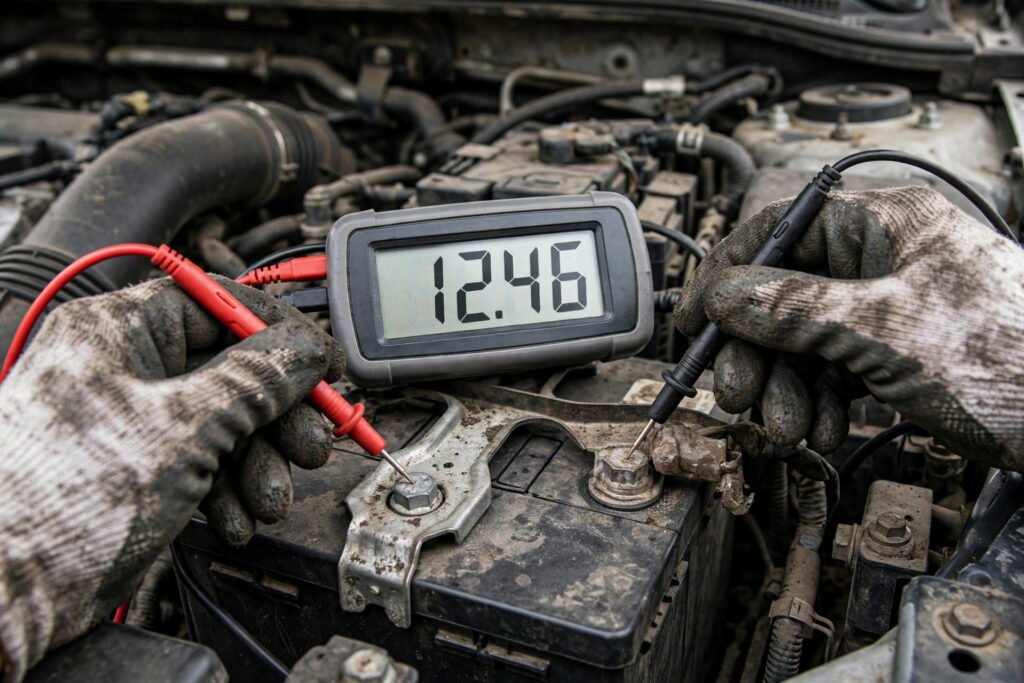
Free testing: every major auto parts chain (AutoZone, O’Reilly, Advance Auto) tests batteries free, usually without removing them — a conductance tester measures cold cranking amps against the battery’s rating in about two minutes. Do this in October as part of your fall winterization routine. DIY voltage check: with the car off for at least an hour, a multimeter across the terminals should read 12.6V+ (fully charged); 12.4V is ~75%; 12.0V is ~25% and effectively dead. With the engine running, 13.7–14.7V confirms the alternator is charging.
Load testing (what the pros do) applies a real load and watches voltage drop — the most accurate assessment of whether the battery will survive winter. If a free test shows marginal results (“weak” or borderline CCA), replace — marginal in October is dead in January. Do not let a borderline battery gamble with your winter.
Choosing the Right Replacement
Match the group size: your owner’s manual or the old battery’s label specifies the physical size and terminal layout — wrong size means it does not fit or connect properly. Meet or exceed cold cranking amps (CCA): the CCA rating measures starting power at 0°F — in Michigan, buy at least the manufacturer’s spec, and consider higher CCA for extreme-cold reliability. Consider AGM: Absorbent Glass Mat batteries cost more ($200–$300 vs. $120–$200 for conventional flooded) but handle deep discharge, vibration, and start-stop systems better — worth it for modern cars with heavy electrical loads.
Check the warranty: 3-year free replacement is standard; longer pro-rated warranties add value. Buy fresh: check the manufacture date on the new battery — sitting on a shelf for a year degrades it; choose one made within the last 3–6 months. Most parts stores install free with purchase (a 15-minute job), and they recycle the old battery (which also gets you out of the core charge). Consumer Reports tests and rates car batteries annually — check before you buy.
Extending Battery Life Through Winter
A new battery still needs care: drive regularly and long enough — short 5-minute trips drain more (starting) than the alternator replaces; combine errands or take the long way home weekly. Keep terminals clean: wire-brush corrosion and apply dielectric grease or anti-corrosion washers. Minimize parasitic drain: turn off lights, unplug chargers, and do not leave the car sitting for weeks — a battery maintainer/trickle charger ($30–$50) is cheap insurance for stored or infrequently driven cars. Park in a garage when possible — every degree helps; a battery blanket ($25) helps more for outdoor parking.
And know the difference between a battery problem and a charging problem: if a new battery dies repeatedly, the alternator or a parasitic drain is the culprit — get a proper electrical diagnosis rather than replacing batteries annually. Baseline electrical knowledge helps here; learning basic car maintenance covers the fundamentals.
The Bottom Line
Replace your car battery before winter if it is 4+ years old, shows any warning signs, or tests marginal — October testing and proactive replacement cost the same as a January failure minus the tow truck, the missed work, and the misery. Buy the right group size with adequate CCA, consider AGM for modern cars, and maintain the new battery through winter with regular driving and clean terminals. Winter always finds the weak battery. Make sure yours is not the one it finds.
Frequently Asked Questions
How long do car batteries last?
Typically 3–5 years, with heat as the main degrader and cold as the revealer. In climates with hot summers and cold winters like Michigan, plan on testing annually from year 3 and replacing proactively by year 4–5.
What voltage should a car battery read?
12.6V or higher at rest (engine off for an hour+) indicates full charge; 12.4V is about 75%; 12.0V is effectively discharged. With the engine running, 13.7–14.7V shows the alternator is charging properly.
Can cold weather kill a car battery?
Cold does not usually cause the underlying damage — summer heat does — but cold exposes it: at 0°F a battery delivers roughly 60% of its rated power while the engine needs more cranking effort. That is why weak batteries die on the first deep-cold morning.
Should I replace my battery before winter if it seems fine?
If it is 4+ years old, yes — “seems fine” in October is exactly when batteries fail by January. A free conductance test at any auto parts store gives you a definitive answer in two minutes.