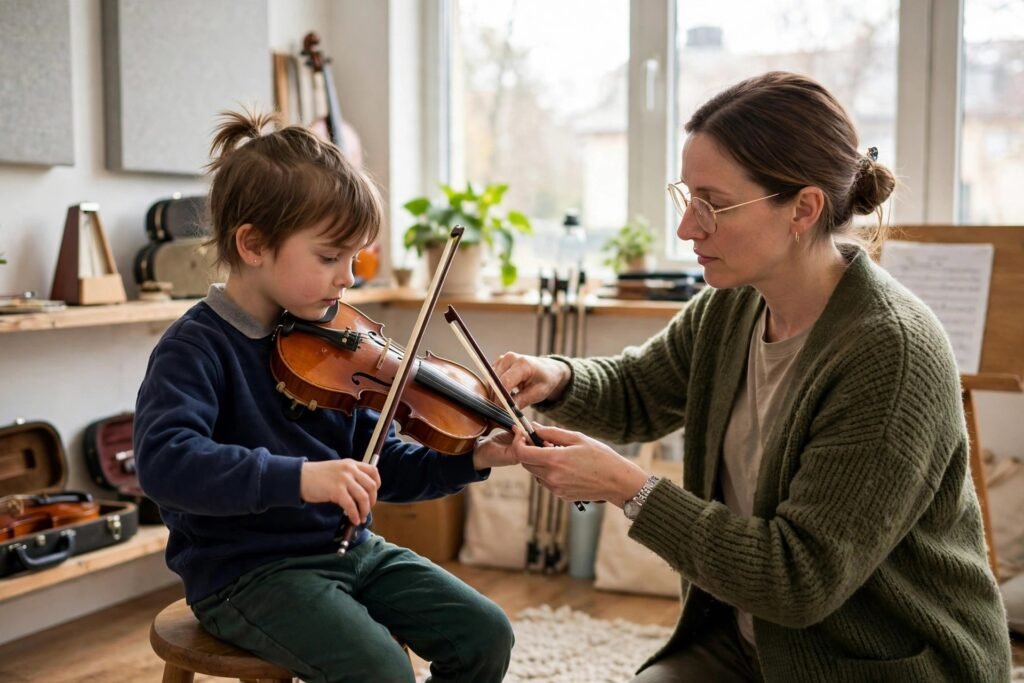
When Should Kids Start Violin Lessons? Full Readiness Guide
The tiny violin — a 1/16-size instrument on a four-year-old who can barely hold a pencil — is either adorable or absurd depending on your perspective. Parents wonder: is earlier better, or does starting too young just manufacture frustration (for everyone)? Violin teachers debate it endlessly, Suzuki programs enroll three-year-olds, and traditionalists say wait until seven or eight. The research and the pedagogy actually converge on a nuanced answer.
This guide covers the developmental readiness signs that matter more than age, the case for and against early starts, what lessons look like at different ages, costs and instrument logistics, and how to choose a teacher who will not ruin music for your child.
The Short Answer: 5-7 Is the Sweet Spot (With Caveats)
Most violin pedagogues land on ages 5 to 7 as the ideal starting window for the average child. The reasoning: by five, most children have the fine motor control to hold the bow, the attention span for a 30-minute lesson, the left-right coordination for fingering, and the cognitive ability to connect symbols (notes) to actions. Starting in this window captures peak neuroplasticity for pitch and motor learning while the child is developmentally ready to actually enjoy the process.
But “average child” hides enormous variance. The real question is not “how old?” but “is this child ready?” — and readiness has specific, observable markers.
Readiness Checklist (More Important Than Age)
Physical: can hold a pencil correctly, has basic finger independence (can wiggle individual fingers), can stand still and focus for 15-20 minutes, arm long enough to manage at least a 1/16 or 1/10 violin. Cognitive: knows left from right reliably, can follow multi-step instructions, recognizes patterns. Emotional: tolerates correction without meltdowns, shows sustained interest in music (not just the idea of a violin), can handle not being instantly good at something. The parent test: are you ready to supervise daily practice? For young beginners, the parent is the at-home teacher — Suzuki programs formalize this as a requirement, and it is the hidden variable behind most early-start successes and failures.
The Case for Starting Early (3-5)
The Suzuki evidence. Shinichi Suzuki’s mother-tongue method — starting at 3-4 with listening immersion, parental involvement, and group classes — has produced generations of excellent players. The method’s core insight is valid: young brains absorb pitch, rhythm, and technique the way they absorb language, implicitly and rapidly. Absolute pitch (“perfect pitch”) correlates strongly with early musical training, with the critical window largely closing around age 6-7.
Physical naturalness. Young children have not yet developed the tension patterns adults fight — they hold the bow with natural relaxation that older beginners must consciously relearn. Posture habits formed at four become invisible by ten.
The caveats are serious. Early start demands heavy parental involvement (daily supervised practice — 15-30 minutes of your focused time), a teacher genuinely specialized in very young children (rare and worth seeking), and a child who actually wants it. Forcing a disinterested three-year-old produces the opposite of musicianship: an enduring hatred of practice. The research on early training benefits assumes willing participation — coerced early starters show no advantage and frequent burnout.
The Case for Starting Later (8-12)
Faster progress. Older beginners learn dramatically faster — reading music, understanding theory, self-directing practice. An 8-year-old starter often catches a 4-year-old starter within 2-3 years, because cognitive maturity compresses the learning curve. The early starter’s “head start” is largely an illusion by early adolescence.
Autonomy. Older children practice independently, choose the instrument themselves (intrinsic motivation beats parental ambition every time), and handle the frustration of the learning plateau without parental scaffolding.
No evidence of missed windows (mostly). Apart from absolute pitch’s early window, there is no critical period for violin mastery that closes at eight or ten. Professional violinists who started at 9, 10, even 12 exist at every level including orchestral — what matters is total quality practice hours, and a motivated 10-year-old accumulates them faster than a reluctant 5-year-old.
The Verdict by Child Type
Eager, musical, parent-available → start at 4-6 with a Suzuki or early-childhood specialist. Interested but average readiness → 6-8, the classic sweet spot. Asking for it themselves at 9+ → start immediately; self-selected starters are the highest-success group at any age. Parent wants it more than the child → wait; revisit in a year. Forcing the timeline is the number one predictor of quitting.
What Lessons Look Like (and Cost)
Format: private 30-minute weekly lessons are the standard for beginners ($30-$80/lesson depending on market — $50 is typical in most U.S. metros). Suzuki programs add weekly group classes. Older beginners can start at 45 minutes. Practice expectations: 15-20 minutes daily for young beginners (parent-supervised), scaling to 30-45 by age 8-10. Consistency beats duration — daily 15 minutes outperforms weekend 2-hour marathons by orders of magnitude.
Instruments: rent, don’t buy, for growing children — fractional violins ($20-$35/month rental) are outgrown every 12-18 months, and rental programs include maintenance and size exchanges. A proper setup matters enormously: a poorly set-up rental with high action and cheap strings makes beginners fight the instrument instead of learning. Use a violin shop, not a general music store, for rentals. Full-size student outfits run $400-$1,000 to buy when growth stabilizes (usually age 11-13).
Budget the accessories too: shoulder rest ($20-$40, essential for comfort and posture), rosin, spare strings, and a metronome/tuner app. Total first-year cost typically runs $2,000-$4,000 including lessons — comparable to youth sports, and worth weighing against other activities competing for the family calendar. (For the economics of kids’ gear generally, our look at laptop costs for elementary kids applies the same buy-for-the-stage-you’re-in logic.)
Choosing a Teacher (The Decision That Matters Most)
A great teacher with an average student outperforms an average teacher with a great student. Look for: specialization in beginners (teaching 5-year-olds is a different skill from coaching conservatory teens — ask directly), a studio of thriving young students (ask to observe a lesson), structured pedagogy (Suzuki, O’Connor, or traditional — any coherent method beats ad-hoc), and warmth with standards — the teacher should be someone your child likes and who clearly expects practice.
Red flags: no beginner students currently enrolled, disdain for parental involvement (for young starters), lesson time spent mostly chatting, or pressure to buy an expensive instrument immediately. Trust your child’s reaction after a trial lesson — dread is data.
The National Association for Music Education (NAfME) publishes guidance on choosing music instruction, and the Suzuki Association (via NAMM’s educator resources) maintains teacher directories for the Suzuki method specifically. For lesson-structure inspiration, our piece on how teachers plan lessons shows what good pedagogy looks like from the other side of the music stand.
Conclusion
Kids should start violin lessons when they show developmental readiness — typically ages 5-7, earlier only with genuine enthusiasm and committed parental involvement, later with zero penalty when the child self-selects. Rent a fractional violin from a real violin shop, find a teacher who specializes in beginners, protect daily practice consistency over duration, and let the child’s interest set the pace. The goal is not the earliest start — it is the start that sticks, building toward the decade of joyful practice that actually makes a violinist.
Frequently Asked Questions
What is the best age to start violin lessons?
Ages 5-7 suit most children developmentally. Ages 3-5 work with Suzuki-trained teachers and heavy parental involvement; ages 8+ starters learn faster and often catch up within a few years. Readiness signs matter more than the birthday.
Is 10 too old to start violin?
Not at all. Older beginners progress faster due to cognitive maturity, practice independently, and frequently catch early starters within 2-3 years. Self-motivated later starters are among the most successful students.
Should I rent or buy a beginner violin?
Rent fractional sizes ($20-$35/month) — children outgrow them every 12-18 months, and rental programs include maintenance and size exchanges. Buy a full-size student outfit ($400-$1,000) once growth stabilizes around ages 11-13.
How much should a beginner practice?
15-20 minutes daily for young beginners (parent-supervised), 30-45 minutes by ages 8-10. Daily consistency matters far more than session length — 15 focused minutes beats occasional marathon sessions.
How do I choose a violin teacher for my child?
Prioritize beginner specialization, observe a trial lesson, check for a coherent method and a studio of thriving young students, and trust your child’s reaction. Avoid teachers with no current beginners or who discourage parental involvement for young starters.