What Is Impermanent Loss in Liquidity Pools? Explained Simply
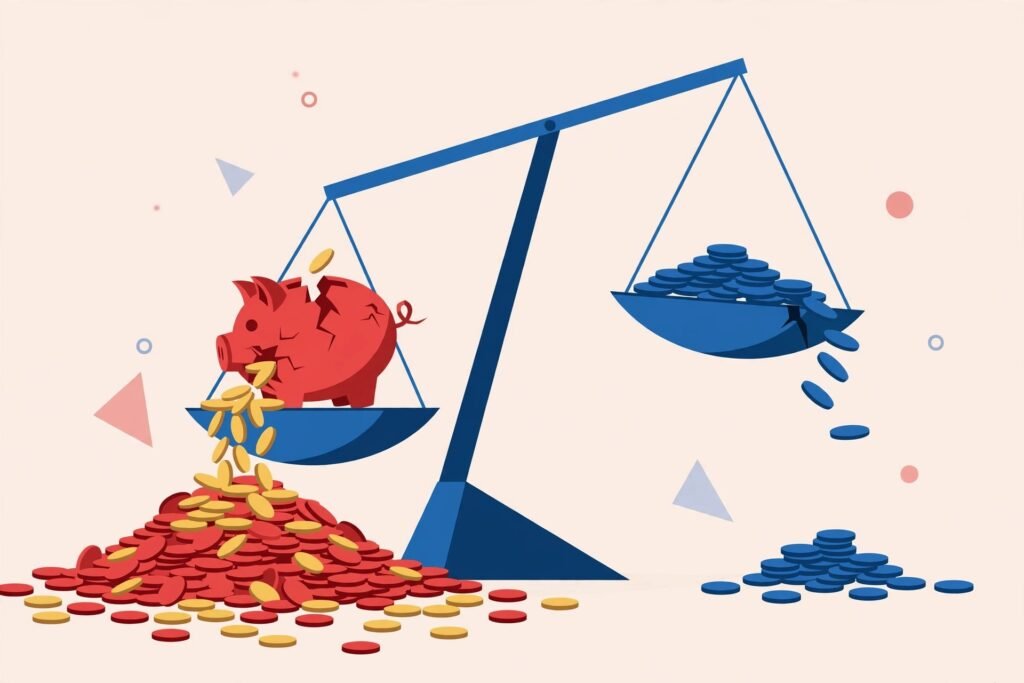
You deposited $10,000 into a liquidity pool earning juicy fees — and months later, you would have had $11,500 by simply holding the tokens in your wallet. That $1,000 gap has a name: impermanent loss. It is the most misunderstood risk in decentralized finance, quietly eroding the returns of liquidity providers who chased high APYs without understanding the math. The term itself is misleading — the loss is only “impermanent” if prices return to exactly where they started, which often never happens. This guide explains impermanent loss in plain English, with real numbers, so you can decide whether providing liquidity is actually profitable for you.
The Simple Explanation
A liquidity pool holds two tokens (say, ETH and USDC) that traders swap between. As an LP (liquidity provider), you deposit both tokens and earn a share of trading fees. Here is the catch: the pool automatically rebalances — when ETH’s price rises, the pool sells your ETH for USDC to maintain its ratio, so you end up with less ETH and more USDC than you started with. If you had just held the original tokens, the ETH portion would have appreciated fully. The difference between “what you have in the pool” and “what you would have by holding” is impermanent loss. It is called impermanent because if ETH’s price returns to exactly your entry price, the loss disappears. But crypto prices rarely round-trip neatly — and every day they do not, the loss edges toward permanent.
A Concrete Example With Numbers
You deposit 1 ETH ($2,000) + 2,000 USDC into a pool — $4,000 total. Then ETH doubles to $4,000:
- If you had held: 1 ETH ($4,000) + 2,000 USDC = $6,000
- In the pool: the pool rebalanced you to ~0.707 ETH ($2,828) + $2,828 USDC = $5,656
- Impermanent loss: $6,000 − $5,656 = $344 (5.7%)
The pool also earned you trading fees — say $200 over the period. Net result: you are still $144 worse off than holding. This is the critical insight beginners miss: fees must exceed impermanent loss for liquidity provision to beat holding. In volatile pairs, they often do not. The loss scales with divergence: a 2x price move costs ~5.7%, a 3x move ~13.4%, a 5x move ~25.5%. Symmetric pools of correlated assets (stablecoin pairs like USDC/DAI) have near-zero impermanent loss — which is why their yields are lower. Risk and reward, always.
When Impermanent Loss Hits Hardest
- Volatile, uncorrelated pairs (ETH/SHIB, BTC/meme tokens) — maximum divergence, maximum loss.
- One-sided moonshots — when one token 10x’s, the pool has sold most of it away from you. The better the token performs, the more you underperform holding it.
- Concentrated liquidity positions (Uniswap v3) — higher fee earnings but amplified impermanent loss within tight ranges; if price exits your range, you stop earning fees entirely while holding 100% of the underperforming asset.
- Low-fee environments — newly launched pools with little trading volume generate negligible fees against full impermanent-loss exposure.
Strategies to Minimize It
Stick to correlated or stable pairs
Stablecoin-stablecoin pools (USDC/USDT/DAI) have minimal price divergence and thus minimal impermanent loss — yields are modest (2–6%) but genuinely low-risk on this dimension. Similarly, correlated pairs (ETH/stETH, BTC/WBTC) diverge far less than volatile altcoin pairs.
Demand fees that justify the risk
Before depositing, estimate: does the pool’s historical fee APR exceed the expected impermanent loss for this pair’s volatility? High-volume established pools (ETH/USDC on Uniswap) often clear this bar; exotic new pairs with 200% advertised APYs usually do not once you account for divergence and the likelihood the APY collapses as more LPs arrive.
Use single-sided or managed vaults cautiously
Some protocols offer single-sided staking or managed LP vaults that rebalance automatically. These reduce complexity but add smart-contract risk and management fees — and they cannot repeal the underlying math, only manage around it.
Consider just holding (or staking)
The unsexy truth: for most people, holding plus staking beats liquidity provision on a risk-adjusted basis. LP returns look exciting until you subtract impermanent loss, gas costs, and your time. If you cannot articulate why LP beats holding for your specific pair, default to holding. Compare honestly with simpler income options too — our roundup of side hustles requiring no startup money puts DeFi yields in perspective against effort-adjusted alternatives.
Running the Numbers Before You Deposit
Make this a habit, not a guess. Before depositing into any pool, answer three questions in writing: (1) What is the pool’s trailing 30-day fee APR from actual volume (not the advertised headline rate, which often includes temporary incentives)? (2) What is this pair’s typical monthly price divergence — check the price ratio chart over the last six months? (3) Does (1) exceed a conservative estimate of (2)’s impermanent-loss cost? If you cannot answer these, you are not investing — you are hoping. A simple spreadsheet with these three inputs takes ten minutes and will save you from the most common LP mistake: chasing a 40% advertised APY on a volatile pair where divergence eats 25%. Sophisticated LPs also model scenarios — what happens to my position if token A doubles, halves, or goes sideways — before committing capital. The pools that survive this scrutiny are fewer than you think, and that selectivity is precisely the edge.
The Tax Angle
Every LP action can be taxable: depositing into a pool, earning fees (ordinary income), withdrawing, and claiming rewards each create record-keeping obligations. Impermanent loss itself is generally not deductible until realized (when you withdraw at a loss versus your basis). The complexity multiplies fast — a year of active LP management across pools can generate hundreds of taxable events. Use crypto tax software from day one, and apply the tracking discipline from our investment tax record-keeping guide. Investor.gov’s digital-asset resources provide the regulatory framing, and Ethereum’s official documentation explains the underlying pool mechanics.
Conclusion
Impermanent loss is the hidden tax on liquidity provision: the gap between what your pooled tokens are worth and what holding them would have earned, driven by the pool’s automatic rebalancing as prices diverge. It is “impermanent” only if prices return to entry — otherwise it is simply loss, offset (sometimes) by trading fees. Before providing liquidity, run the numbers for your specific pair: volatile pairs demand high fees to justify the risk, stable pairs offer modest but honest returns, and for most investors, holding plus staking remains the better risk-adjusted choice. Understand the math, and liquidity pools become a calculated tool rather than an expensive lesson.
Frequently Asked Questions
Can impermanent loss exceed my fee earnings?
Yes — frequently, in volatile pairs. Always compare expected fee income against the pair’s historical divergence before depositing. If fees do not clearly exceed likely IL, do not provide liquidity.
Is impermanent loss permanent?
It reverses only if token prices return to exactly your entry ratio. In practice, prices rarely round-trip, so treat it as effectively permanent and demand compensation via fees.
Which pools have the least impermanent loss?
Stablecoin pairs (USDC/DAI) and tightly correlated pairs (ETH/stETH, WBTC/BTC) — minimal price divergence means minimal IL, though yields are correspondingly lower.
Does Uniswap v3 concentrated liquidity increase impermanent loss?
It concentrates both fee earnings and IL within your chosen price range — higher capital efficiency, but sharper losses if price moves against you, and zero fee income if price exits your range entirely.
Should beginners provide liquidity?
Generally no — start with holding and staking, which have simpler risk profiles. Graduate to liquidity provision only after you can calculate expected IL for a pair and confirm fees justify it.