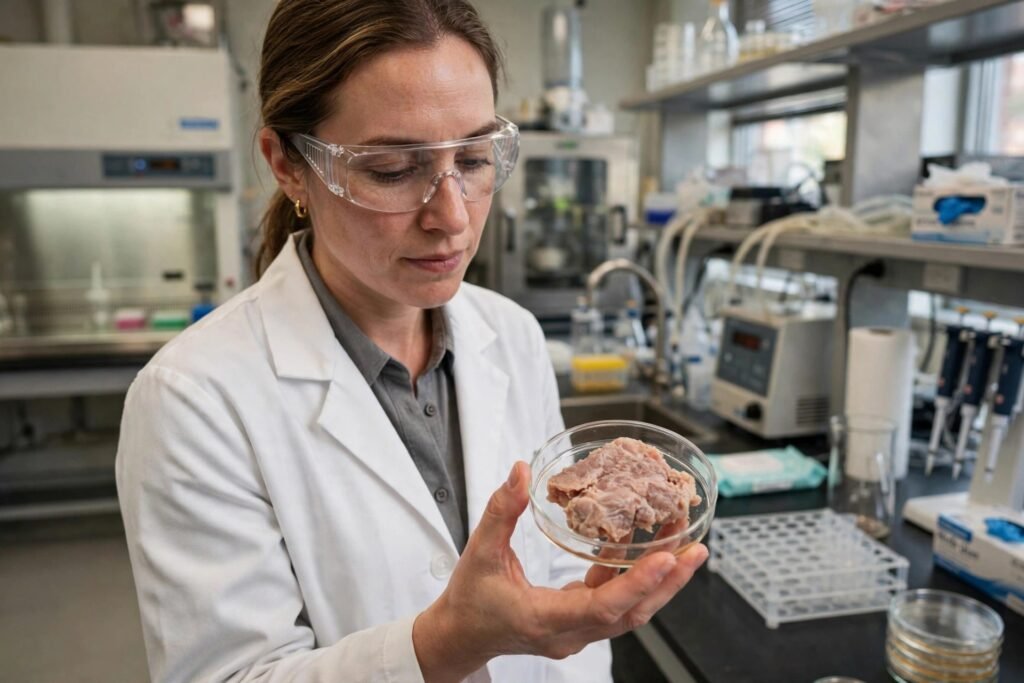
Is Lab Grown Meat Safe to Eat? Regulators’ Full Verdict
Cultivated meat — real animal meat grown from cells in bioreactors instead of raised on farms — has moved from science-fiction demo to regulated reality. Singapore approved it in 2020; the United States followed in 2023, with the FDA and USDA jointly clearing cultivated chicken from two companies for sale. The industry promises meat with a fraction of the environmental footprint and zero slaughter. But the question consumers actually ask is simpler: is it safe to eat?
The short answer from regulators is yes — but the full answer is more interesting. This guide explains how cultivated meat is made, what the safety reviews actually examined, the legitimate open questions, and how it compares to conventional meat on the safety dimensions that matter.
How Cultivated Meat Is Made
The process has four stages. 1. Cell sourcing: a small biopsy of muscle cells (or embryonic stem cells) is taken from a living animal — no slaughter required, though fetal bovine serum was historically used in growth media (the industry has largely shifted to animal-free media). 2. Proliferation: cells feed on a nutrient broth of amino acids, sugars, vitamins, and growth factors inside a bioreactor — essentially a brewery fermenter — multiplying from millions to trillions. 3. Differentiation and scaffolding: cells are coaxed into muscle (and sometimes fat) tissue on edible scaffolds that give structure. 4. Harvest and processing: the tissue is collected, shaped, and processed much like conventional ground or formed meat products.
The result is biologically animal muscle tissue — the same proteins, fats, and micronutrients as farmed meat — without the animal’s lifetime of feed, antibiotics, manure, or slaughter. Current products are mostly ground/minced formats (nuggets, burgers, sausages); whole-cut steaks with marbling and texture remain the industry’s hard problem, years from market.
What Regulators Actually Reviewed
The U.S. safety clearance was not casual. The FDA’s pre-market consultation examined the cell lines, every input to the growth media, and the manufacturing process for two companies (Upside Foods and Good Meat), issuing “no questions” letters — the agency’s signal that it accepts the safety conclusion. The USDA then inspected the production facilities and approved labels, the same dual oversight applied to conventional meat plants.
What they evaluated: cell line stability (do the cells remain normal muscle cells through many divisions, without tumor-like changes?), input safety (are all media components food-safe, and are residuals washed out?), microbiological safety (is the sterile bioreactor process actually sterile — contamination would be the main hazard?), allergenicity (it is still chicken/beef protein — existing meat allergies apply), and nutritional equivalence (does it deliver the expected protein and micronutrients?). The FDA’s cultivated meat resources detail the consultation process, and the USDA’s Food Safety and Inspection Service covers the facility-inspection side.
The Strongest Safety Argument
Paradoxically, cultivated meat’s production method is its best safety feature. Conventional meat’s biggest hazards — Salmonella, E. coli, Campylobacter — come from intestinal contamination during slaughter and from crowded feedlot conditions. Cultivated meat is grown in sterile bioreactors with no intestines, no manure, no slaughter floor. The entire category of slaughter-contamination risk is engineered out. It is also produced without antibiotics — removing one more driver of the resistance crisis.
The Legitimate Open Questions
Honest assessment requires the caveats regulators acknowledge:
Long-term consumption data does not exist yet. Cultivated meat has been eaten by thousands, not millions, over years not decades. The components are all familiar (muscle cells, food-grade media), so toxicologists consider novel risks low — but “low” is not “zero,” and post-market surveillance is the real long-term safety net.
Cell-line drift. Cells dividing thousands of times can accumulate genetic changes. Manufacturers monitor for this, and regulators reviewed the monitoring — but it is a process control that must be maintained forever, at every facility, which is a regulatory challenge as the industry scales globally.
Growth media residuals. The industry has moved away from fetal bovine serum (expensive, animal-derived, variable), but whatever replaces it must be food-safe at residual levels. Regulators reviewed current formulations; future cost-cutting reformulations will need re-review.
Fraud and mislabeling. As with any premium product, the risk that cheap conventional meat gets passed off as cultivated (or vice versa) will require testing infrastructure that barely exists yet.
Nutritional differences. Cultivated meat matches conventional meat on protein, but micronutrient profiles (B12, iron, zinc — influenced by the animal’s diet and the media formulation) may differ. Labels will need to reflect actual content, not assumed equivalence.
How It Compares to Conventional Meat on Safety
Dimension by dimension: Foodborne pathogens: cultivated wins decisively (sterile production vs. slaughter contamination). Chemical contaminants: cultivated avoids the pesticide, heavy metal, and veterinary drug residues that accumulate through animal feed — though media inputs need their own screening. Allergens: equivalent — it is still meat protein. Processing risks: equivalent — once harvested, cultivated meat is ground, seasoned, and cooked like any meat, with the same handling rules (which is why our meat refreezing safety guide applies identically). Unknown long-term risks: conventional meat has centuries of consumption data; cultivated has years. The familiar devil versus the unfamiliar angel.
Should You Eat It?
If it is sold in the U.S. or Singapore, it has passed the same regulatory safety review as any new food process — the evidence supports trying it without safety anxiety. The reasons to hesitate are not safety but values and economics: price (currently restaurant-only, far above conventional meat), environmental claims that depend on clean energy powering the bioreactors (coal-powered cultivated meat can footprint worse than chicken), and personal comfort with the technology. None of those are safety issues — and conflating them with safety is the industry’s critics’ favorite move.
For the home cook, the practical reality: you will not see cultivated meat in grocery stores at competitive prices for several more years. When you do, handle it exactly like conventional ground meat — same temperatures, same hygiene, same respect for the slow-cooker fundamentals that make any meat delicious.
Conclusion
Lab-grown (cultivated) meat cleared rigorous FDA and USDA safety reviews covering cell lines, media inputs, sterility, and nutrition — and its sterile, slaughter-free production eliminates conventional meat’s biggest hazards (fecal pathogens, antibiotic use). Legitimate open questions remain around long-term data, cell-line monitoring at scale, and nutritional equivalence. The verdict: as safe as regulators can determine for a new food technology, with a safety profile that is arguably better than conventional meat on the hazards we understand best. Whether you eat it is now a question of price, values, and taste — not safety.
Frequently Asked Questions
Is cultivated meat FDA approved?
The FDA completed pre-market consultations (issuing “no questions” letters) for cultivated chicken from two companies, and the USDA inspected facilities and approved labels — the full U.S. regulatory clearance, granted in 2023.
How is lab-grown meat made?
Animal muscle cells are biopsied, multiplied in nutrient broth inside bioreactors, differentiated into muscle tissue on scaffolds, then harvested and processed like conventional ground meat. No slaughter is involved in production.
Does cultivated meat taste like real meat?
It is real meat at the cellular level — same proteins and fats. Current products (nuggets, burgers) test comparably in tastings; whole-cut texture (steak marbling) remains the industry’s unsolved challenge.
Is lab-grown meat better for the environment?
Potentially much better on land use and slaughter-free production, but the climate benefit depends heavily on the energy powering bioreactors — clean-energy-powered facilities footprint far better than fossil-powered ones. Independent lifecycle data is still limited.
Do meat allergies apply to cultivated meat?
Yes. Cultivated chicken is still chicken protein — anyone with poultry allergies must avoid it, just like conventional chicken. Allergen labeling follows the same rules.