Laminate Flooring in a Living Room: Real Installation Costs
Laminate Flooring in a Living Room: Real Installation Costs
Laminate flooring is the budget-friendly way to get the wood look — and in a living room, it’s one of the smartest upgrades per dollar. But “budget-friendly” still means real money, and the quotes can confuse you. Most living room installs land between $1,500 and $4,000 all-in.
Here’s what drives that number and how to get it done right.
Material Costs: What You’re Actually Paying For
Laminate itself runs $1 to $5 per square foot, and the price tiers mean something. Budget laminate ($1 to $2) looks flat and plasticky up close; mid-range ($2 to $3.50) has textured grain and beveled edges that genuinely mimic wood; premium ($3.50 to $5) adds waterproof cores and hyper-realistic visuals. For a living room — the most visible floor in the house — mid-range minimum is my strong recommendation. A typical living room is 250 to 400 square feet, so materials run $500 to $2,000.
Don’t forget the extras: underlayment ($0.30 to $0.60 per square foot — and yes, you need it even with attached pad for sound and moisture), transitions and moldings ($50 to $150), and 10% extra material for cuts and waste. If your subfloor needs leveling or old flooring needs removal, add $1 to $3 per square foot. These “extras” surprise people; budget them from the start.
Labor: Pro Install vs. DIY
Professional installation runs $2 to $5 per square foot, so labor for a 300-square-foot living room is $600 to $1,500. Pros are worth it if your room has tricky angles, stairs nearby, or subfloor issues — they’ll finish in a day and the cuts around doorways will be clean. Get three quotes and ask whether furniture moving, old floor removal, and baseboard work are included; those line items separate honest quotes from lowball ones.
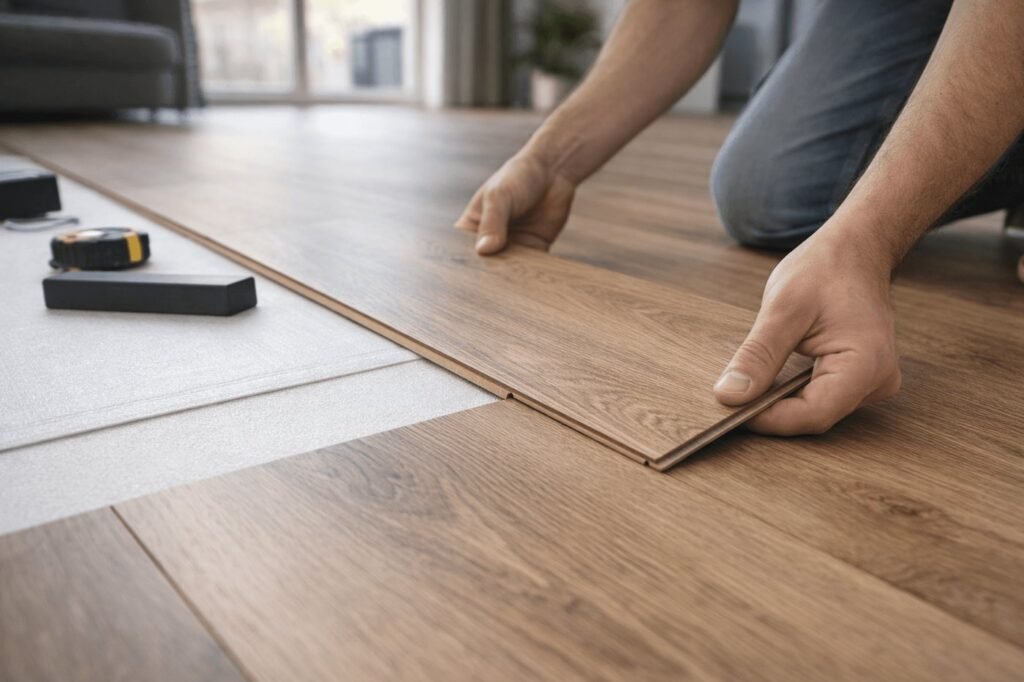
DIY is genuinely realistic with click-lock laminate — it’s the most beginner-friendly flooring there is. You’ll need a tapping block, pull bar, spacers, a jigsaw or miter saw for cuts, and a weekend. Material-only cost for that 300-square-foot room: $700 to $1,200. The catch: your first room will have imperfect cuts, and you’ll work slower than you expect. Watch two full installation videos before buying anything; if it still looks doable, it is.
What Drives the Price Up (or Down)
Room shape matters more than room size. A square room is fast; a living room with bay windows, angled walls, and three doorways doubles the cutting time and waste. Subfloor condition is the other big variable — a flat plywood subfloor is ideal, while old tile that needs removal or concrete that needs leveling adds hundreds.
To keep costs down: choose mid-range laminate on sale (flooring goes on sale constantly — never pay full price), install over the existing floor if it’s flat and you can afford the height change, and handle the demo and baseboard removal yourself even if you hire the install. To spend wisely, not just cheaply: upgrade the underlayment for sound (living rooms echo with cheap pad) and pick a waterproof core if you have kids or pets — the $0.50 per square foot premium pays for itself the first time someone spills.
Laminate Living Room Budget Planner
For a typical 300 sq ft living room:
- Materials (mid-range): $600-$1,050 plus 10% waste.
- Underlayment, transitions, moldings: $150-$300.
- Pro labor: $600-$1,500 (or $0 DIY).
- Old floor removal/subfloor prep: $0-$900 if needed.
- Realistic total: $1,500-$2,500 DIY; $2,000-$4,000 pro-installed.
- Always get 3 quotes; confirm furniture moving and baseboards included.
- Buy mid-range minimum — cheap laminate looks cheap in a living room.
The Bottom Line
Budget $1,500 to $4,000 to install laminate flooring in a living room, with $2,000 to $2,500 as the sweet spot for quality mid-range materials with professional installation. DIY cuts that roughly in half if you’re handy.
Laminate has grown up — the good stuff genuinely looks like wood and handles real life. Spend the money on mid-range materials and good underlayment, and your living room floor will look great for 15 years.
Living With Laminate: Care and Realistic Expectations
Laminate’s reputation for durability is deserved but not unlimited. It handles kids, pets, and daily life well — but it’s not waterproof unless you bought waterproof-core products, and even those have limits at the seams. Wipe spills promptly, never wet-mop (damp mop only), and put felt pads on furniture. The aluminum-oxide wear layer resists scratches impressively, but dragging heavy furniture across it will leave marks — lift, don’t slide.
One thing to know: laminate can’t be refinished. When the wear layer eventually dulls (15-25 years for quality products), replacement is the only option — unlike hardwood, which sands down to new wood. This is the real trade-off for the lower price. Buy the best wear rating you can afford (AC4 or AC5 for active households) to maximize lifespan, and keep a box of spare planks from the original batch — manufacturers discontinue colors, and having matching replacements for damaged planks is invaluable.
For resale, quality laminate in a living room is a neutral-to-positive: buyers see clean, modern floors, not the material’s price tag. Cheap, obviously-fake laminate is a negative that savvy buyers mentally price for replacement. The difference between $2/sq ft and $3.50/sq ft laminate is invisible in your wallet after installation but visible in every showing. In the most-seen room of the house, the upgrade pays for itself.
Quick Answers
Can laminate go in kitchens and bathrooms?
Only waterproof-core laminate, and even then wipe spills fast. Standard laminate swells with moisture — keep it to dry areas.
Does laminate increase home value?
Quality laminate is neutral to slightly positive; it reads as updated flooring. Cheap laminate can be a negative.
How long does laminate flooring last?
15-25 years for quality products with proper care. High-traffic commercial ratings (AC5) last longest residentially.
The transition details separate amateur laminate jobs from professional-looking ones — and they’re where DIYers most often stumble. Every doorway and room change needs a proper transition strip: T-molding for same-height floors, reducer strips for height differences, end caps where laminate meets carpet. These $10-$20 pieces prevent the chipped edges and tripping hazards of unfinished transitions. Plan them before you start — knowing where each transition goes affects your layout direction and plank staggering.
Underlayment choice deserves more thought than most DIYers give it. The basic foam ($0.30/sq ft) is fine for ground floors, but for second stories or condos, upgrade to acoustic underlayment ($0.60-$1.00/sq ft) — your downstairs neighbors will notice the difference, and many HOAs require specific sound ratings (IIC/STC). For concrete slabs, a vapor barrier is non-negotiable (6-mil poly sheeting or underlayment with built-in barrier) — concrete wicks moisture that destroys laminate from below. The $50-$100 underlayment upgrade is invisible in the finished floor but decisive in its performance and longevity.
Further reading: the North American Laminate Flooring Association, the EPA on flooring and indoor air quality.