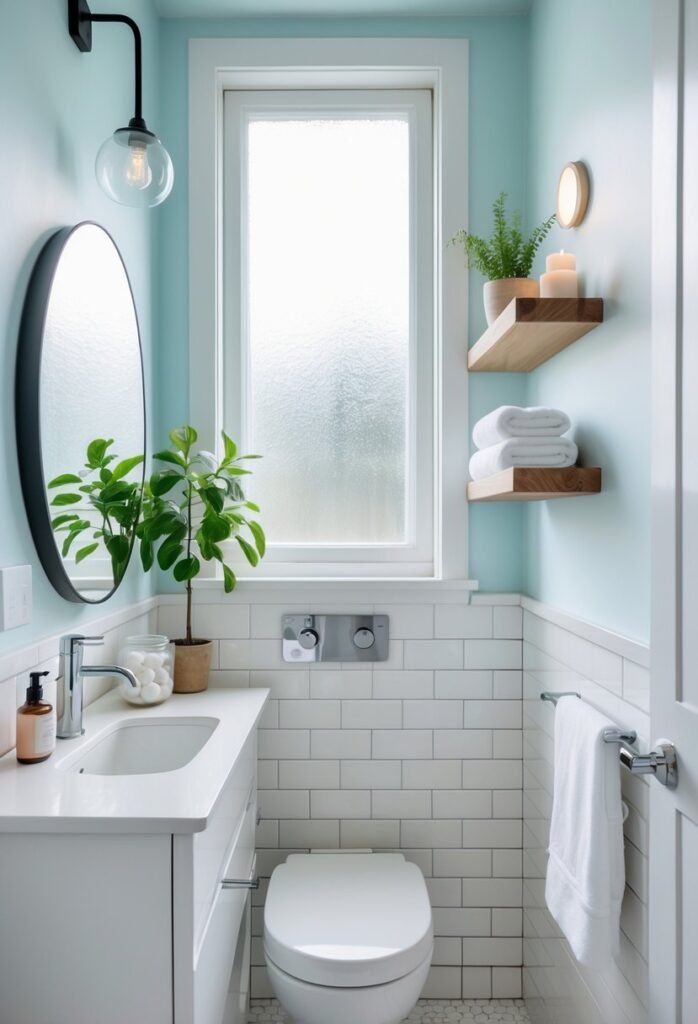
How to Make a Small Bathroom Look Bigger (No Renovation)
How to Make a Small Bathroom Look Bigger (No Renovation)
Small bathrooms are a fact of life in most homes — but a cramped-feeling bathroom is usually a design problem, not a size problem. I’ve seen 40-square-foot bathrooms that felt spacious and 70-square-foot ones that felt like closets. The difference is never the square footage.
These are the visual tricks designers actually use. Most cost under $100, none require a contractor, and you can do all of them in a weekend.
Light and Mirrors: The Two Biggest Levers
Light is everything in a small bathroom. If you have a window, maximize it — replace heavy curtains with frosted film or a light-filtering shade that gives privacy without blocking daylight. Then layer your artificial light: the single harsh overhead is what makes small bathrooms feel like interrogation rooms. Add a second light source — sconces beside the mirror, or even a $20 LED strip behind the mirror — and the room instantly feels larger and more expensive.
Mirrors are the oldest trick because they work. One large mirror (or a mirrored medicine cabinet) spanning the vanity doubles the visual space. Go bigger than you think — a mirror that nearly fills the wall above the sink is better than a small decorative one. If there’s a blank wall, a second mirror opposite the window bounces daylight around the room. Frameless or thin-framed mirrors keep the look clean; heavy frames visually chop up the space.
Color, Clutter, and Visual Continuity
Paint is the cheapest transformation: light, cool colors (soft white, pale gray, light blue-green) recede visually and make walls feel farther away. But here’s the designer secret — painting the walls, trim, and even ceiling the same light color eliminates the visual “stops” where your eye catches a boundary, making the room read as one continuous space. Dark colors can work in tiny powder rooms for drama, but for feeling bigger, light wins.
Clutter is the enemy. Every bottle on the counter, every towel draped over the shower rod, makes the room feel smaller. Corral toiletries into a cabinet, a shower caddy, or matching containers — visual uniformity reads as spaciousness. Swap a bulky vanity for a pedestal or floating vanity if you can ($150 to $300 and a plumber’s hour), or at minimum choose a vanity with legs rather than a blocky cabinet — seeing floor underneath tricks the eye into perceiving more space.
Details That Add Up
Swap your shower curtain for clear glass doors (or just a clear curtain liner, $15) — a patterned curtain visually cuts the room in half, while clear glass lets your eye travel the full depth. Hang the curtain rod higher and wider than the tub to fake taller ceilings. Choose large-format tiles for any refresh — fewer grout lines mean less visual busyness — and run floor tile wall-to-wall without a contrasting border.
Scale your fixtures to the room: an oversized vanity light or chunky faucet overwhelms a small bath. A streamlined faucet, a round mirror instead of rectangular (softens the boxy feel), and matching towels in light colors all contribute. And keep the floor as visible as possible — a tiny bath mat instead of wall-to-wall rugs, toilet paper stored in a slim cabinet rather than a floor-standing tower. Every square inch of visible floor counts double.
Small Bathroom, Bigger Feel: Action List
Weekend projects, roughly in order of impact:
- Maximize natural light: frosted film instead of heavy curtains.
- Install the largest mirror you can fit above the vanity.
- Add a second light source — sconces or LED strip, not just overhead.
- Paint walls, trim, and ceiling the same light color.
- Declutter every surface; corral toiletries into cabinets.
- Switch to a clear shower curtain or glass doors.
- Show more floor: floating vanity, slim storage, small bath mat.
- Use large-format tiles and matching light-colored towels.
The Bottom Line
Making a bathroom look bigger without renovating comes down to light, mirrors, continuous color, and ruthless decluttering. None of it requires a contractor, and the total for all of it can stay under $300.
The room won’t gain a single square foot — but it’ll feel like it did. That’s the whole point of good design: working with what you have instead of wishing for more.
Storage Tricks That Double as Space Illusions
In a small bathroom, storage and spaciousness are usually enemies — more storage means more visual clutter, which means smaller feel. The trick is invisible storage: recessed medicine cabinets ($60-$120) that sit inside the wall instead of protruding, over-the-toilet shelving that uses dead vertical space, and inside-cabinet organizers that hide the chaos. Every item with a hidden home is an item not shrinking your room visually.
The shower is a major clutter zone. A corner tension-pole caddy ($25) uses vertical space without drilling; a built-in niche (doable in a weekend if you’re retiling, or a $40 adhesive niche shelf) keeps bottles off the tub edge. Squeegee the glass after showers — water spots on glass make the whole bathroom look dingy, and a 20-second squeegee habit keeps everything sparkling. Clear containers and matching dispensers (decant the shampoo) create visual calm that reads as spaciousness.
Don’t forget the back of the door — an over-door organizer ($15) holds towels, cleaning supplies, and toiletries invisibly when the door is open (which is most of the time). And under-sink: stackable bins and a tension rod for spray bottles convert the chaotic cabinet into organized storage. The principle throughout: if you can see it, it should be beautiful or minimal; everything else hides. Small bathrooms feel big when they’re visually quiet.
Quick Answers
What color makes a small bathroom look biggest?
Light, cool colors — soft white, pale gray, light blue-green. Painting walls, trim, and ceiling the same light color maximizes the effect.
Should I use a shower curtain or glass door?
Clear glass (or a clear liner) makes the room feel larger by letting your eye travel the full depth. Patterned curtains visually halve the space.
Does a big mirror really help?
Dramatically — it’s the single highest-impact change. A mirror spanning the vanity wall can make a small bath feel twice as large.
The grout factor is the hidden variable in small-bathroom spaciousness. Dark or high-contrast grout creates a busy grid pattern that visually chops the room into tiny squares — the opposite of spacious. Matching grout closely to the tile color (light grout with light tile) creates a calm, continuous surface that reads as larger. And larger tiles mean fewer grout lines overall. If you’re retiling a small bath, the combination of large-format light tile with matching grout is the single most spacious-looking choice you can make. It’s a detail nobody notices consciously, but everyone feels in the room’s perceived size.
Further reading: the National Kitchen & Bath Association design resources, Energy Star lighting guidance.