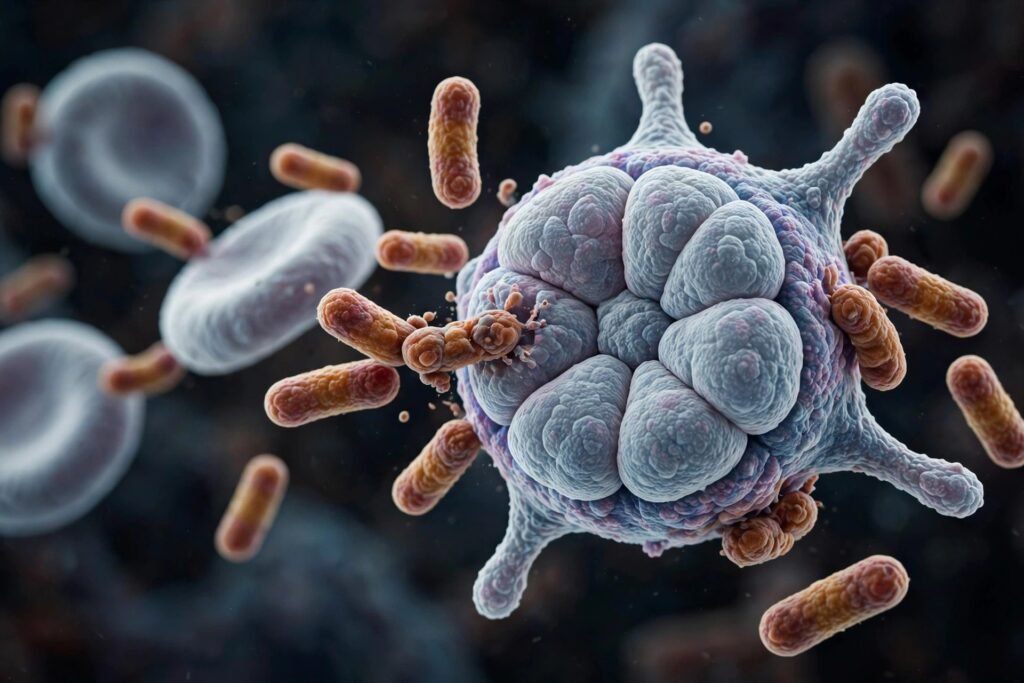
How Does Your Immune System Fight Infections? Full Guide
Right now, as you read this, your body is fighting a war you cannot feel. Viruses land on your mucous membranes with every breath. Bacteria probe your skin’s defenses. Fungi, parasites, and mutated cells probe for weakness. Against all of it stands the immune system — a distributed defense network of trillions of cells, dozens of specialized cell types, and signaling molecules, operating with a sophistication that makes modern militaries look disorganized.
Most explanations stop at “white blood cells fight germs.” The reality is far more interesting: a layered defense with tripwires, identification systems, targeted assassins, and a memory that lasts decades. This guide walks through how your immune system actually fights infections — from the skin barrier to antibodies to the memory cells that make vaccines work.
Layer 1: The Barriers (Keeping Invaders Out)
The immune system’s first victories are the infections that never happen. Physical barriers — skin, mucous membranes — block most pathogens outright; your skin’s slightly acidic pH and antimicrobial peptides make it actively hostile ground. Chemical barriers include stomach acid (dissolving most swallowed microbes), lysozyme in tears and saliva (an enzyme that shreds bacterial walls), and the mucus escalator: airways lined with mucus trap inhaled particles while tiny cilia sweep them upward to be swallowed and destroyed.
The microbiome is the newest-recognized barrier: trillions of beneficial bacteria in the gut and on the skin that outcompete pathogens for space and nutrients, produce antimicrobial compounds, and calibrate immune responses. This is why broad-spectrum antibiotics — which carpet-bomb the microbiome — temporarily increase vulnerability to infections like C. difficile: the guards have been dismissed.
Layer 2: Innate Immunity (The Rapid Response)
When pathogens breach the barriers, the innate immune system responds within minutes — no prior exposure needed. Its cells recognize broad molecular patterns shared by pathogens (but not by human cells) using pattern-recognition receptors:
Macrophages — the sentinels and garbage trucks. Stationed in tissues throughout the body, they engulf pathogens and debris (phagocytosis), then display fragments of the invader on their surface like a “wanted” poster — a critical handoff to the adaptive system.
Neutrophils — the shock troops. The most abundant white blood cell, they swarm infection sites within minutes, devour pathogens, and deploy NETs (neutrophil extracellular traps) — webs of DNA and antimicrobial proteins that snare microbes. They die in the fight; pus is largely their corpses.
Dendritic cells — the intelligence officers. They sample the battlefield, carry pathogen fragments to lymph nodes, and present them to T cells — the crucial bridge between innate and adaptive immunity. Vaccines work by giving dendritic cells a safe preview of the enemy.
Natural killer (NK) cells — the assassins. They patrol for cells that look wrong — virus-infected or cancerous — detecting the absence of normal “self” markers, and kill them on contact. No prior exposure required.
Inflammation is the innate system’s battle plan made visible: blood vessels dilate and become leaky (redness, heat, swelling), recruiting cells and walling off the infection site. The symptoms we hate — fever, swelling, soreness — are largely the immune system working, not the pathogen. Fever, for instance, is a deliberate hypothalamic reset that makes the body inhospitable to many pathogens while accelerating immune cell activity.
Layer 3: Adaptive Immunity (The Precision Strike)
The innate response holds the line, but the adaptive immune system wins the war — with specificity, firepower, and memory. It takes days to ramp up on first exposure (which is why new infections make you sick for a week), but it is devastatingly precise:
B cells and antibodies. Each B cell produces antibodies shaped to bind one specific molecular target (antigen) — and the body generates millions of B cell variants through genetic shuffling, collectively capable of recognizing essentially any pathogen. When a B cell’s antibody matches an invader, it activates, multiplies into a clone army, and floods the blood with antibodies that tag pathogens for destruction, neutralize toxins, and block viruses from entering cells.
T cells — the specialists. Helper T cells (CD4+) are the generals: they coordinate the entire response, activating B cells, macrophages, and killer T cells. (HIV’s devastation comes from destroying exactly these coordinators.) Killer T cells (CD8+) are the snipers: they recognize infected cells displaying pathogen fragments and order them to self-destruct — critical against viruses hiding inside cells where antibodies cannot reach. Regulatory T cells are the brakes, preventing the response from destroying healthy tissue.
Immunological Memory: Why You (Usually) Get Each Disease Once
After the battle, most effector cells die off — but a small population of memory B and T cells remains, sometimes for decades. On re-exposure, they mount a response in hours instead of days — faster than the pathogen can establish itself. This is why second infections are milder or silent, and it is the entire basis of vaccination: a safe preview that builds memory without the disease. Measles memory can last a lifetime; influenza memory is undermined by the virus’s rapid mutation, which is why flu shots are annual.
When the System Misfires
The immune system’s power makes its errors dangerous. Allergies are the system attacking harmless targets (pollen, peanuts) with weapons meant for parasites. Autoimmune diseases — rheumatoid arthritis, lupus, multiple sclerosis, type 1 diabetes — are friendly-fire incidents where tolerance to “self” breaks down, often triggered by genetic susceptibility plus environmental factors. Immunodeficiency — from HIV, chemotherapy, or genetic conditions — removes layers of defense, leaving the body open to opportunistic infections.
Cytokine storms — the immune overreaction seen in severe influenza, COVID-19, and sepsis — show that much of the damage in serious infections comes from the defense, not the invader. Modern immunology’s frontier is largely about modulation: boosting the response against cancer (checkpoint inhibitors, CAR-T therapy) while calming it in autoimmunity.
Supporting Your Immune System: What Actually Works
The supplement industry sells immune “boosting,” but immunology does not work that way — a “boosted” immune system is called an allergy or autoimmune disease. What the evidence supports is not undermining the system you have:
Sleep. The single best-supported immune behavior. Chronic sleep deprivation measurably reduces vaccine responses, NK cell activity, and infection resistance. Our guide to falling asleep without pills covers the fundamentals.
Vaccination. The most powerful immune intervention in history — it trains the adaptive system without the disease. Exercise (moderate, regular — extreme endurance efforts temporarily suppress immunity). Nutrition — adequate protein, vitamins A, C, D, and zinc; deficiencies impair immunity, but megadoses in the already-sufficient do little. Stress management — chronic cortisol suppresses immune function measurably. Not smoking, moderate alcohol — both directly impair immune defenses.
Seasonal basics help too — see our evidence-based look at boosting immunity before flu season for the practical pre-winter checklist.
For authoritative references, the CDC’s immune health resources and the NIH’s National Institute of Allergy and Infectious Diseases publish accessible explainers on how immunity works and what the research supports.
Conclusion
Your immune system fights infections in layers: barriers that prevent most invasions, an innate rapid-response force that holds the line within minutes, and an adaptive precision strike — B cells, antibodies, and T cells — that learns, remembers, and usually wins within days. The symptoms you feel are mostly the battle, not the enemy. Support the system with sleep, vaccines, nutrition, and stress management rather than “boosting” gimmicks — and appreciate the trillions-strong defense force that lets you read this article instead of fighting for your life.
Frequently Asked Questions
What is the difference between innate and adaptive immunity?
Innate immunity responds within minutes to broad pathogen patterns — no prior exposure needed (macrophages, neutrophils, inflammation). Adaptive immunity takes days to activate on first exposure but is precisely targeted and remembers (B cells, antibodies, T cells) — it is what vaccines train.
How do antibodies work?
Antibodies are Y-shaped proteins produced by B cells, each shaped to bind one specific pathogen target. They tag invaders for destruction by other immune cells, neutralize toxins, and block viruses from entering cells.
Why do we get fevers when sick?
Fever is a deliberate immune strategy: the hypothalamus raises body temperature, which inhibits many pathogens’ replication while accelerating immune cell activity. It is the defense working, not the infection itself.
Can you really “boost” your immune system?
Not in the way supplements claim — an overactive immune system causes allergies and autoimmunity. What works is not undermining it: sleep, vaccination, adequate nutrition, exercise, stress management, not smoking, and moderate alcohol.
How long does immune memory last?
It varies: measles immunity can last a lifetime, while influenza memory is defeated by rapid viral mutation (hence annual shots). Memory B and T cells persist for years to decades depending on the pathogen.