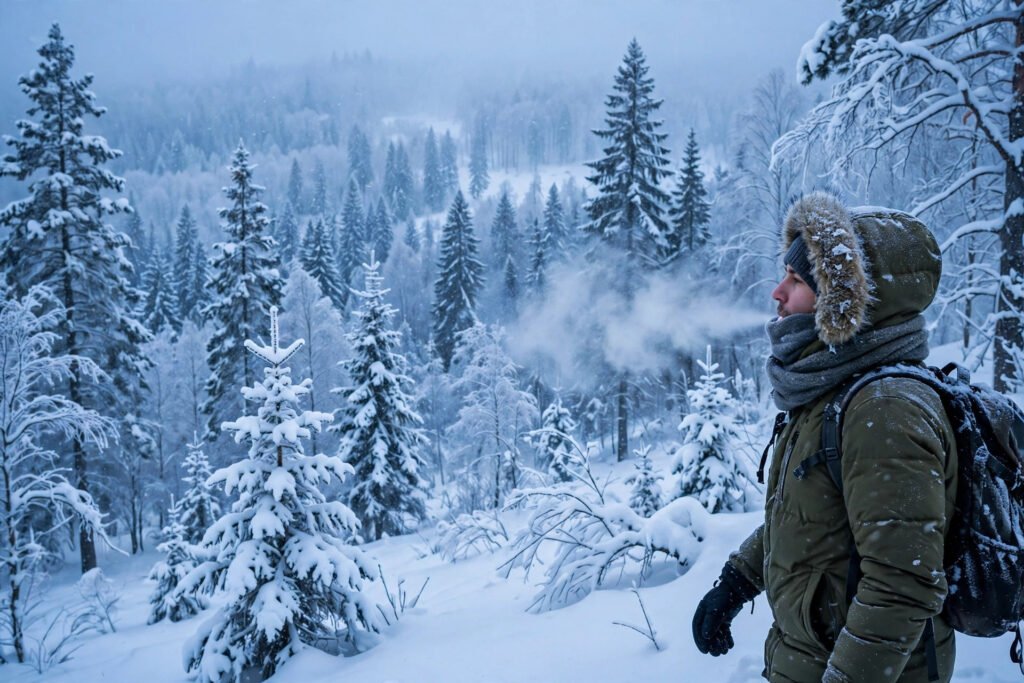
How Your Body Regulates Temperature in Extreme Cold (Science) all winter.
In January 2019, Chicagoans endured wind chills of -55°F — cold enough to frostbite exposed skin in five minutes. Yet the human body walked out into it, kept its core at 98.6°F, and (mostly) survived. Your body is a furnace wrapped in a thermostat of astonishing sophistication, defending a core temperature within a degree or two across environments ranging from desert noon to Arctic midnight. In extreme cold, that defense becomes a full-body emergency operation. Here’s how it works — and where its limits are.
The Core Mission: Protect the Organs
Everything the body does in cold serves one priority: keep the core — brain, heart, lungs, abdominal organs — at ~98.6°F. Enzymes, the protein machines running your chemistry, work within a narrow temperature band; a few degrees off and they malfunction, which is why hypothermia kills. The body defends the core ruthlessly, sacrificing the extremities without hesitation. Cold fingers aren’t a malfunction — they’re the strategy working: blood is being rationed to where it matters.
The hypothalamus, a almond-sized brain region, runs the operation. It receives temperature data from sensors in the skin, spinal cord, and organs, compares it to the 98.6°F set point, and orchestrates responses — all unconsciously. You don’t decide to shiver; your hypothalamus decides for you.
First Response: Vasoconstriction and Shivering
The instant cold is detected, blood vessels in the skin and extremities constrict — vasoconstriction — reducing warm blood flow to the surface where heat would escape. Skin pales, fingers go numb, and heat loss drops dramatically. It’s why your hands are the first casualty: the body is deliberately abandoning them to save the core.
Simultaneously, muscles begin shivering — rapid involuntary contractions that burn energy as heat. Shivering can quintuple the body’s heat production, making it the most powerful short-term defense. But it’s expensive: shivering depletes glycogen stores within hours, which is why exhausted, unfed people succumb to cold faster. The hierarchy is clear — constrict first (save heat), shiver second (make heat).
The Deep Defenses: Brown Fat and Hormones
Beyond shivering lies non-shivering thermogenesis, driven by brown adipose tissue — brown fat. Unlike white fat (storage), brown fat is packed with mitochondria that burn calories directly as heat, no movement required. Babies rely on it heavily (they can’t shiver effectively); adults retain smaller deposits around the neck and spine, and cold exposure can actually recruit more. It’s the body’s furnace room.
Hormones join the effort: the thyroid ramps up metabolic rate in sustained cold (weeks of exposure measurably raise basal metabolism), and adrenaline sharpens the acute response. This is also why the CDC’s extreme cold safety guidance emphasizes food and hydration — your furnace needs fuel, and dehydration thickens blood, worsening circulation to extremities.
Behavioral Thermoregulation: The Brain’s Other Half
Physiology is only half the system; behavior is the other. Feeling cold motivates action — seeking shelter, adding layers, moving, huddling, building fire. Humans are tropical animals surviving Arctic winters primarily through behavior and technology, not biology. Our physiological cold defenses are modest compared to Arctic mammals; our behavioral ones (clothing, shelter, fire) are unmatched.
This is worth remembering because behavioral failures cause most cold injuries. The Mayo Clinic’s hypothermia and frostbite resources stress the same pattern: victims are usually caught by surprise, underdressed, wet, or impaired — situations where behavior failed before physiology did. Sweat is the traitor: moisture conducts heat away from skin 25x faster than air, which is why “cotton kills” is the hiker’s mantra and why changing out of damp layers matters more than adding dry ones.
When Defenses Fail: Hypothermia’s Stages
Hypothermia begins when heat loss outpaces production and core temperature drops below 95°F. Mild hypothermia (90–95°F): violent shivering, confusion, clumsiness. Moderate (82–90°F): shivering stops (a bad sign — the fuel is gone), heart rhythm destabilizes, consciousness fades. Severe (below 82°F): unconsciousness, cardiac arrest risk, death. The cruel twist: moderate hypothermia impairs judgment, so victims stop helping themselves — the “paradoxical undressing” of severe cases, where people tear off clothes feeling burning hot, is a neurological misfire.
Frostbite is the parallel injury: extremities sacrificed too long. Ice crystals form in skin cells, killing tissue — fingers, toes, nose, ears. The treatment protocol (gradual rewarming, never rubbing) reflects the physiology: damaged microcirculation needs gentle restoration, not friction.
Acclimatization: Training the Thermostat
The system adapts. People exposed to cold regularly over weeks develop measurable acclimatization: shivering starts later, brown fat activity increases, peripheral circulation improves (the “hunter’s response” — periodic rewarming of extremities). Korean ama divers, who harvest seafood in cold water with minimal protection, show profound versions of these adaptations. You can’t think your way warm, but repeated exposure genuinely upgrades the hardware.
The practical takeaway: respect the system but support it. Dress in layers that trap air (the actual insulator), keep moving to generate heat, eat and hydrate, stay dry above all, and know the signs of trouble in yourself and others. Your body is running a sophisticated thermal defense — give it the supplies and the shelter it needs. Smart layering is the behavioral half of the equation: layering for cold without bulk works with your physiology, not against it. And the outer layer matters enormously — how much to spend on a winter coat is really a question about how much you value your thermal defense.
Cold Adaptation in Animals: Nature’s Upgrades
Humans are mediocre at cold compared to the specialists. Arctic foxes circulate warm blood to their feet through countercurrent heat exchangers — arteries and veins wrapped together so outgoing heat warms incoming blood. Emperor penguins huddle in rotating formations, sharing warmth with mathematical efficiency. Wood frogs survive being frozen solid, their cells protected by natural antifreeze. Studying these adaptations isn’t just fascinating — it’s inspiring medical research into organ preservation and therapeutic hypothermia. Evolution solved cold; we’re still taking notes.
Conclusion
Your body regulates temperature in extreme cold through a layered defense: vasoconstriction to conserve heat, shivering to generate it, brown fat for sustained furnace output, hormonal metabolic shifts, and behavioral strategies from clothing to shelter — all orchestrated by the hypothalamus defending a 98.6°F core. It sacrifices fingers to save organs, burns fuel prodigiously, and adapts with exposure. It’s a remarkable system. Just don’t test it at -55°F wind chill without respecting what it needs: fuel, dryness, and sense.
Frequently Asked Questions
Why do fingers go numb first in the cold?
Vasoconstriction deliberately reduces blood flow to extremities to preserve core heat. Numb fingers mean the strategy is working — blood is being rationed to your brain and organs.
What is brown fat?
Specialized fat tissue packed with mitochondria that burns calories directly as heat (non-shivering thermogenesis). Babies have lots; adults retain smaller deposits that can be increased with regular cold exposure.
At what temperature does hypothermia begin?
When core temperature drops below 95°F. This can happen in surprisingly mild conditions (40s–50s°F) with wind, wetness, and exhaustion — hypothermia is about heat loss exceeding production, not just extreme cold.
Can you train yourself to handle cold better?
Yes — regular cold exposure over weeks produces real acclimatization: delayed shivering onset, more active brown fat, and better extremity circulation. Start gradually and never alone in extreme conditions.
Why is wet clothing so dangerous in cold?
Water conducts heat away from skin roughly 25 times faster than air. Wet layers destroy insulation and accelerate heat loss catastrophically — staying dry is the #1 rule of cold safety.