What Is the Easiest Bookkeeping Method for a One-Person Business?
What Is the Easiest Bookkeeping Method for a One-Person Business?

You’re great at your craft and terrible at paperwork — receipts in a shoebox, income scattered across three apps, tax season a annual panic. What is the easiest bookkeeping method for a one-person business that you’ll actually stick with? Because the ‘best’ system is the one you use, and complicated systems die by February.
Here’s the minimalist bookkeeping setup that keeps solo businesses tax-ready with about 15 minutes a week. No accounting degree required.
What is the easiest bookkeeping method for a one-person business?
The Core System: Separate, Capture, Categorize
The entire method is three habits. 1. Separate: one business bank account and one business credit card (even a separate personal card works to start). Every business dollar flows through these — no exceptions. This single step does 70% of bookkeeping automatically: your statements become your records. 2. Capture: photograph every receipt the moment you get it. Apps like Wave (free), Expensify, or just a phone folder — the method doesn’t matter, the immediacy does. Paper receipts fade; digital ones don’t.
3. Categorize: once a week (pick a day — ‘Finance Friday’), spend 15 minutes assigning each transaction a category: supplies, mileage, software, meals, etc. That’s it. Income in, expenses out, everything categorized. At tax time, your categories map directly to Schedule C lines. This 15-minute weekly habit replaces the 15-hour March panic — and it’s genuinely all most one-person businesses need.
Free vs. Paid Tools (Honest Recommendations)
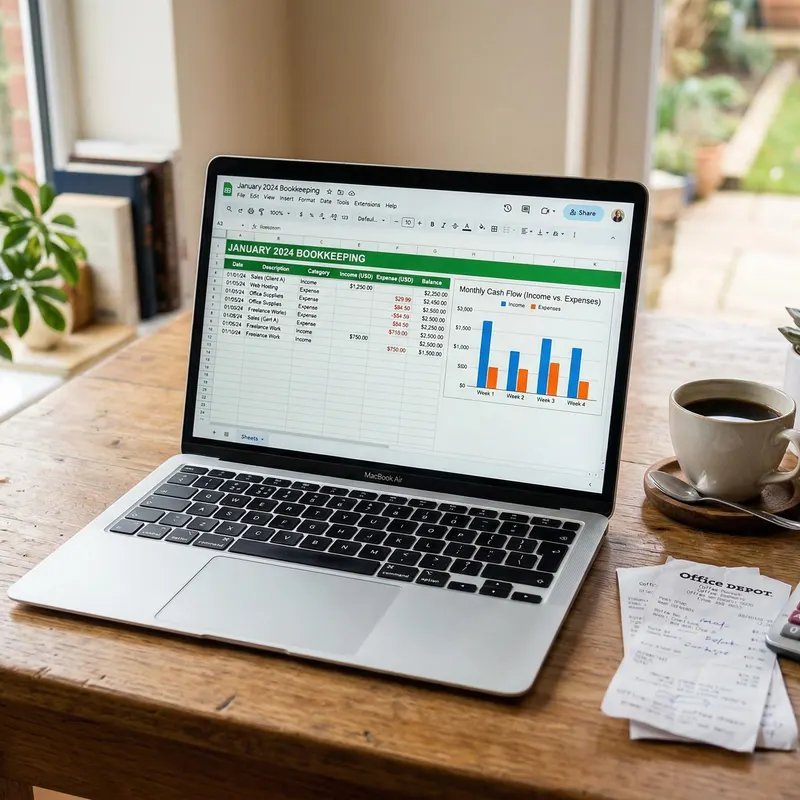
Free that actually works: Wave — free invoicing, accounting, and receipt scanning; the best free option by a mile and enough for most solo businesses. A well-organized spreadsheet also works if your transactions are few (under ~20/month) — Date / Description / Category / Amount columns, plus a tab for mileage. Worth paying for: QuickBooks Self-Employed ($15/month) if you want automatic mileage tracking and quarterly tax estimates calculated for you; Xero ($15/month) if you’re growing toward needing a real accountant later.
What not to do: buy the $60/month plan with payroll and inventory features for your freelance writing business — overkill kills consistency. And don’t mix tools: pick one system and commit. The tool matters 10%; the weekly habit matters 90%. Whichever you choose, connect your business bank account for automatic transaction import — manual entry is where bookkeeping systems go to die.
The Monthly and Yearly Rhythms
Weekly (15 min): categorize transactions, photograph stray receipts, check that income matches invoices sent. Monthly (30 min): reconcile — do your records match the bank statement? Review profit/loss: are you actually making money? (Many solo operators discover they’re not, which is vital information.) Set aside tax money (25–30% of profit — see the freelance tax guide). Quarterly: pay estimated taxes if required, review which expense categories are growing.
Yearly: hand your clean books to tax software or a CPA and watch the magic of a stress-free filing. Total annual bookkeeping time at this cadence: ~20 hours. Compare that to the 40+ hours of receipt-archaeology most disorganized solos endure. And as revenue grows past ~$50K, consider a bookkeeper ($100–$300/month) — at that point your time is worth more than the fee. Until then, separate-capture-categorize, 15 minutes a week, done.
Quick Answers
- Separate: dedicated business bank account + card — 70% of bookkeeping done automatically.
- Capture: photograph every receipt immediately — paper fades, digital doesn’t.
- Categorize: 15 minutes weekly (‘Finance Friday’) — income in, expenses out, categories assigned.
- Free tools: Wave (best free all-in-one); spreadsheet works under ~20 transactions/month.
- Worth paying: QuickBooks Self-Employed ($15/mo) for auto mileage + tax estimates.
- Monthly: reconcile statements, review P&L, set aside 25–30% for taxes.
- Yearly: clean books → easy filing. ~20 hours/year total vs. 40+ hours of March panic.
The Bottom Line
The easiest bookkeeping for a one-person business: separate accounts, capture receipts instantly, categorize 15 minutes weekly. Free tools like Wave handle the rest. That’s the whole system — and it works because it’s simple enough to survive your busiest weeks.
Bookkeeping isn’t about accounting; it’s about knowing whether you’re making money and being ready for taxes without panic. Fifteen minutes a week buys you both. Start this Friday.
Frequently Asked Questions
Spreadsheet or software — which is really easier?
Under ~20 transactions a month: a spreadsheet is genuinely easier — no learning curve, total control, free. Above that, or with invoicing needs: Wave (free) pulls ahead because automatic bank import eliminates manual entry, which is where spreadsheet systems die. The honest answer: start with whichever you’ll actually open weekly. A spreadsheet you use beats software you ignore. Upgrade when transaction volume makes manual entry painful, not before.
How do I separate business and personal expenses easily?
Two accounts, one rule: business card for business, personal card for personal — no exceptions, no ‘I’ll sort it later.’ The sorting never happens, and commingled expenses are how deductions get lost and tax prep becomes hell. If you slip (everyone does), transfer the exact amount between accounts immediately and note it. One business checking account + one business card is the entire system. Open them before your first expense, not after your fiftieth.
What records do I need to keep for taxes?
Income records (invoices, 1099s, payment confirmations), expense receipts (digital photos suffice), mileage logs (app-tracked), home office measurements, and bank/credit statements. Keep everything 3 years minimum (7 for some situations) — digital storage makes this trivial. The IRS accepts digital receipts; paper originals aren’t required. Organize by year in cloud folders. That’s it — no shoebox, no panic, just a folder structure and a weekly 15-minute habit.
When should I hire a bookkeeper?
When bookkeeping consistently doesn’t happen (the habit failed — outsource the habit), when revenue passes ~$50K–$75K (your time is worth more than the $100–$300/month fee), or when complexity arrives (inventory, employees, multi-state). A good bookkeeper pays for themselves in found deductions and reclaimed hours. Until then, the 15-minute weekly system in this article suffices. Don’t hire one to avoid learning the basics — you still need to understand your numbers; the bookkeeper just handles the mechanics. The IRS bookkeeping guidance for small businesses sets the official record-keeping standard — it’s simpler than most people fear.
How does bookkeeping connect to invoicing?
Directly — every invoice you send should become an income entry the moment it’s paid, matched by invoice number. The cleanest solo workflow: send invoice (Wave/PayPal, free) → payment arrives in business account → categorize in bookkeeping → done. Reconciling monthly means checking that invoiced amounts match received amounts — which catches the ‘forgot to follow up’ invoices that silently cost freelancers thousands. Our freelance invoice guide covers the invoice side; this article covers what happens after the money arrives.
Pingback: Turn Your Hobby Into a Profitable Etsy Shop: Guide