What Is Permafrost and Why Does It Matter? Explained (2026) on Earth.
Beneath nearly a quarter of the Northern Hemisphere’s land surface lies ground that hasn’t thawed in thousands of years — in places, for hundreds of thousands. Permafrost: permanently frozen earth, sometimes hundreds of meters deep, holding everything from ancient mammoth bones to twice as much carbon as the entire atmosphere. And it’s thawing. Scientists call permafrost one of climate change’s great sleeping giants, because what happens when it wakes up affects everyone, everywhere. Here’s what permafrost is, and why it matters far beyond the Arctic.
What Permafrost Actually Is
Permafrost is ground — soil, rock, sediment — that stays at or below 0°C (32°F) for at least two consecutive years. That’s the entire definition; it doesn’t have to contain ice, though most of it does. It underlies about 15% of the exposed land in the Northern Hemisphere: most of Alaska, northern Canada, Siberia, Greenland, and high mountain regions. In the coldest zones it’s continuous — frozen everywhere beneath the surface layer. Further south it’s discontinuous or patchy, existing in islands under peat bogs and shaded slopes.
Above the permafrost sits the “active layer” — the top few inches to several feet that thaw each summer and refreeze each winter. This thin living skin is where Arctic plants grow, where buildings’ foundations sit, and where most human interaction with permafrost happens. The permafrost below can extend 500+ meters deep in Siberia — a frozen archive reaching back through multiple ice ages.
The Carbon Bomb: Why Thawing Matters Globally
Here’s the number that concentrates minds: Arctic permafrost holds an estimated 1,400–1,600 gigatons of carbon — roughly twice what’s currently in the atmosphere. This carbon accumulated over millennia as dead plants and animals froze into the ground before they could fully decompose. As long as it stays frozen, it’s inert. When it thaws, microbes wake up and start digesting it, releasing carbon dioxide — and, in waterlogged conditions, methane, a far more potent greenhouse gas.
This creates the permafrost carbon feedback: warming thaws permafrost, thawing releases greenhouse gases, gases cause more warming. Current estimates suggest permafrost emissions could add significantly to human-caused warming this century — not enough to dominate the story, but enough to meaningfully worsen it. The U.S. Geological Survey’s permafrost research works to quantify exactly how fast this feedback is engaging, because the difference between gradual and abrupt thaw changes the math enormously.
What Thaw Looks Like on the Ground
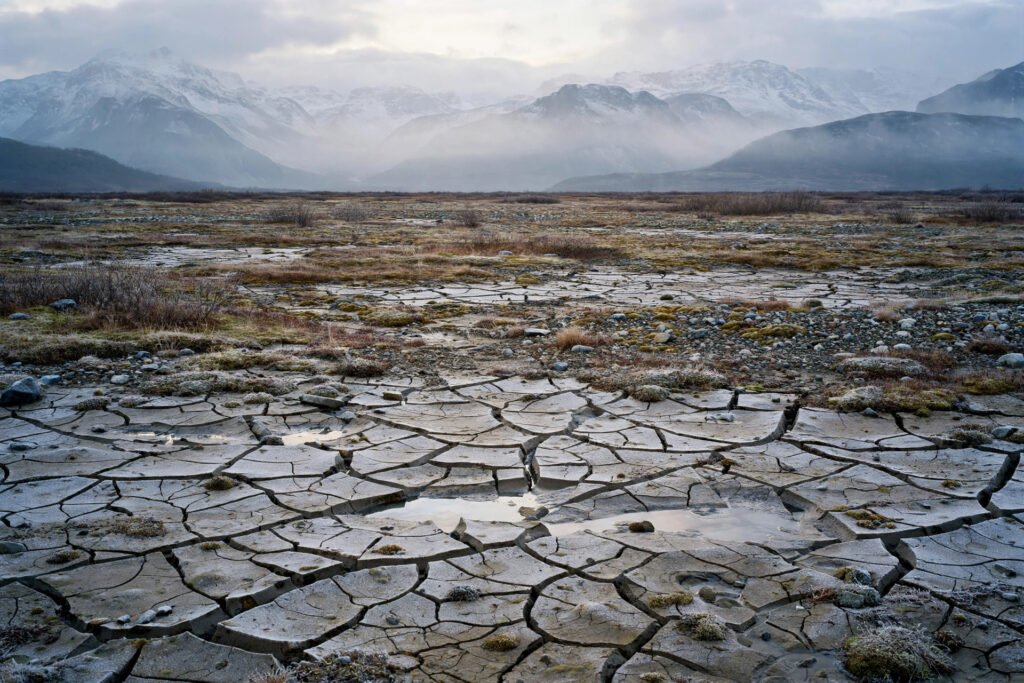
Permafrost thaw isn’t a slow, even melt — it’s lumpy and dramatic. Ice-rich permafrost contains massive ice wedges and lenses; when they melt, the ground collapses into pits, gullies, and landslides called thermokarst. Hillsides slump, lakes drain overnight through newly thawed channels, and coastlines crumble as the frozen glue holding bluffs together disappears. Arctic villages in Alaska are being forced to relocate as the ground beneath them literally falls into the sea.
Infrastructure built on the assumption of permanence is failing: roads buckle, pipelines strain, building foundations tilt, and runways crack. Engineers now design Arctic infrastructure for a thawing future — thermosyphons that keep ground frozen under buildings, adjustable foundations, flexible pipelines. The National Snow and Ice Data Center’s permafrost monitoring tracks these changes across the Arctic in near-real time.
The Microbes, Mammoths, and Methane Craters
Thawing permafrost is also a scientific treasure chest and a Pandora’s box. The treasure: impeccably preserved specimens — mammoths, ancient wolves, 40,000-year-old seeds that scientists have germinated — offering windows into ice-age ecosystems. The box: ancient microbes reviving after millennia frozen, including viruses unknown to modern immune systems. Most are harmless, but the possibility commands serious study.
Then there are Siberia’s methane craters — enormous holes appearing suddenly in the Yamal Peninsula, likely caused by thawing permafrost releasing pressurized methane pockets explosively. They’re dramatic evidence that permafrost thaw can be abrupt, not gradual — and abrupt changes are the ones that blindside both ecosystems and climate models.
Can Anything Be Done?
Permafrost thaw is, to a large degree, already committed: the heat is in the system, and permafrost responds slowly. But the rate and extent of future thaw depend directly on emissions this century — every fraction of a degree of avoided warming keeps more carbon frozen. Locally, communities are adapting: relocating villages, re-engineering infrastructure, monitoring thaw with satellite and ground sensors.
There’s also active research into whether thaw can be slowed locally — reindeer grazing to compress snow (reducing insulation), for instance — but these are experimental at best. The real lever is global: permafrost is one more reason the climate math is urgent, because thawing permafrost makes every other warming problem slightly worse. It’s the interest payment on the carbon debt, compounding.
The cold-climate connection runs through daily life too: the same insulation principles that fail in thawing permafrost apply to homes — stopping drafts in winter is permafrost physics at household scale. And sealing gaps around windows uses the same logic engineers apply to Arctic foundations: control the heat flow, control the outcome.
Permafrost and Your Weather
Arctic permafrost thaw doesn’t stay in the Arctic. The amplified warming that thaws it — the Arctic heats roughly twice as fast as the global average — weakens the temperature gradient that drives the jet stream, potentially making its meanders slower and more persistent. Some researchers link this to the stuck weather patterns behind recent extremes: prolonged heat domes, stalled rain systems, bitter cold outbreaks plunging south. The science is still being refined, but the plausible chain runs from thawing Siberian ground to the weather on your street — permafrost as a gear in the planetary climate machine.
Conclusion
Permafrost is permanently frozen ground underlying a sixth of the Northern Hemisphere’s land, holding twice the atmosphere’s carbon in deep freeze. It matters because thawing releases that carbon in a self-reinforcing feedback, collapses the ground beneath Arctic communities and infrastructure, and may already be engaging faster than models predicted. You don’t have to live in the Arctic to be affected by permafrost — its carbon, once airborne, belongs to everyone’s atmosphere.
Frequently Asked Questions
What is the active layer?
The top layer of ground above permafrost that thaws each summer and refreezes each winter — anywhere from inches to several feet thick. It’s the only part of the Arctic soil system where plants grow and where most human infrastructure sits.
How much of the Earth has permafrost?
About 15% of exposed land in the Northern Hemisphere — most of Alaska, northern Canada, Siberia, and Greenland, plus high mountain areas. In the Southern Hemisphere it’s limited to Antarctica and high peaks.
Is permafrost melting?
Yes. Arctic permafrost temperatures have risen measurably for decades, the active layer is deepening, and thermokarst collapse features are increasing across Alaska, Canada, and Siberia.
What happens if all permafrost thaws?
Complete thaw would release up to ~1,500 gigatons of carbon over centuries — a massive addition to atmospheric greenhouse gases. Full thaw is a multi-century process, but significant partial thaw this century is already underway.
Where can you see permafrost?
Roadcuts in Alaska and northern Canada expose it dramatically — look for layered ice wedges in the soil profile. Guided tours in Fairbanks include permafrost tunnels carved into frozen ground, with mammoth bones still embedded in the walls.
Can permafrost refreeze?
On human timescales, effectively no. Once thawed, the ground’s thermal and hydrological properties change, and refreezing would require sustained colder conditions than the current climate trajectory allows.