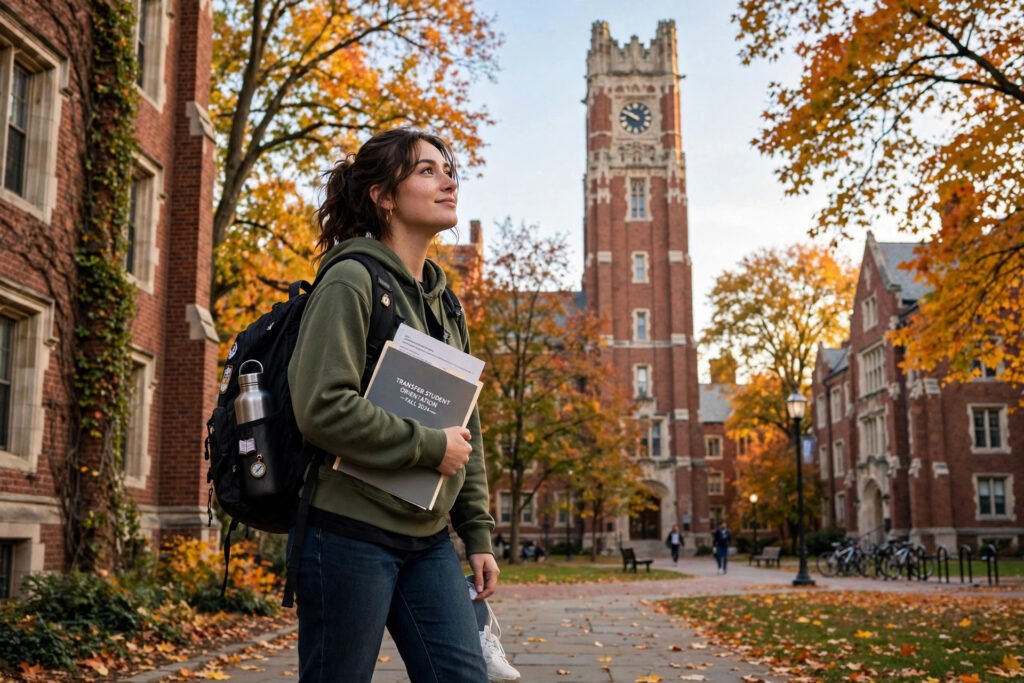
How to Transfer from Community College to Ohio State
Starting at a community college and transferring to Ohio State is one of the smartest financial moves in higher education: two years at ~$5,000/year, then an Ohio State degree at the end — the same diploma as four-year students, for roughly half the total cost. Ohio has built excellent transfer infrastructure to make this work. But successful transfers don’t happen by accident — they require planning from day one. Here’s exactly how to transfer from community college to Ohio State.
Why This Path Works So Well in Ohio
Ohio’s transfer system is designed for this. The Ohio Transfer 36 (formerly Ohio Transfer Module) guarantees that 36+ general education credits transfer to any Ohio public university. Transfer Assurance Guides (TAGs) guarantee specific course equivalencies in popular majors. And Ohio State admits thousands of transfer students annually — it’s a well-worn path, not a loophole.
The math is compelling: Columbus State Community College runs ~$5,000/year in tuition versus Ohio State’s ~$12,000/year in-state. Two years at Columbus State saves ~$14,000 in tuition alone, plus lower living costs. Your diploma says “The Ohio State University” — employers never see the transfer route, and they wouldn’t care if they did. Check federal aid options at studentaid.gov — transfer students get the same federal aid as everyone else.
Choosing the Right Community College
Columbus State Community College is the natural feeder — same city, deep Ohio State transfer advising, and the Preferred Pathway program offering structured transfer tracks. But any Ohio community college works: Cuyahoga Community College (Cleveland), Cincinnati State, Sinclair (Dayton), and others all feed Ohio State transfers successfully.
What matters most is your college’s transfer advising quality and articulation agreements. Ask the advising office specifically: “How many students transferred to Ohio State last year, and into which majors?” Strong numbers signal a well-supported pipeline. Some colleges have guaranteed-admission agreements for students meeting GPA thresholds — ask about these explicitly, as they’re the closest thing to a sure bet.
The Academic Plan: What to Take
This is where transfers succeed or fail. From your first semester, plan backwards from Ohio State’s requirements for your intended major:
Complete the Ohio Transfer 36: English composition, math, arts/humanities, social sciences, natural sciences — these 36+ credits are guaranteed to transfer and satisfy Ohio State general education requirements.
Follow the TAGs for your major: Transfer Assurance Guides map specific community college courses to Ohio State major prerequisites. An engineering transfer needs calculus and physics sequences; a business transfer needs accounting and economics. Taking the wrong courses wastes semesters — taking the right ones means you arrive as a true junior.
Protect your GPA: Ohio State transfer admission is competitive — a 3.0+ GPA is the practical minimum, 3.5+ for competitive majors (business, engineering, nursing). Every grade at community college counts exactly as much as grades at Ohio State for admission purposes. Take academics seriously from day one — and know the academic integrity rules wherever you study.
The Application Process and Timeline
Apply to Ohio State as a transfer during your final community college year — applications open well before deadlines, and competitive majors fill. You’ll need: official transcripts from all colleges attended, a personal statement (take it seriously — explain your path and goals), and sometimes letters of recommendation. High school records matter less for transfers with 30+ college credits — your college GPA is the star.
Key deadlines: Ohio State’s transfer application deadlines are typically months before the semester starts — check the current dates early and apply ahead of them. Apply for housing simultaneously (transfer housing fills fast), file your FAFSA (list Ohio State), and apply for transfer-specific scholarships — Ohio State offers merit aid for transfers, and many students miss it by not applying.
Maximizing Credits and Minimizing Cost
Before enrolling at community college, get pre-approval: use Ohio State’s transfer credit evaluation tools to confirm each planned course transfers as expected. After acceptance, review your transfer credit report line by line — challenge anything miscategorized; advising offices fix errors routinely when asked.
Financial strategy: live at home during community college years if possible (the biggest savings lever), work part-time to graduate with minimal debt, and apply for the Department of Education’s full range of federal aid plus Ohio state grants each year. The two-plus-two path done right can produce an Ohio State degree with under $20,000 total debt — life-changing compared to the alternative. Keep student spending lean — budget laptop picks are one easy win.
Common Transfer Mistakes to Avoid
The failed transfers I’ve seen share patterns — avoid them all. Mistake 1: taking random courses. Every semester without a transfer plan risks wasted credits; meet your advisor before registering, every term. Mistake 2: assuming a 2.5 GPA is fine. It meets minimums but not competitive reality — aim for 3.5+. Mistake 3: missing scholarship deadlines. Transfer merit aid has earlier deadlines than admission at some schools; calendar both. Mistake 4: not visiting Ohio State first. Tour as a prospective transfer, meet the department, picture yourself there — motivation matters. Mistake 5: going it alone. Join transfer student groups online before you arrive; arriving with connections changes everything.
Thriving After Transfer
Transfer students sometimes struggle socially — arriving as a junior when friend groups formed freshman year. Counter it deliberately: join student organizations immediately, consider transfer-specific orientation programs, live near campus if possible, and get involved in your major’s department. Academically, the jump in rigor is real — Ohio State courses demand more than community college did. Use office hours, tutoring centers, and study groups from week one, not after the first bad midterm.
Know this: transfer students graduate at rates comparable to four-year students and report equal satisfaction. The path is proven. Your job is just to walk it deliberately.
Conclusion
Transferring from community college to Ohio State works brilliantly when planned: choose a college with strong transfer advising, complete the Ohio Transfer 36 plus TAG courses for your major, maintain a 3.0+ GPA (3.5+ for competitive majors), apply early with a strong personal statement, and verify every credit transfers. The reward: an Ohio State degree at roughly half the cost, with a fraction of the debt. Start planning in your first community college semester — your future self will thank you.
Frequently Asked Questions
What GPA do I need to transfer to Ohio State?
A 3.0+ is the practical minimum for most majors; competitive programs (business, engineering, nursing) typically want 3.5+. Your community college GPA is the primary admission factor.
Will my community college credits transfer to Ohio State?
Ohio Transfer 36 credits are guaranteed to transfer to any Ohio public university, and TAG courses transfer as specific major equivalents. Verify with Ohio State’s transfer credit tools before enrolling in courses.
Is a transfer degree the same as a four-year degree?
Yes — your diploma says “The Ohio State University” with no indication of the transfer route. Employers and graduate schools treat it identically.
Can transfer students get financial aid and scholarships?
Yes — full federal aid, Ohio state grants, and Ohio State transfer merit scholarships are all available. File FAFSA listing Ohio State and apply for transfer scholarships specifically.
When should I apply as a transfer?
During your final community college year, well before Ohio State’s published transfer deadlines. Competitive majors and housing fill early — apply ahead of deadlines, not on them.