How to Protect Your Hearing at Concerts Without Missing the Music
The bass hits your chest, the crowd roars, and somewhere around the third song your ears start ringing — the badge of honor concertgoers wear proudly and audiologists mourn deeply. Here is the uncomfortable math: a typical rock concert blasts 110–120 decibels, and at that volume, permanent hearing damage begins in under 15 minutes. The ringing that fades by morning is not harmless — it is your inner ear’s distress signal, and repeated exposures accumulate into irreversible loss. The good news: protecting your hearing at concerts is easy, cheap, and does not ruin the experience. In fact, most musicians do it religiously. Here is the complete guide.
How Concerts Damage Hearing (The 15-Minute Rule)
Sound intensity is logarithmic: every 10-decibel increase represents ten times the sound energy. A normal conversation sits around 60 dB; a concert at 115 dB is not “twice as loud” — it is over 100,000 times more intense. Your inner ear’s hair cells, which convert sound to nerve signals, can tolerate brief loud exposure but die under sustained assault — and unlike skin or liver cells, they do not regenerate. Dead hair cells mean permanent hearing loss, usually starting with high frequencies and the ability to follow conversations in noisy rooms.
The exposure-time math is brutal: OSHA’s guideline allows 8 hours at 90 dB, but only 15 minutes at 115 dB — and many concerts exceed that. That ringing after the show (tinnitus) indicates temporary damage; when it stops fading fully between shows, the damage is becoming permanent. An estimated 1.1 billion young people worldwide are at risk of noise-induced hearing loss from recreational sound, per the World Health Organization — concerts and clubs are the leading venue. If you are planning your concert calendar, finding free concerts in your city is great — just bring protection to every single one.
Earplugs: The $20 Fix That Changes Everything
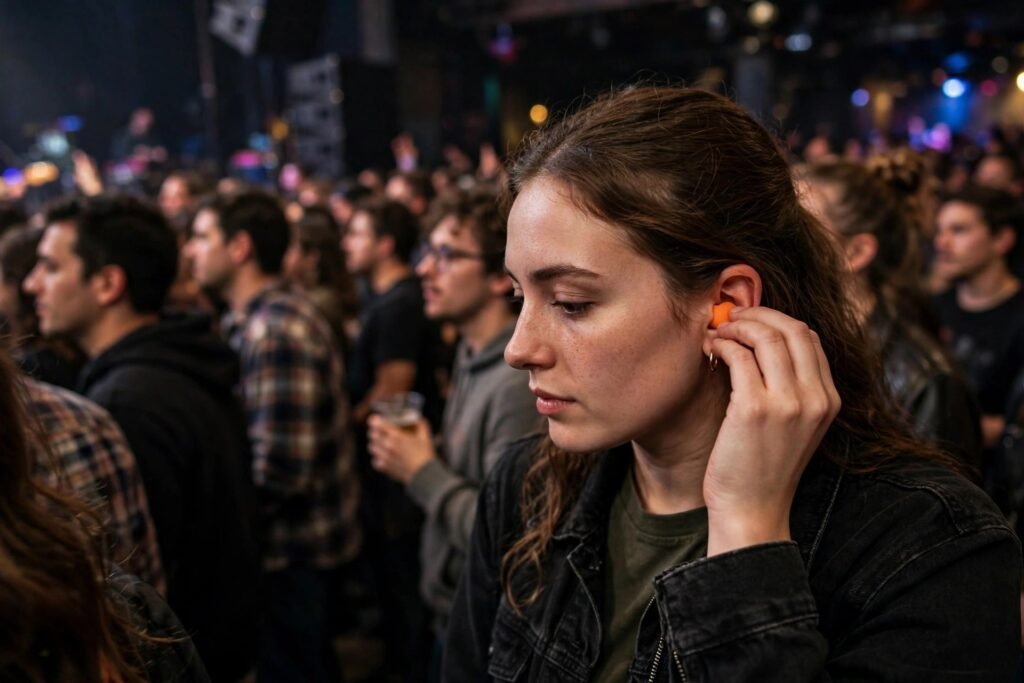
Foam earplugs (the 50-cent kind) reduce volume by 25–30 dB — enough to make a 115 dB concert safe for hours. They muffle high frequencies disproportionately, so music sounds duller, but they are infinitely better than nothing and belong in every bag. The real upgrade is high-fidelity musician’s earplugs ($15–$30): precision-tuned filters that lower volume evenly across frequencies, preserving sound quality while cutting 15–25 dB. Concerts sound the same, just safer — most musicians and sound engineers wear them.
For regular concertgoers, custom-molded earplugs ($150–$200 from an audiologist) are the gold standard: perfect fit, interchangeable filters for different venues, all-day comfort. Whatever tier you choose, the rule is absolute: plugs go in before the music starts (damage accumulates from the opener too) and stay in — removing them “just for the favorite song” during the loudest set defeats the purpose. Keep a spare pair in your wallet; what to bring to an outdoor concert should always list earplugs first.
How to Insert Foam Plugs Correctly
Most people do this wrong: roll the plug into a thin cylinder, reach over your head to pull the ear up and back (straightening the canal), insert deeply, and hold 30 seconds while it expands. A poorly inserted plug blocks almost nothing — technique matters as much as the plug itself.
Positioning and Breaks: Free Protection
Where you stand matters enormously. Sound intensity drops with distance — moving 20 feet back from the stage speakers can cut exposure by 6–10 dB, effectively quadrupling your safe time. Never stand directly in front of speaker stacks; the front-center “best spot” is the worst spot for your ears. Balconies and side positions offer the best sound-to-safety ratio.
Take listening breaks: step to the lobby or outside for 10 minutes every hour. Your ears partially recover during quiet intervals — the damage mechanism is cumulative dose, and breaks meaningfully reduce the total. Outdoor venues are inherently safer than indoor clubs (sound dissipates instead of reflecting), but still loud enough to require plugs. And monitor yourself: if your ears ring for more than 24 hours after a show, or sounds seem muffled the next day, you overdosed — see an audiologist and upgrade your protection before the next one.
Protecting Kids’ Hearing at Concerts
Children’s ears are more vulnerable — smaller ear canals amplify sound pressure, and kids cannot always articulate discomfort. Rules: proper hearing protection is non-negotiable (kid-sized earmuffs for toddlers, fitted plugs for older kids), keep them away from speakers, take frequent breaks, and consider the venue — an outdoor amphitheater lawn is far safer than a front-row club spot. If a child covers their ears or cries at the volume, leave — no concert is worth a child’s hearing.
Model the behavior: kids who see parents wearing earplugs adopt them without stigma. The “uncool” factor evaporates when the whole family gears up together. Many family-friendly venues now distribute free foam plugs at entry — take them even if you brought your own; spares save the day when one gets dropped in the dark.
What to Do If Damage Has Already Happened
Be honest about symptoms: persistent ringing (tinnitus), difficulty following conversations in restaurants, needing the TV louder than others, or a feeling of fullness after loud events. See an audiologist for a baseline hearing test — it is painless, often covered by insurance, and gives you a reference point to track over years.
There is no cure for noise-induced loss, but there is management: hearing aids have become remarkably discreet and effective, tinnitus retraining therapy helps many, and — most importantly — protecting what remains stops the progression cold. The ear you save today is the conversation you follow at 60. The CDC’s hearing loss prevention resources and the WHO’s hearing loss data both stress the same point: noise-induced loss is nearly 100 percent preventable, which makes every unprotected concert a choice.
Conclusion
Protecting your hearing at concerts comes down to three habits: wear high-fidelity earplugs every time (no exceptions, no “just one song”), position yourself away from speaker stacks and take breaks, and protect kids even more aggressively than yourself. The music sounds just as good through filters — ask any professional musician. Your future self, following dinner conversation effortlessly at 65, will thank your present self for the $20 plugs. The ringing was never a badge of honor. It was a warning. Start listening to it.
Frequently Asked Questions
Do earplugs ruin the concert sound quality?
Foam plugs muffle highs noticeably, but high-fidelity musician’s plugs ($15–$30) reduce volume evenly — music sounds the same, just quieter. Most audiophiles and all professional musicians prefer filtered plugs for exactly this reason.
How loud is too loud at a concert?
Above 100 dB, limit exposure to under 15–30 minutes without protection; typical concerts run 110–120 dB. If you must shout to be heard by someone an arm’s length away, it is loud enough to require earplugs.
Can one concert cause permanent hearing damage?
A single extremely loud exposure (front-row at a 120 dB+ show, pyrotechnics) can cause permanent damage, though most loss accumulates over repeated exposures. The ringing that does not fully fade is the line between temporary and permanent.
Are phone decibel meter apps accurate?
Approximately — within 2–5 dB for most modern phones, good enough to know whether you are in the danger zone. They are excellent awareness tools: check the reading when you arrive and let the number motivate the earplugs.