How to Fix Cakey Makeup Around the Nose (2026 Guide)
You catch your reflection at 2 p.m. and there it is: foundation caked into the creases around your nose, emphasizing every pore and fine line, looking somehow worse than wearing nothing at all. Cakey makeup around the nose is one of the most common makeup complaints — the nose area has larger pores, more oil production, and constant movement from talking and expressions, making it ground zero for foundation failure. The fix is not more product. It is better technique at every step.
Here is how to fix cakey makeup around the nose: why it happens, the skincare prep that prevents it, the application method that keeps foundation smooth, and the midday rescue when the damage is already done.
Why the Nose Area Cakes First
Three factors conspire. First, the nose and its surroundings have the face’s highest concentration of sebaceous glands — oil breaks down foundation from beneath, causing it to separate and settle. Second, the skin around the nose is textured: enlarged pores, blackheads, and fine lines create topography that thick foundation fills unevenly. Third, constant movement — talking, smiling, nose-scrunching — flexes the product until it cracks into creases. Heavy, full-coverage formulas applied thickly fail fastest; the more product sitting on textured, oily, moving skin, the worse the caking.
Skincare Prep: The Real Fix
Exfoliate the nose zone
Dead skin buildup around the nose grabs foundation and creates patchiness. Gentle chemical exfoliation (a low-percentage salicylic acid product, ideal for oily nose areas) one to three times weekly keeps the surface smooth. The American Academy of Dermatology notes that consistent gentle exfoliation improves makeup application on textured skin. Physical scrubs are too harsh for daily-adjacent use — chemical exfoliation dissolves the buildup without micro-tears.
Moisturize strategically
Dehydrated skin overproduces oil, worsening the cycle. Apply a lightweight, oil-free moisturizer and let it absorb fully — at least two to three minutes — before any makeup. Makeup applied over tacky, half-absorbed moisturizer pills and cakes guaranteed. In winter, when the nose area gets dry and flaky, a proper hydration-layering approach (humectant serum, ceramide moisturizer, light occlusive) prevents the dryness that makes foundation cling to flakes.
Prime with purpose
A mattifying or pore-filling primer specifically on the nose area — not necessarily the whole face — creates a smooth base and controls oil breakthrough. Silicone-based primers blur pore texture; niacinamide primers regulate oil over time. Primer is the step most people skip and the step that most prevents nose-area caking.
Application: Less Product, Better Tools
Thin layers, stippled not dragged
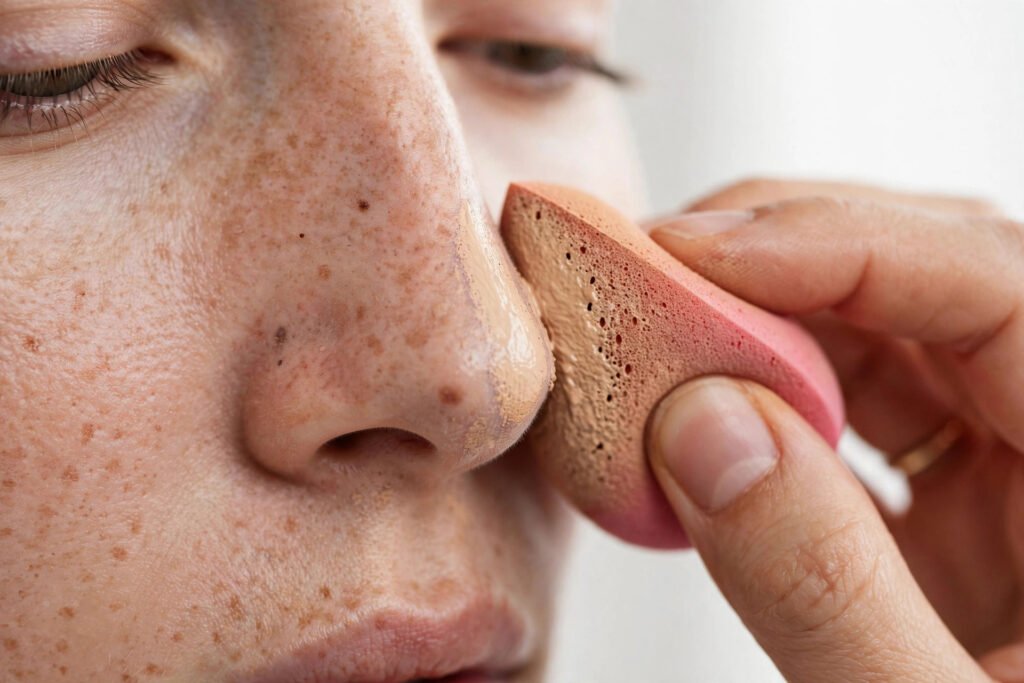
The golden rule: the nose needs the least foundation, not the most. Apply a tiny amount and stipple (bounce) it in with a damp beauty sponge — the dampness sheers the product out and presses it into skin rather than sitting on top. Dragging with fingers or a brush deposits too much product into pores and lines. Build coverage only where needed; the nose rarely needs full coverage.
Choose the right formula
Lightweight, medium-coverage foundations and skin tints cake far less than full-coverage mattes around the nose. If you love full coverage elsewhere, use two formulas: fuller coverage on cheeks and forehead, sheered-out product on the nose. This “targeted coverage” technique is what makeup artists actually do — nobody’s entire face needs the same formula.
Set strategically
A light dusting of translucent powder on the nose sets foundation against oil breakthrough — but heavy baking (thick powder left to sit) is a top cause of caking, not a cure. Press a small amount in with a puff, then brush off the excess. The goal is oil control, not a powder mask.
The Midday Rescue
Already cakey at 2 p.m.? Do not add more foundation — it compounds the problem. Instead: press a blotting paper or tissue gently over the nose to lift excess oil (never rub), then mist lightly with setting spray or thermal water, and press — not swipe — with a clean damp sponge to re-melt the existing product smooth. This “press and reset” revives foundation without adding layers. For chronic midday breakdown, the issue is usually too much morning product or insufficient primer — adjust the routine, not the rescue.
Long-Term Fixes
If caking is constant despite technique, consider: switching to a lighter foundation formula overall, addressing enlarged pores with consistent niacinamide or retinoid use (shrinking pore appearance over months), managing oil with blotting papers rather than powder layering, and checking expiration dates — old foundation separates and cakes worse (the FDA’s cosmetics information covers product safety and shelf-life guidance). Sometimes the product is the problem: foundations that worked in your 20s may cake on changing skin in your 30s and 40s, when evolving skincare needs alter the skin’s surface. If sunscreen is part of your morning routine — and it should be — let it set fully before makeup, and if the nose area reacts to formulas, take time to learn how to choose the right sunscreen for sensitive skin so your base layers stop fighting your foundation.
Cakey Nose by Skin Type
Oily skin cakes at the nose because excess oil breaks down foundation from beneath — the fix is oil control: niacinamide serum in skincare, mattifying primer specifically on the nose, lightweight foundation, and blotting papers (not powder layering) through the day. Resist the urge to pile on powder; each layer added over oil creates more cake, not less.
Dry skin cakes at the nose for the opposite reason: foundation clings to flakes and settles into dehydrated fine lines. The fix is hydration: richer moisturizer (fully absorbed), hydrating primer, dewy or satin foundation sheered thin, and minimal powder — or none at all on the nose. Exfoliate the nose zone gently twice weekly; dry skin accumulates the dead cells that grab foundation.
Mature skin combines both challenges: more texture plus changing oil production. The winning approach is the lightest possible coverage — a skin tint pressed in with a damp sponge, set with the barest dusting of powder, refreshed with mist rather than more product. Across all types, the universal rule holds: the nose needs the least product and the most technique. Diagnose whether your caking is oil-driven or dryness-driven, treat that cause, and the symptom resolves.
Conclusion
Fixing cakey makeup around the nose means prepping with exfoliation and full-absorbing moisturizer, priming the nose zone specifically, applying the thinnest stippled layer of a suitable formula, setting lightly, and rescuing midday with blotting and pressing — never more product. None of this requires luxury spending: drugstore primers, sponges, and blotting papers perform beautifully, so fold them into how much you budget for monthly self-care and keep the routine sustainable. The nose defeats heavy application every time; it rewards restraint. Less foundation, better technique, smoother nose.
Frequently Asked Questions
Why does my foundation look cakey only around my nose?
The nose area combines high oil production, textured pores, and constant movement — the three factors that break down foundation fastest. It needs the lightest application and the most prep, not the heaviest coverage.
Should I use powder to fix cakey foundation?
Lightly, preventively — not as a fix after caking appears. Adding powder over caked foundation worsens it. Blot oil, mist, and press with a damp sponge instead.
Does primer really make a difference?
Yes, particularly pore-filling or mattifying primers on the nose area specifically. It is the highest-impact single step for preventing nose-area caking.
What foundation is best for avoiding cakiness?
Lightweight, medium-coverage formulas and skin tints cake least. Full-coverage mattes cake most. Using a lighter formula just on the nose while keeping fuller coverage elsewhere is the professional approach.