How to Choose Sunscreen for Sensitive Skin (Without the Burn)
How to Choose Sunscreen for Sensitive Skin (Without the Burn)
If every sunscreen you’ve tried leaves your face red, stinging, or broken out, you’re not alone — and you’re not doomed to choose between sun damage and irritation. Sensitive skin just needs a different approach to sun protection, not the absence of it.
I have reactive skin that flares at fragrances I can’t even pronounce, and it took me years of trial and error to find sunscreens I can wear daily without regret. Here’s the shortcut version of everything I learned.
Mineral vs. Chemical: Why It Matters for Sensitive Skin
Sunscreens work two ways. Chemical (organic) filters — avobenzone, octocrylene, homosalate — absorb UV and convert it to heat. Mineral (inorganic) filters — zinc oxide and titanium dioxide — sit on top of skin and scatter UV. For sensitive skin, mineral is usually the safer starting bet: zinc oxide in particular is non-comedogenic, rarely allergenic, and doubles as a mild anti-inflammatory (it’s the same ingredient in diaper cream).
The tradeoff is cosmetic: mineral formulas can leave a white cast, especially on deeper skin tones. Tinted mineral sunscreens solve this elegantly — iron oxides in the tint add visible-light protection too, which matters for melasma. Modern mineral formulas have improved enormously; the chalky lifeguard-nose stereotype is a decade out of date.
Chemical isn’t automatically bad for sensitive skin — some people tolerate newer-generation filters fine — but if you’re reactive, start mineral. Patch-test any new sunscreen on your jawline for 24 hours before full-face commitment. Your skin’s opinion matters more than any review.
How Do I Choose the Right Sunscreen for Sensitive Skin? Read the Label Like This
First, SPF 30 minimum, broad-spectrum — non-negotiable regardless of skin type. SPF 30 blocks about 97% of UVB; higher numbers add marginally, so don’t chase SPF 100 while ignoring whether you’ll actually reapply. Water resistance matters if you sweat or swim (40 or 80 minutes — then reapply).
Then scan for what to avoid. Fragrance (including ‘natural’ essential oils like lavender and citrus) is the top irritant in sunscreens — choose ‘fragrance-free,’ not just ‘unscented’ (unscented products can contain masking fragrance). Drying alcohols (alcohol denat.) irritate reactive skin; fatty alcohols like cetyl alcohol are fine. Oxybenzone is worth avoiding both for sensitivity and environmental reasons — Hawaii and other places have banned it for reef damage.
Look for soothing supporters instead: niacinamide, ceramides, aloe, and green tea extract all play well with sensitive skin. And check the inactive ingredients, not just the actives — most irritation comes from the base formula, preservatives, or fragrance, not the UV filters themselves. The American Academy of Dermatology's sunscreen guide has a straightforward guide to selecting sunscreen that covers the label basics well.
Formulas Worth Trying (by Situation)
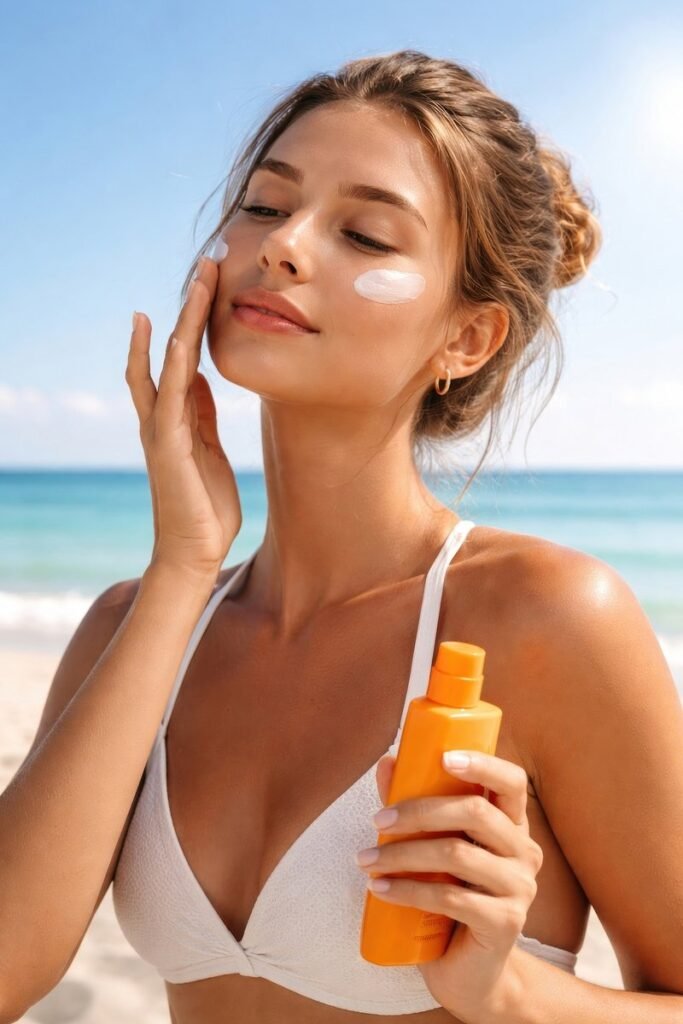
Daily face: a tinted mineral SPF 30–50 moisturizer-sunscreen hybrid. These layer beautifully under makeup and eliminate the white-cast issue. Apply a full quarter-teaspoon for face alone — most people use half what’s needed and get half the protection.
Outdoor sports: a water-resistant mineral sport stick or lotion. Sticks are brilliant for reapplication — no messy hands, precise around eyes, and they don’t run into eyes when you sweat (sunscreen-in-eyes sting ruins more workouts than anything).
Kids and ultra-reactive skin: pure zinc oxide formulas marketed for babies are often the gentlest options on the shelf, and adults can absolutely use them. If even mineral stings, consider that the culprit may be another ingredient — try a minimal-ingredient formula and add products back one at a time.
Body: don’t overthink it — a basic fragrance-free mineral or gentle chemical body sunscreen you’ll actually apply generously beats a fancy one you use sparingly. A shot-glass full (one ounce) for full body coverage is the real measure; almost everyone under-applies.
The Habits That Matter More Than the Product
The best sunscreen is the one you wear every day — dermatologists chant this because compliance beats formulation. Keep it visible: next to your toothbrush, in your bag, in the car. Out of sight means unworn. Reapply every two hours outdoors; no sunscreen survives sweat, touching, and time intact.
Layer smart: sunscreen goes last in your morning routine (after moisturizer, before makeup), and makeup with SPF doesn’t count as your sunscreen — you’d need seven times the normal amount of foundation to hit the labeled SPF. Hats and sunglasses do real work too; a wide-brim hat shades what sunscreen misses and protects the scalp part-line everyone forgets.
Don’t skip cloudy days or winter — up to 80% of UV penetrates clouds, and snow reflects up to 80% of UV back at you. Daily use is the habit; the product is just the tool. For understanding what an eye exam costs when UV damage goes unchecked, that’s a different article — but protecting your eyes with UV-blocking sunglasses counts as sun protection too.
Reapplying Over Makeup: The Real-World Solution
The number-one reason people don’t reapply sunscreen is makeup — nobody wants to smear foundation at 2 p.m. But un-reapplied sunscreen stops protecting after about two hours outdoors, so this problem needs a real answer, not guilt. The solutions, ranked by effectiveness: SPF setting sprays and mists (easiest — a quick spritz over makeup, no touching; keep one in your bag), powder sunscreens with brush applicators (surprisingly practical for touch-ups, though the actual SPF delivered is debated — better than nothing by far), and cushion-compact SPF (press gently over makeup; works but disturbs foundation somewhat).
The honest hierarchy: a dedicated sunscreen reapplied properly beats all of these — but ‘best’ is the enemy of ‘done.’ A midday SPF mist over makeup, applied generously, maintains meaningful protection for the casual outdoor exposure most people get (commutes, lunch errands). For extended sun — beach days, hiking, outdoor events — plan makeup-free or minimal from the start; no touch-up method substitutes for a proper base layer plus reapplication.
And the layering truth: makeup with SPF 15 plus moisturizer with SPF 15 does not equal SPF 30 — SPF doesn’t stack that way. Your protection equals roughly the highest-SPF product applied at full thickness. One proper sunscreen layer, then makeup, then touch-up methods through the day. That’s the complete system.
The Takeaway
Start with a fragrance-free mineral SPF 30+ (tinted if white cast bothers you), patch-test first, and apply more than you think — a quarter-teaspoon for the face.
The perfect sunscreen you never wear protects no one. Find one your skin tolerates, put it where you’ll see it, and make it as automatic as brushing your teeth.