How to Find Your Perfect Red Lipstick Shade (2026 Guide)
Red lipstick is the fastest transformation in beauty — one swipe and you look intentional, polished, powerful. It is also the easiest purchase to get wrong: the wrong red can make teeth look yellow, skin look sallow, or the whole face look harsh. With hundreds of reds on every beauty counter, from blue-based cherries to orange-based corals, finding your perfect red lipstick shade feels like guesswork. It is not. It is color theory, and it is learnable.
Here is how to find your perfect red lipstick shade: how undertones determine everything, the swatch test that never lies, matching red to your skin depth and lip shape, and the application techniques that make any red look expensive.
Undertones: The Only Thing That Really Matters
Your skin’s undertone — the subtle hue beneath the surface — decides which reds flatter you. Cool undertones (pink, red, or bluish hints; veins look blue-purple; silver jewelry flatters) pair with blue-based reds: cherry, cranberry, raspberry, classic blue-red. These shades make teeth look whiter and brighten cool skin. Warm undertones (golden, peachy, or yellow hints; veins look green; gold jewelry flatters) pair with warm reds: tomato, brick, orange-red, coral-red. These harmonize with golden skin instead of fighting it. Neutral undertones can wear both families — the lucky middle.
Not sure of your undertone? The white-paper test: hold white paper to your bare face in natural light. Skin that looks rosy beside it is cool; skin that looks golden is warm; skin that looks neither strongly is neutral. The vein check and jewelry preference confirm it. This five-minute diagnosis eliminates 80 percent of bad red purchases.
Matching Red to Skin Depth
Fair skin
True blue-reds and cherry reds are stunning on fair skin — the contrast is the point. Avoid orange-reds that can overwhelm paleness, and be cautious with deep oxblood shades that can look gothic unless that is the goal. Sheer red formulas (tinted balms, stains) are the easy entry point: all the effect, none of the commitment. The same undertone logic applies to blush and other color cosmetics — cool fair skin wants blue-based color, warm fair skin wants warm color.
Medium and olive skin
The most versatile range — nearly every red family works. Brick reds, classic true reds, and berry-reds all flatter. Olive undertones particularly love orange-reds and warm brick shades that echo the skin’s golden-green cast. This is the skin depth where you can experiment most freely.
Deep skin
Rich, saturated reds — deep crimson, wine-red, bold orange-red — look spectacular on deep skin, where the contrast creates drama. Blue-based reds brighten; warm reds glow. Avoid sheer or pale reds that can look ashy; go for full-pigment formulas that show up with one swipe. Dark berry and oxblood shades that overwhelm fair skin are magnificent here.
The Swatch Test That Never Lies
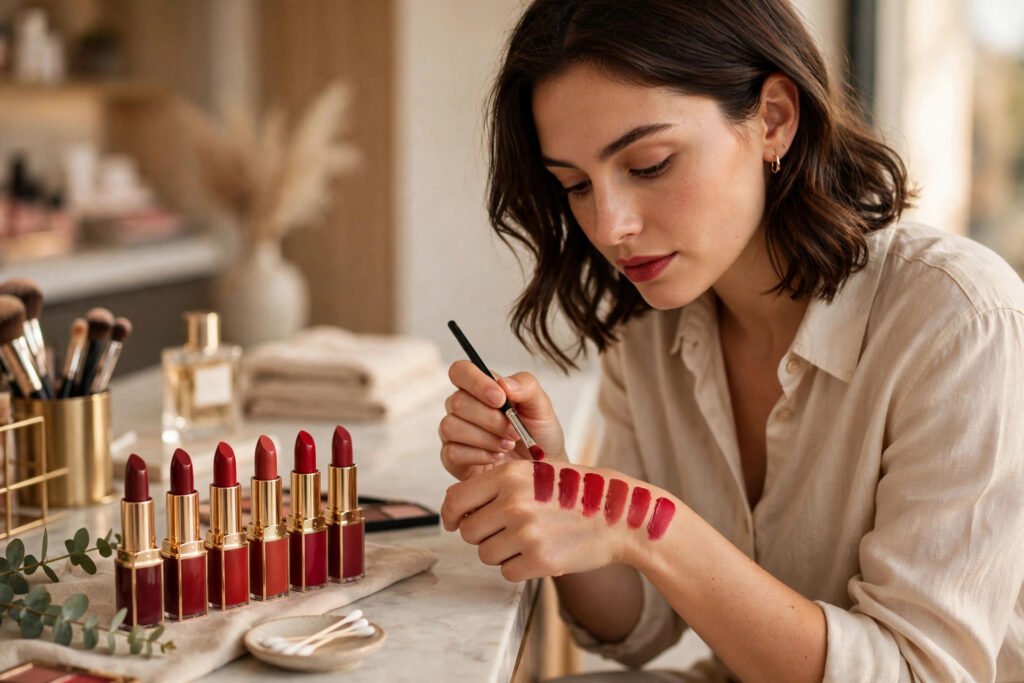
Counter lighting lies — it is designed to sell, not to flatter. Always swatch on your inner wrist or, better, the back of your hand near the fingers, then walk to natural daylight (the store entrance counts). The right red will make your skin look brighter and your hand look healthier; the wrong red will make skin look dull or sallow by comparison. Swatch three finalists side by side — the winner is usually obvious in daylight. Great reds exist at every price point — drugstore formulas can look utterly luxurious, which helps if you are learning to look stylish on a tight budget.
Test wear, not just color: apply a full lip, wear it for two hours, and check how it fades. The best reds fade evenly into a stain; cheap ones feather into lip lines or leave a clownish ring. Ask for a sample to test at home when possible — the red you love at noon may disappoint by dinner.
Formula Matters as Much as Shade
Matte liquid lipsticks offer the longest wear and boldest color but emphasize lip texture — exfoliate and moisturize first. Cream and satin finishes are the most forgiving: comfortable, flattering on texture, and easy to reapply. Sheer stains and tinted balms suit red beginners and low-maintenance wearers. Whatever the formula, lip liner in a matching shade is the difference between polished and messy — it defines the edge, prevents feathering, and extends wear. (If you are concerned about ingredients, the FDA’s cosmetics safety information covers what is actually regulated in lip products.)
Application: Making Any Red Look Expensive
Exfoliate lips gently (a damp toothbrush works), apply balm and blot the excess, line just inside your natural lip line (overlining reads trendy but risks clownish in classic red), fill with liner as a base, then apply lipstick — blotting between two layers doubles wear time. Clean the edges with a small brush and concealer for the razor-sharp finish that makes red look intentional. Keep the rest of the face balanced: bold red plus heavy eye makeup competes; red with clean skin and defined lashes is timeless. For lip health underneath the color, Cleveland Clinic dermatologists recommend daily SPF lip balm — red lipstick is not sun protection.
Red for Different Occasions
The “perfect” red shifts with context. For daytime and professional settings, sheer reds, red-tinted balms, and blotted-down cream reds deliver polish without drama — the color reads as intentional rather than bold. For evenings, full-pigment matte or satin reds bring the classic impact; this is where deep blue-reds and rich wines shine. For weddings (as a guest), lean slightly sheer — you want to look polished in photos without competing with the bridal party.
Workplace red deserves special thought: in conservative industries, a muted brick or sheer cherry reads powerful but appropriate; in creative fields, anything goes. The application matters as much as the shade — a precisely applied red looks professional at any depth, while a smudged bold red looks careless. When in doubt, blot: pressing lips on a tissue after application removes excess and leaves a stain-like finish that is universally wearable. One great red, worn three ways (full, blotted, sheered with balm), covers every occasion on your calendar.
Conclusion
Your perfect red lipstick shade is determined by undertone first (cool skin: blue-based reds; warm skin: warm reds; neutral: both), refined by skin depth (fair: cherry and true reds; medium: everything; deep: rich saturated reds), and confirmed by the daylight swatch test. Match the formula to your wear needs, line for precision, and keep the rest of the face quiet. Work your shade experiments into how much you budget for monthly self-care so the hunt for ‘the one’ stays fun, not expensive. Get these right and red stops being a risk — it becomes your signature.
Frequently Asked Questions
What red lipstick makes teeth look whiter?
Blue-based reds — cherry, cranberry, classic blue-red. The blue undertone neutralizes yellow in teeth optically. Orange-based reds do the opposite, emphasizing yellow.
Can I wear red lipstick with fair skin?
Absolutely — fair skin plus red is a classic combination. Choose blue-based cherry or true reds, consider sheer formulas while learning, and keep the application precise.
How do I stop red lipstick from feathering?
Line and fill lips with a matching liner as a base, blot between layers, avoid glossy formulas on mature lips, and clean edges with concealer. Liner is the single biggest anti-feathering step.
What is the difference between warm and cool reds?
Cool reds have blue undertones (cherry, berry-red); warm reds have orange or yellow undertones (tomato, brick, coral-red). Hold shades side by side — the difference is obvious once you look for it.