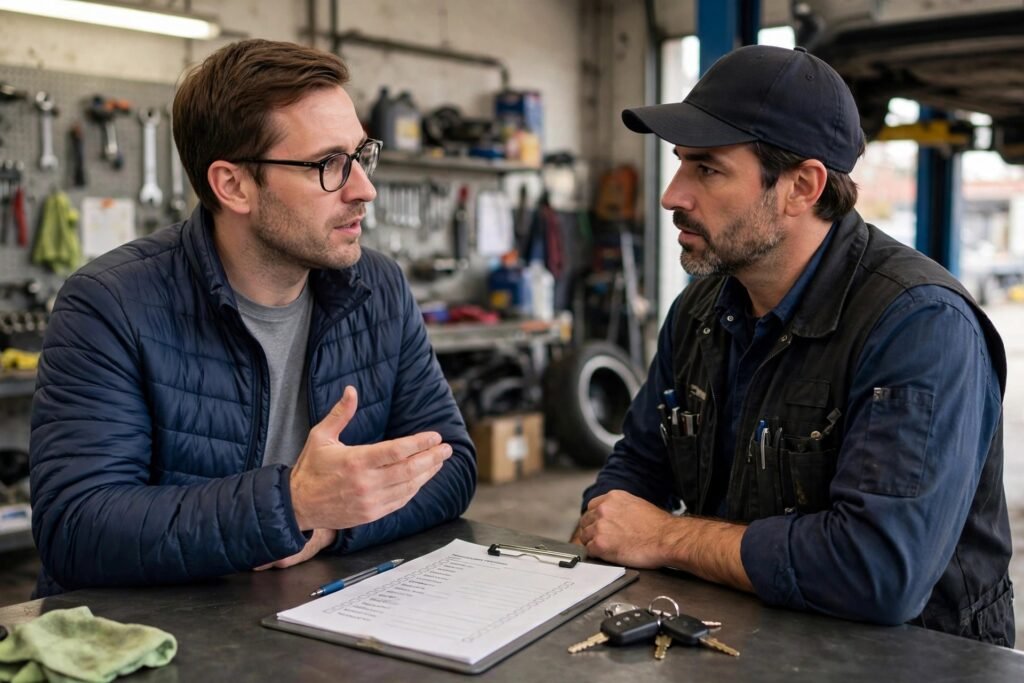
How to Dispute a Car Repair Bill and Win: Full Step-by-Step
The call comes with a number that makes your stomach drop: “$1,850.” You brought the car in for a noise. Now you are staring at an itemized bill full of parts you have never heard of, labor hours that seem inflated, and work you are not sure was authorized. Disputing a car repair bill feels intimidating — the shop has your car, the jargon, and the home-field advantage. But you have more leverage than you think, because auto repair is one of the most consumer-protected transactions in American law.
This guide walks through the dispute process in order: what to do before you pay, how to negotiate effectively, how to escalate when negotiation fails, and the legal rights most drivers do not know they have.
Step 1: Do Not Pay (Yet) — and Do Not Sign Away Rights
Your leverage is highest before money changes hands. Once you pay in full, you are asking for a refund; before payment, you are negotiating a bill. That said, the shop may assert a mechanic’s lien — in most states, they can legally hold your vehicle until paid. The practical middle path: pay under written protest (“paid under protest, dispute pending” written on the receipt) or pay with a credit card, which preserves chargeback rights. Never pay cash in a dispute — cash leaves no trail and no recourse.
Read before you sign. Some shops slip authorization language into intake forms (“I authorize all necessary repairs”) — broad authorizations weaken your position. In many states, shops must provide written estimates and obtain authorization before exceeding them by a set amount (often 10 percent or $100). Know your state’s rule before you argue it; the FTC’s auto repair guidance and your state attorney general’s consumer protection page spell out local requirements.
Step 2: Audit the Bill Line by Line
Ask for the itemized invoice and interrogate every line:
Were all charges authorized? Compare the final bill to the written estimate and to what you actually approved. Unauthorized work is the strongest basis for a dispute — in many states, you simply do not owe for repairs you did not approve.
Are parts priced fairly? Look up part numbers online (RockAuto, dealer parts sites) to check markup. Shops routinely mark parts up 30-100 percent over wholesale, which is normal business — but 300 percent is gouging. Ask whether aftermarket or remanufactured parts were substituted for the OEM parts you were quoted.
Are labor hours legitimate? Shops bill by “book time” — standardized labor guides (Mitchell, AllData) specifying hours per job. Ask which guide they used and look up the book time yourself; many are published online. A job billed at 4 hours with a 1.8-hour book time needs an explanation.
Is there double-billing? Overlapping jobs sometimes double-charge labor — e.g., billing full labor for both a water pump and a timing belt when the pump must come off to reach the belt anyway. Ask which operations overlapped.
Was the diagnosis right? If the $900 repair did not fix the problem, you paid for a wrong guess. Ethical shops re-diagnose at reduced or no charge; the bill for a misdiagnosis is very disputable.
Get a Second Opinion (It Is Worth the Tow)
For bills over $500 that smell wrong, pay the diagnostic fee at an independent shop or dealer for a second opinion. A written second estimate showing the work was unnecessary or overpriced is your most powerful negotiation and legal evidence. Mentioning “I’d like my old parts back” also disciplines estimates — in many states you have a legal right to replaced parts, and shops that planned to charge for work they did not do suddenly get careful.
Step 3: Negotiate Like a Professional
Disputes are won with calm specificity, not volume. The framework:
1. State the facts, not feelings. “Your estimate was $600. The bill is $1,100. I authorized the $600 repair; I did not authorize the additional $500 in parts” beats “you’re ripping me off” every time.
2. Name the specific adjustment you want. “Remove the unauthorized $500,” “reduce labor to book time,” “re-do the diagnosis at no charge.” Vague complaints get vague responses.
3. Escalate within the shop. The service writer often cannot discount; the service manager can. Ask for them by title, politely. For dealerships, the general manager outranks the service manager.
4. Use your evidence. The second opinion, the book-time lookup, the estimate-vs-bill comparison — lay them out. Most shops will deal when the alternative is clearly a formal complaint.
5. Get agreements in writing. Any discount, rework promise, or payment plan gets written on the invoice and signed before you leave.
The same muscles apply to any billing fight — the cancellation-tactic awareness in our guide to canceling free trials before charges hit is the same “read the terms, act early, document everything” discipline. And prevention beats disputes: our basic car maintenance guide helps you spot the upsell (“your blinker fluid is low”) before it becomes a line item.
Step 4: Escalate Outside the Shop
If negotiation fails, you have a ladder of external pressure — use it in order:
Credit card chargeback. If you paid by card, file a dispute for unauthorized charges or services not rendered. Card networks take these seriously, and shops hate chargebacks — mentioning one often reopens negotiation.
State attorney general / consumer protection. File a written complaint. AG offices track complaint patterns; a shop with a file full of complaints gets investigated. This costs you nothing.
State repair-shop licensing board. Many states (California’s BAR is the famous example) license repair shops and operate mediation programs with real enforcement teeth — fines, license suspension. Check whether your state has one.
Better Business Bureau. Less powerful than regulators, but BBB complaints are public and businesses often respond to protect ratings. File at bbb.org with documentation attached.
Manufacturer. For dealership disputes, the automaker’s customer care line can pressure the dealer over customer satisfaction scores.
Step 5: Small Claims Court — The Nuclear Option That Isn’t
Small claims court sounds dramatic; in practice it is designed for exactly this — disputes of a few hundred to a few thousand dollars, no lawyers needed, filing fees of $30-$100. Auto repair cases are among the most common and consumer-friendly docket items, because judges see the pattern constantly and the documentation (estimate vs. bill) speaks for itself.
To win: bring the written estimate, the final bill, authorization records, the second opinion, and a clear timeline. Most shops settle once served — the owner would rather discount than spend a day in court.
Know your state’s small claims limit ($5,000-$10,000 in most states — check yours) and the statute of limitations for contract disputes (typically 3-6 years, but do not wait).
Preventing the Next Dispute
The best dispute is the one that never happens. Going forward: always get a written estimate with the authorization limit stated; authorize a diagnostic fee separately from repair authorization (“diagnose it for $120, then call me before doing anything”); ask for old parts back as a matter of routine; photograph the odometer and any existing damage at drop-off; and build a relationship with one independent shop — regulars get straighter answers than strangers.
Conclusion
A disputed repair bill is a negotiation backed by law, not a confrontation to win by volume. Audit the bill against your authorization, get a second opinion, negotiate with specific facts, and escalate through chargebacks, regulators, and small claims court if needed. Shops count on customers feeling too intimidated to push back — which means the customers who push back, calmly and with documentation, usually get the adjustment.
Frequently Asked Questions
Can a mechanic keep my car if I refuse to pay?
In most states, yes — a mechanic’s lien lets shops hold the vehicle until paid. The workaround is paying under written protest or by credit card (preserving chargeback rights), then disputing the charges.
Do I have to pay for repairs I did not authorize?
Generally no. Most states require written estimates and authorization before work, often with a cap (e.g., 10% or $100) on exceeding estimates without re-authorization. Unauthorized work is among the strongest bases for a dispute.
What is “book time” for auto labor?
Standardized labor-time guides (Mitchell, AllData) specifying how long each repair should take. Shops bill by book time rather than actual clock time. Looking up the book time for your repair lets you spot inflated labor charges.
How do I file a complaint against an auto repair shop?
File with your state attorney general’s consumer protection division and your state’s repair-shop licensing board if one exists (e.g., California’s Bureau of Automotive Repair). Both are free and create an official record.
Is small claims court worth it for a repair dispute?
Often yes for disputes of $500-$5,000: filing costs $30-$100, no lawyer is needed, and estimate-vs-bill documentation makes these cases straightforward. Many shops settle once served.