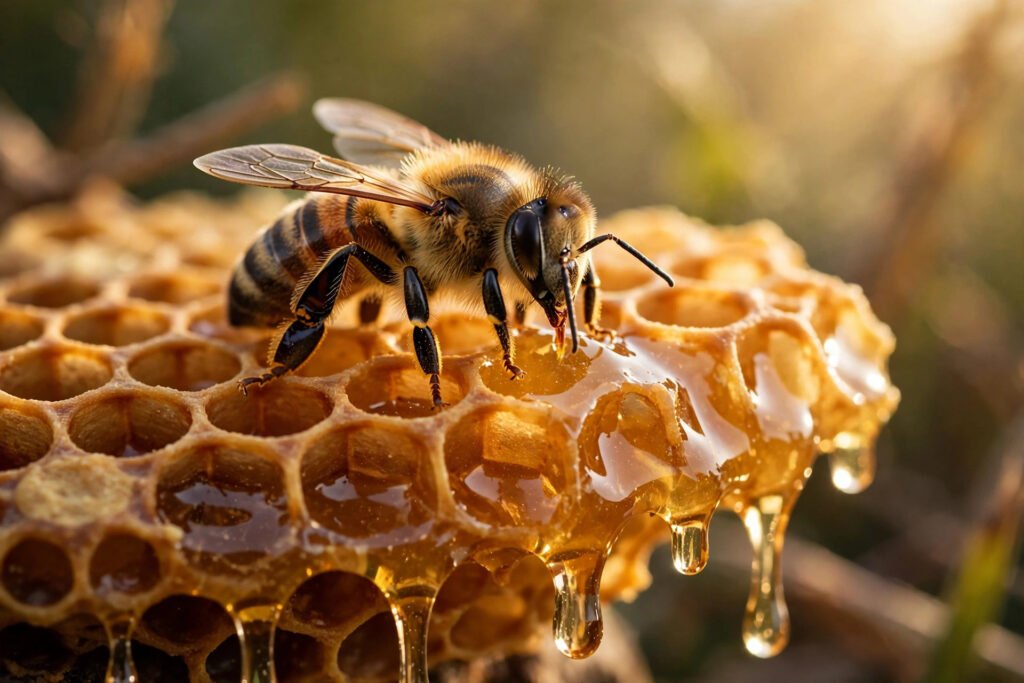
How Do Bees Make Honey? Step-by-Step Colony Magic
A single honeybee colony can produce 60–100 pounds of honey per year, created through one of nature’s most remarkable manufacturing processes — a microscopic assembly line involving tens of thousands of workers, precise chemistry, and structural engineering that humans still study and admire. No single bee “makes” honey; it’s a colony-scale collaboration where each bee performs one specialized step. Here’s exactly how bees make honey, step by step, from flower to jar.
Step 1: Foraging — Collecting Nectar
It starts with forager bees, the colony’s field workers. A forager visits 50–100 flowers per trip, using her long tongue (proboscis) to suck nectar — essentially sugar water, about 70–80% water — into a special expandable sac called the honey stomach (separate from her digestive stomach). A full load weighs nearly as much as the bee herself. She’ll make 10–15 such trips daily, and a strong colony’s foragers collectively visit millions of flowers to produce a single pound of honey.
Foragers communicate flower locations through the famous waggle dance — a figure-eight movement encoding direction and distance relative to the sun. Different flowers produce different nectars, which is why honey varies so dramatically: orange blossom, clover, wildflower, buckwheat — each is a record of what bloomed nearby. The USDA’s pollinator resources document how critical these foraging relationships are to American agriculture.
Step 2: The Handoff — Trophallaxis
Back at the hive, the forager doesn’t deposit nectar directly into comb. Instead, she regurgitates it mouth-to-mouth to a house bee — a process called trophallaxis. This isn’t just transport; it’s the first processing step. During the handoff, the forager adds enzymes from glands in her head, most importantly invertase, which begins breaking the nectar’s complex sucrose into simpler glucose and fructose — sugars that won’t crystallize easily and that resist spoilage.
The nectar may pass through several bees’ mouths in a relay chain, each adding more enzymes. This communal processing is why honey is fundamentally different from just concentrated nectar — it’s been biochemically transformed by the colony’s collective digestive chemistry before it ever reaches a cell.
Step 3: Dehydration — Fanning Away the Water
Fresh nectar is 70–80% water — far too wet to store (it would ferment). The bees’ solution is elegant: house bees deposit droplets of processed nectar into honeycomb cells, then thousands of workers fan their wings to create airflow through the hive, evaporating the water. On warm days, you can hear the hive humming with fanning activity and feel warm air streaming from the entrance.
This dehydration is painstaking: reducing moisture from ~75% to under 18% takes days of continuous fanning. The 18% threshold is critical — below it, yeasts can’t grow and honey becomes essentially immortal (edible honey has been found in ancient Egyptian tombs). Beeswax comb itself aids the process; its hexagonal cells maximize surface area for evaporation. If you keep plants, you already appreciate these pollinators’ world — see how to keep houseplants alive with little sunlight, since many houseplants’ wild relatives depend on bees exactly like these.
Step 4: Capping — Sealing the Harvest
Once a cell’s honey reaches the right moisture content, worker bees cap it with a thin layer of beeswax — the signal beekeepers watch for. Capped honey is finished honey: chemically stable, protected from moisture, ready for long-term storage. A strong colony fills frame after frame through the nectar flow season, building the 60–100+ pound surplus that sustains them through winter and provides the beekeeper’s harvest.
The wax itself is remarkable: worker bees produce it from glands on their abdomens, chewing and molding each flake into the comb’s precise hexagonal architecture — a structure mathematicians have proven uses the least wax for the most storage. The colony is simultaneously a chemical plant, a climate-control system, and a construction crew.
Step 5: From Hive to Jar (Beekeeping)
Beekeepers harvest by removing frames of capped honey, slicing off the wax caps, and spinning the frames in a centrifuge (honey extractor) — flinging honey out without destroying the comb, which goes back to the hive for reuse. The honey is then strained (not ultra-filtered, in quality operations — filtering removes pollen, which is both nutritious and the fingerprint of the honey’s floral origin) and jarred.
Responsible beekeepers never take all the honey — colonies need 60–80 pounds to survive winter, and ethical harvesters leave that plus a margin. Raw, unfiltered honey retains enzymes, pollen, and subtle flavors destroyed by industrial processing. That flavor complexity is why single-origin honeys command premium prices — and why honey deserves its reputation as a remarkable food. Honey’s culinary versatility is endless; it shines as a natural sweetener in everything from tea to easy homemade bread, where it adds moisture, flavor, and a beautiful crust.
Why It Matters: Bees Beyond Honey
Honey is the delicious byproduct; pollination is the real service. Honeybees pollinate roughly one-third of the food crops humans eat — almonds, apples, blueberries, cucumbers, and dozens more depend on them. Colony collapse and pollinator decline threaten not just honey supplies but food security itself, which is why the EPA maintains pollinator protection programs regulating pesticides harmful to bees.
You can help: plant pollinator-friendly flowers, avoid spraying pesticides during bloom, leave some bare ground for native bee nesting, and buy honey from local beekeepers who steward healthy colonies. The honey on your toast connects you to one of nature’s great collaborations — tens of thousands of individuals, each doing one small job perfectly, producing something no individual could make alone.
Conclusion
Bees make honey through a five-step colony collaboration refined over millions of years of evolution: foragers collect nectar in their honey stomachs, house bees process it mouth-to-mouth adding transformative enzymes, thousands of workers fan away moisture to under 18%, the finished honey is sealed under wax caps, and beekeepers harvest the surplus by centrifuge. No single bee makes honey — the colony does, through chemistry, engineering, and cooperation refined over millions of years. It’s manufacturing at its most miraculous.
Frequently Asked Questions
How long does it take bees to make honey?
A strong colony can fill a honey super (about 30–40 pounds) in 1–2 weeks during a heavy nectar flow. From flower visit to capped, finished honey takes several days of processing per batch.
Do bees get hurt when honey is harvested?
Responsible beekeepers harvest carefully — using smoke to calm bees, leaving 60–80+ pounds for winter, and extracting without destroying comb. Ethical harvesting doesn’t harm the colony; it takes only the genuine surplus.
Why doesn’t honey spoil?
Low moisture (under 18%), natural acidity, and antimicrobial compounds (including hydrogen peroxide produced by bee enzymes) make honey inhospitable to bacteria and yeast. Archaeologists have found edible honey thousands of years old.
What is the difference between raw and regular honey?
Raw honey is unheated and minimally strained, retaining pollen, enzymes, and flavor compounds. Commercial “regular” honey is often heated and ultra-filtered, which removes pollen and subtle flavors for clarity and shelf uniformity.
How much honey does one bee make in its lifetime?
About 1/12th of a teaspoon — a lifetime of work barely sweetens a cup of tea. It takes roughly 550 bees’ lifetime output to produce one pound of honey, visiting around two million flowers.