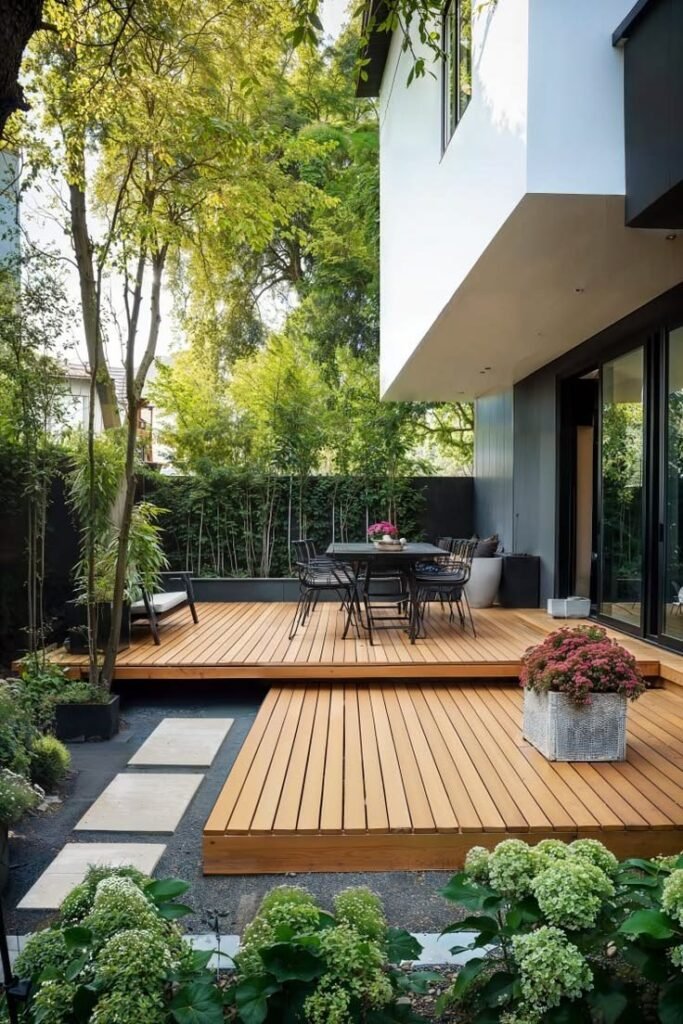
How Much Does It Cost to Build a Simple Backyard Deck?
How Much Does It Cost to Build a Simple Backyard Deck?
A simple backyard deck is one of the best outdoor upgrades — it effectively adds a room to your house for half the year. But deck quotes range from “that’s reasonable” to “are you kidding,” and the difference is materials, size, and who’s swinging the hammer. Most simple decks land between $4,000 and $12,000 professionally built.
Here’s the real cost breakdown.
Cost Per Square Foot by Material
Pressure-treated wood is the budget standard: $15 to $30 per square foot installed ($4,000 to $8,000 for a typical 300 sq ft deck). It’s affordable and looks classic, but needs staining every 2 to 3 years and lasts 10 to 15 years. Cedar and redwood run $20 to $40 per square foot installed — prettier, naturally rot-resistant, similar maintenance needs.
Composite decking (Trex, TimberTech) costs $30 to $60 per square foot installed — $9,000 to $18,000 for that same 300 sq ft deck. The premium buys near-zero maintenance (no staining, no splinters) and 25+ year lifespans. The honest math: composite costs roughly double upfront but saves $3,000 to $5,000 in maintenance over its life. If you’ll be in the house 10+ years, composite usually wins on total cost. If budget is king today, pressure-treated gets you outside this summer.
What Drives the Price Beyond Materials
Height and foundation work matter enormously. A low deck near ground level is simple; an elevated deck needs deeper footings, railings (code requires them above 30 inches), and stairs — each stair section adds $500 to $1,500. Permits run $100 to $500 depending on your municipality, and yes, you need one in most places; unpermitted decks cause nightmares at sale time.
Site conditions add up: sloped yards need more structural work, poor soil needs deeper footings, and removing an old deck or concrete patio costs $500 to $1,500. Extras stack fast — built-in benches ($500 to $1,500), lighting ($300 to $1,000), a pergola ($2,000 to $6,000). Keep the first deck simple: a clean rectangle at a comfortable height. You can add the pergola next year. Get three quotes minimum and make sure each specifies the same materials, dimensions, and footing depth.
DIY: The Real Savings and the Real Work
DIY cuts the cost roughly in half: a 300 sq ft pressure-treated deck runs $2,000 to $5,000 in materials. It’s genuinely doable for a handy homeowner — deck building is carpentry, not rocket science — but it’s heavy, slow work. Budget two to three full weekends with a helper, and rent the auger for footings ($75 a day beats hand-digging holes in clay).
The non-negotiables for DIY: get the permit and follow the span tables (your lumber yard or local code office provides them free — this is structural work), use proper joist hangers and ledger flashing (water intrusion from a bad ledger connection rots houses), and don’t skip the concrete in the footings. Mistakes in deck structure aren’t cosmetic. If any of that sounds intimidating, hire the structure and DIY the decking boards and railings — a common hybrid that saves money where it’s safe to.
Simple Deck Budget Planner
For a typical 300 sq ft deck:
- Pressure-treated, pro-built: $4,000-$8,000.
- Cedar, pro-built: $6,000-$12,000.
- Composite, pro-built: $9,000-$18,000.
- DIY pressure-treated: $2,000-$5,000 in materials.
- Add: permits ($100-$500), stairs ($500-$1,500 per section), old structure removal.
- Get 3 quotes with identical specs: materials, size, footing depth.
- Keep it simple first — add pergolas and built-ins later.
The Bottom Line
A simple backyard deck costs $4,000 to $12,000 professionally built, or $2,000 to $5,000 DIY. Pressure-treated wood gets you outside cheapest; composite costs more now but less over its lifetime.
It’s one of the highest-joy projects in home improvement — morning coffee outside, dinners under the sky. Price it honestly, permit it properly, and build it once.
Deck Maintenance: Protecting Your Investment
A deck is only as good as its maintenance — and the maintenance starts the day it’s built. For pressure-treated wood, the critical task is staining/sealing every 2-3 years ($200-$400 in materials for DIY, $800-$1,500 professionally). Unsealed wood grays, cracks, and rots; sealed wood lasts 15+ years. The test: sprinkle water on the deck — if it beads, the sealer’s working; if it soaks in dark, it’s time. Don’t wait for visible graying; by then, damage has started.
Annual maintenance is simple: sweep regularly (trapped debris holds moisture), wash yearly with deck cleaner and a stiff brush or low-pressure washer (high pressure gouges wood — keep it under 1,500 PSI and use a fan tip), inspect for popped nails/screws, rot spots, and loose railings every spring. Tighten, replace, and repair small issues immediately — a $5 screw today prevents a $500 board replacement later. Check the ledger board connection (where the deck meets the house) annually; it’s the structural critical point and the most common failure location.
Composite decks need less but not zero maintenance: wash twice yearly with soap and water to prevent mold and mildew in the textured grain, clear debris from between boards (trapped organic matter stains), and avoid harsh chemicals or pressure washing (it voids warranties and damages the capping). The ‘maintenance-free’ marketing is overstated — it’s ‘low-maintenance,’ and the low maintenance still matters. Either material, a well-maintained deck lasts decades; a neglected one becomes a teardown in 10 years.
Quick Answers
How often should I stain my wood deck?
Every 2-3 years, or when water stops beading on the surface. Don’t wait for graying — that means damage has begun.
Can I pressure wash my deck?
Yes, carefully: under 1,500 PSI with a fan tip. High pressure gouges wood and voids composite warranties.
What’s the #1 deck safety check?
The ledger board connection to the house — it’s the most common failure point. Inspect annually for rot, loose bolts, and missing flashing.
Railing choices affect both cost and character more than most people expect. Wood railings ($20-$40/linear foot installed) match wood decks naturally but need the same staining maintenance. Metal/aluminum railings ($40-$80/ft) look sleek, need zero maintenance, and last decades — the modern choice that’s worth the premium. Cable railings ($60-$100/ft) preserve views beautifully (ideal for scenic yards) but cost the most and need periodic tensioning. Glass panels ($100-$150/ft) are the luxury option for view properties. For a simple deck, the railing can cost as much as the decking — budget it explicitly rather than discovering it in the quote.
Don’t forget what goes under and around the deck: proper drainage (water pooling under decks rots posts and breeds mosquitoes — grade the ground and consider a drainage system, $200-$500), skirting or lattice to close the under-deck area (keeps animals out, looks finished, $300-$800), and lighting planning (post-cap lights at $20 each, installed during construction, transform evening use). These unglamorous details are what separate decks that age gracefully from decks that become eyesores. A deck is a 20-year structure; build the invisible parts as carefully as the visible ones.
Further reading: the North American Deck and Railing Association, This Old House deck building guides.