How to Add Storage to a Small Kitchen Cheaply
How to Add Storage to a Small Kitchen Cheaply
Small kitchens aren’t short on space — they’re short on used space. The average kitchen has shocking amounts of dead zone: the insides of cabinet doors, the wall above the counter, the gap above the cabinets, the sides of the fridge. I’ve organized tiny galley kitchens that gained the equivalent of two extra cabinets without spending $200.
Here’s where to find the hidden storage and what to put there.
Use the Walls and Doors You Already Have
Cabinet doors are free real estate. Stick-on or screw-in organizers ($8 to $20 each) turn door interiors into spice racks, lid holders, and cleaning-supply stations. The inside of the under-sink doors alone can absorb all your sprays and sponges. Over-the-door racks on the pantry door add a full shelf of storage for $15 to $30 — canned goods, wraps, and foil live happily there.
Wall space above the counter is the biggest win. A simple rail system with hooks ($25 to $40) holds utensils, mugs, and pans that currently clog drawers. Open floating shelves ($20 to $40 each) replace upper-cabinet function for everyday dishes — and they make the kitchen feel bigger, not smaller, because they don’t block light or sightlines. Magnetic knife strips ($15) free an entire drawer. Pegboard ($20 for a 2×4 sheet) on any blank wall becomes infinitely reconfigurable storage.
Fix the Cabinets You Have Before Adding More
Most kitchen storage problems are organization problems. Pull-out cabinet organizers ($20 to $40 each) convert deep, dark lower cabinets from black holes into accessible storage — the back of the cabinet becomes usable for the first time. Tiered shelf risers ($12 to $20) double the capacity of every shelf by using vertical space; canned goods and spices stack in visible rows instead of hiding behind each other.
Turntables (lazy Susans, $10 to $20) rescue corner cabinets and deep pantries. Drawer dividers ($10 to $15) stop the utensil-junk-drawer chaos. Under-shelf baskets ($8 to $12) clip onto existing shelves and create a second layer for mugs and small items. A $100 organizer spree across your existing cabinets genuinely feels like a remodel — measure your cabinet interiors before ordering so everything fits the first time.
Claim the Weird Spaces
Every kitchen has dead zones. The gap above the cabinets? Lined baskets ($10 each) store the holiday platters and rarely-used appliances. The side of the fridge? A magnetic spice rack or a slim rolling cart ($30) that slides into the 6-inch gap beside it. The toe-kick under lower cabinets? Shallow drawers can be retrofitted there for baking sheets.
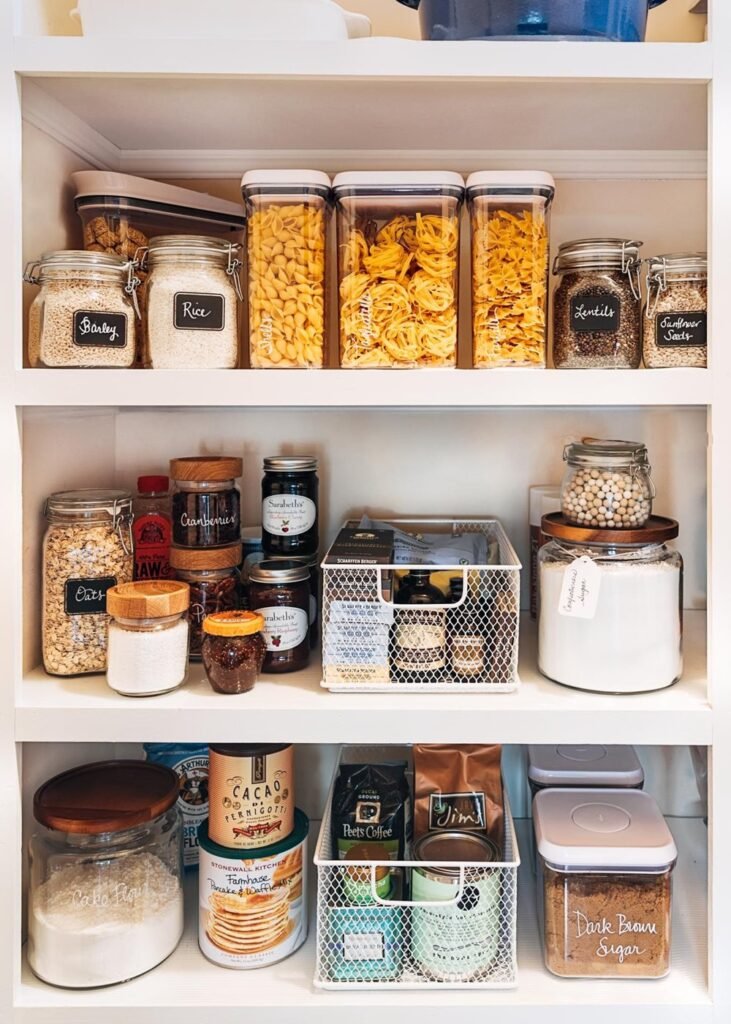
Above the stove, a mounted rail holds daily cooking utensils. Inside deep drawers, vertical dividers store cutting boards and sheet pans on edge — the single best trick for bulky flat items. And decant dry goods into uniform square containers: they stack without wasted air gaps, unlike the random boxes and bags they replace. Square containers in a small kitchen aren’t aesthetic fussiness; they’re geometry.
Cheap Small-Kitchen Storage Wins
Biggest impact per dollar, in order:
- Over-the-door pantry rack: $15-$30 for a shelf of new storage.
- Wall rail with hooks for utensils and mugs: $25-$40.
- Pull-out organizers for deep lower cabinets: $20-$40 each.
- Tiered shelf risers to double every shelf: $12-$20.
- Magnetic knife strip to free a whole drawer: $15.
- Slim rolling cart for the gap beside the fridge: $30.
- Uniform square containers for dry goods — pure geometry gains.
- Total realistic budget: $100-$200 for a transformed kitchen.
The Bottom Line
Adding storage to a small kitchen cheaply is about using the surfaces you already own: door interiors, wall space, vertical shelf space, and the weird gaps. $100 to $200 in organizers buys the functional equivalent of new cabinets.
Start with one problem area — the chaotic cabinet, the cluttered counter — and fix it this weekend. Small kitchens reward small interventions more than any other room in the house.
The Pantry: Your Kitchen’s Storage Powerhouse
If you have even a small pantry or pantry closet, it’s the highest-leverage storage space in the kitchen — and most are used terribly. The fix: door-mounted racks ($20) for spices and small items, tiered shelf organizers ($15 each) so nothing hides behind anything, and clear bins grouped by category (baking, snacks, canned goods). A $60 pantry overhaul typically doubles usable capacity. The key principle: nothing behind anything — every item visible and reachable, or it doesn’t exist.
No pantry? Create one. A freestanding pantry cabinet ($100-$200) against any blank wall adds the equivalent of 3-4 upper cabinets. An over-the-fridge cabinet (that dead space above the refrigerator) with a step stool nearby holds rarely-used items. Even a narrow rolling cart ($30) in a hallway nook becomes a pantry annex for overflow. The pantry doesn’t have to be a room — it has to be a system.
The inventory habit that makes it all work: keep a running list (paper on the pantry door, or a phone note) of what you have. Pantries fail when you buy duplicates of what you own and run out of what you need — the list prevents both. When you finish something, add it to the grocery list immediately rather than ‘remembering later.’ This 30-second habit is the difference between a pantry that serves you and one that just stores your forgetfulness in cans.
Quick Answers
How do I organize deep pantry shelves?
Use bins as drawers — pull the whole bin out to see everything. Tiered risers for cans. Nothing loose and shoved to the back.
What’s the best container for pantry staples?
Square, stackable, airtight containers — they use space efficiently and keep food fresh. Decant only what you use regularly.
How often should I clean out the pantry?
Twice a year: toss expired items, wipe shelves, reassess the organization. Tie it to daylight-saving time changes so you remember.
The ‘one in, one out’ rule is the maintenance habit that prevents re-cluttering. Every new kitchen item that enters must replace or displace something — new gadget in, old duplicate out. Kitchens accumulate because inflow never stops (gifts, gadgets, ‘deals’) while outflow requires effort. Make outflow frictionless: a permanent donation box in the pantry or garage, and a quarterly 15-minute purge of the obvious dead weight (the third water bottle, the chipped mugs, the single-purpose gadgets unused in a year). Organized kitchens stay organized through habits, not systems — the best storage in the world fills up again without the outflow discipline.
Further reading: the National Kitchen & Bath Association, Energy Star on kitchen efficiency.