The Best Paint Finish for a High-Traffic Hallway
The Best Paint Finish for a High-Traffic Hallway
Hallways are the most abused walls in your house — shoulders, bags, kids, pets, furniture being moved. And yet people paint them with the same flat paint they’d use in a bedroom, then wonder why it looks terrible in a year. The finish matters more than the color here.
The short answer: satin or eggshell from a quality paint line. Here’s why, and when to break the rule.
Why Satin and Eggshell Win Hallways
Paint finish is a durability spectrum. Flat paint hides imperfections but scuffs if you look at it wrong and can’t be scrubbed — terrible for hallways. Eggshell has a soft glow, resists scuffs moderately, and tolerates gentle cleaning. Satin is a step glossier, notably tougher, and genuinely scrubbable — fingerprints and smudges wipe off with a damp cloth.
For most hallways, satin is the sweet spot: durable enough for daily abuse, not so glossy that it highlights every drywall imperfection (which is semi-gloss’s problem — it shows everything). Eggshell works if your walls are in rough shape and you want more forgiveness, but accept you’ll touch up more often. Either way, buy quality paint — a $55 gallon of satin outperforms a $30 gallon in scrubbability by a mile, and the hallway is where that difference shows.
The Case for Semi-Gloss (and When to Use It)
Semi-gloss is the toughest common finish — it shrugs off scrubbing, moisture, and impact. The trade-off is aesthetic: it’s shiny, shows every bump and patch in the drywall, and can look institutional on large wall areas. That’s why pros typically reserve it for trim, doors, and cabinets rather than hallway walls.
But there are hallway cases for semi-gloss: homes with young kids or large dogs where walls take constant contact, rental properties where durability beats beauty, and narrow hallways where the reflective quality actually bounces light around nicely. A good compromise: satin on the walls, semi-gloss on the trim and doors. The trim takes the most physical abuse anyway (it’s what bags and hands actually hit), and the slight contrast looks intentional and crisp.
Application Tips That Make the Finish Last
The finish can only perform if the prep is right. Wash hallway walls before painting — they hold more grime than you think, and paint over grime peels. Fill dings and sand smooth; satin will highlight anything you skip. Use a quality primer on patched spots or color changes so the finish cures uniformly.
Apply two full coats — the second coat is what builds the scrubbable film; one coat of satin performs like eggshell. Let it cure fully before testing its toughness: latex paint feels dry in hours but takes 2 to 4 weeks to reach full hardness. Those first weeks, clean gently. After curing, most marks come off satin with a damp microfiber cloth — no harsh cleaners needed, which is the whole point of choosing a washable finish.
Hallway Paint Finish Quick Guide
Pick your finish:
- Best all-around: satin — scrubbable, attractive, hides minor flaws.
- Runner-up: eggshell — softer look, needs more touch-ups.
- Toughest: semi-gloss — best for kids, pets, rentals; shows wall flaws.
- Never use flat in a hallway — it scuffs and can’t be cleaned.
- Use semi-gloss on trim and doors regardless of wall finish.
- Buy quality paint — scrubbability differences are huge between tiers.
- Two coats minimum; allow 2-4 weeks full cure before scrubbing.
The Bottom Line
The best paint finish for a high-traffic hallway is satin — tough enough to scrub, attractive enough to live with, forgiving enough for real-world walls. Pair it with semi-gloss trim and quality paint, and your hallway will look fresh for years instead of months.
It’s a small decision that pays off every day. Hallways are the connective tissue of your home — they deserve paint that can take it.
Hallway Color Psychology: What Works
Color choice in hallways affects more than aesthetics — it shapes how the space feels to move through. Light, warm neutrals (warm white, light greige, pale warm gray) make hallways feel welcoming and spacious; they’re the safe default that works in every home. Cool light colors (pale blue-gray, soft sage) feel calm and clean but can read cold in north-facing hallways with little natural light — warm them up with warm-white lighting (2700K) to compensate.
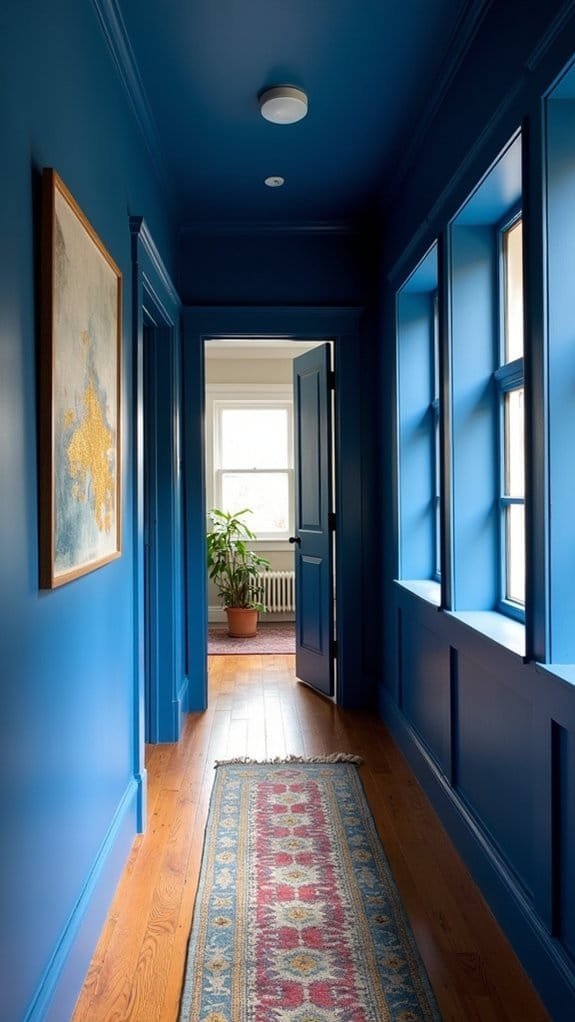
Dark hallway colors are the controversial move: deep navy, charcoal, or forest green in a hallway creates drama and coziness, and — counterintuitively — can make the rooms off the hallway feel brighter and larger by contrast. It works best in hallways with good lighting and white trim for definition. But it demands confidence and the right house; in a small home with low natural light, dark hallways can feel oppressive rather than dramatic. If you’re tempted, try it in a powder room first — same drama, lower commitment.
Whatever color you choose, finish consistency matters: use the same sheen throughout the hallway (all satin, for instance) for a professional look, and carry the ceiling in flat white. One often-overlooked trick: painting the hallway ceiling a shade lighter than the walls (or stark white) visually lifts low ceilings. And in long, tunnel-like hallways, painting the far end wall a slightly darker accent shade shortens the perceived length — a subtle designer move that costs nothing extra.
Quick Answers
What sheen is best for hallway walls?
Satin for most hallways — scrubbable and attractive. Eggshell if walls are imperfect. Semi-gloss for maximum durability with kids/pets.
Should hallways be light or dark?
Light colors make hallways feel larger; dark colors add drama but need good lighting. Light is the safer default.
How often should hallways be repainted?
Every 3-5 years in busy households, 5-7 in quiet ones. Touch up scuffs annually to extend the cycle.
Application technique matters as much as finish choice in a hallway — arguably more. Hallways show every flaw because you view them up close, in raking light, from multiple angles. The pro approach: cut in carefully with a quality angled brush (the $12 brush, not the $4 one — the difference is visible), roll with a 3/8-inch nap cover for smooth walls, and maintain a wet edge to avoid lap marks. Work in 3-foot sections, top to bottom. And back-roll every section — the second pass evens the stipple and eliminates the roller marks that cheap jobs show.
One more consideration: the ‘hallway as gallery’ trap. Hallways tempt people to hang lots of small art, which visually chops the space and creates a cluttered tunnel feeling. If you want art in the hallway, go big and few — one or two substantial pieces with breathing room around them. Or skip art entirely and let the paint color and lighting carry the space. The most elegant hallways are often the simplest: beautiful wall color, good light, clean lines, nothing competing for attention. Restraint is a design choice, and in hallways it’s usually the right one.
Further reading: This Old House painting guides, the EPA on low-VOC paints.