Is It Safe to Replace an Electrical Outlet Yourself?
Is It Safe to Replace an Electrical Outlet Yourself?
Replacing an electrical outlet is one of the most common DIY electrical jobs — and one of the ones that makes people (rightly) nervous. The honest answer: yes, it’s safe for a careful homeowner, as long as you follow non-negotiable safety steps. Electricians do this exact task in 15 minutes; you can too.
But “careful” is doing a lot of work in that sentence. Here’s what safe actually looks like, and when to call a pro instead.
The Non-Negotiable Safety Rules
Rule one: turn off the breaker, not just the wall switch. Switches can be wired to interrupt the neutral instead of the hot wire, leaving the outlet live. Go to your panel, flip the breaker for that circuit, and then — this is the critical part — test the outlet with a non-contact voltage tester ($15) before touching anything. Test the tester on a known-live outlet first so you know it works.
Rule two: never assume. After the breaker is off, test every wire in the box, not just the outlet slots — in older homes, boxes sometimes contain wires from two different circuits. Keep one hand in your pocket while working if you want to be extra cautious (it prevents current crossing your chest in a worst case). And never work on electrical with wet hands or standing on a damp floor. These rules aren’t paranoia; they’re what keep a simple job simple.
The Replacement, Step by Step
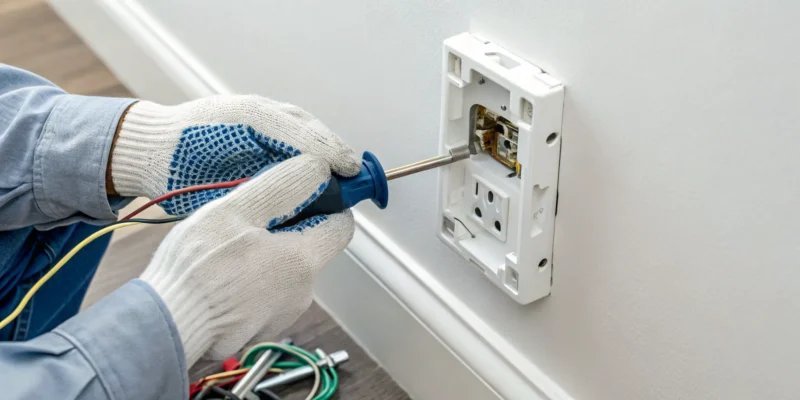
With power confirmed off, unscrew the outlet cover and the outlet itself, then gently pull it from the box. Take a photo of the wiring before disconnecting anything — wire positions matter. Note which wires go where: black (hot) to brass screws, white (neutral) to silver screws, bare copper or green (ground) to the green screw. That’s the whole color code.
Disconnect the old outlet and connect the new one identically. Wrap wires clockwise around the terminal screws so tightening the screw pulls the wire in, not out — or use the back-wire clamps if the outlet has them (better than stab-in back connections, which loosen over time). Push the outlet in carefully without pinching wires, screw it to the box, attach the cover, turn the breaker back on, and test with a plug-in outlet tester ($10) to confirm correct wiring. Total time: 15 to 25 minutes.
When to Call an Electrician Instead
DIY outlet replacement assumes a standard, modern setup. Call a pro if: there’s no ground wire in the box (common pre-1960s — you need GFCI protection, which has specific installation rules), the box is crammed with wires or you see aluminum wiring (requires special handling), wires are brittle, scorched, or the insulation is crumbling, or you’re replacing a standard outlet with a GFCI/AFCI in a location that requires one and you’re unsure of the line/load wiring.
Also call a pro for anything beyond a simple swap: adding a new outlet where none existed, moving an outlet, or anything involving the breaker panel itself. The $150 to $250 electrician visit is cheap insurance against a house fire. Know the line between “replacing a device” (DIY-friendly) and “modifying the circuit” (pro territory) — and stay on your side of it.
Outlet Replacement Safety Checklist
Every single time, no exceptions:
- Turn off the breaker — never rely on the wall switch alone.
- Verify dead with a non-contact voltage tester (test the tester first).
- Photograph the existing wiring before disconnecting anything.
- Match wire colors: black to brass, white to silver, ground to green.
- Wrap wires clockwise around screws; avoid stab-in back connections.
- Test the finished job with a plug-in outlet tester.
- Stop and call a pro for: no ground wire, aluminum wiring, scorched wires, or new circuits.
The Bottom Line
Yes, replacing an outlet yourself is safe — if you kill the breaker, verify with a tester, and wire the new outlet exactly like the old one. It’s a 20-minute job that electricians charge $150+ for.
The danger isn’t the task; it’s skipping the safety steps. Test twice, photograph everything, and know when the job is bigger than a swap. Respect the electricity and it’ll respect you back.
Upgrading Outlets While You Replace Them
Since you’re already replacing the outlet with the power off, consider whether an upgrade makes sense — the marginal cost is small. Tamper-resistant outlets (now code for most locations, $3-$5) have internal shutters that prevent kids from inserting objects; if your home predates them, every replacement is a chance to modernize. GFCI outlets ($15-$25) are required in kitchens, bathrooms, garages, and outdoors — if you’re replacing a standard outlet in one of these locations, upgrading to GFCI is both code-smart and genuinely life-saving.
USB-combination outlets ($20-$35) add charging ports directly to the outlet — excellent for bedrooms, kitchens, and home offices where charger bricks multiply. They install exactly like standard outlets (same wiring) and eliminate the wall-wart clutter. For bedrooms, consider outlets with built-in night lights ($15) — subtle, automatic, and they end the stubbed-toe era. None of these upgrades change the wiring; they’re all device swaps using the same three wires.
One caution: don’t upgrade to a 20-amp outlet on a 15-amp circuit (the T-shaped neutral slot) — the breaker and wiring must match the outlet rating. And if you’re replacing outlets throughout an older home, do them one at a time and test each before moving on. Batch-replacing six outlets and then discovering a wiring error means re-opening all six. Slow, verified, one-at-a-time is the professional pace.
Quick Answers
Can I replace a two-prong outlet with three-prong?
Only with proper grounding or GFCI protection — a three-prong outlet without ground is dangerous and a code violation. This is electrician territory.
Why do my outlets feel warm?
Warm outlets indicate loose connections or overload — both fire risks. Turn off the breaker and call an electrician; don’t just replace the outlet.
How often should outlets be replaced?
Quality outlets last 15-25 years. Replace if plugs fall out loosely, the outlet is cracked, or you see discoloration.
The panel-directory habit is the unglamorous skill that makes all future electrical work safer and faster. While you’re at the breaker panel for this project, take 20 minutes to properly label every breaker — turn circuits off one by one and note what loses power. Most panels have cryptic labels (‘plugs??’, ‘kitchen??’) or none at all, and mislabeled panels cause dangerous assumptions. A clear directory means the next outlet replacement (or any electrical work) starts with certainty instead of guesswork. Use a label maker or neat permanent marker; future you — and any electrician you ever hire — will be grateful for the 20 minutes you spent today.
Further reading: the Electrical Safety Foundation International, the Consumer Product Safety Commission on home electrical safety.