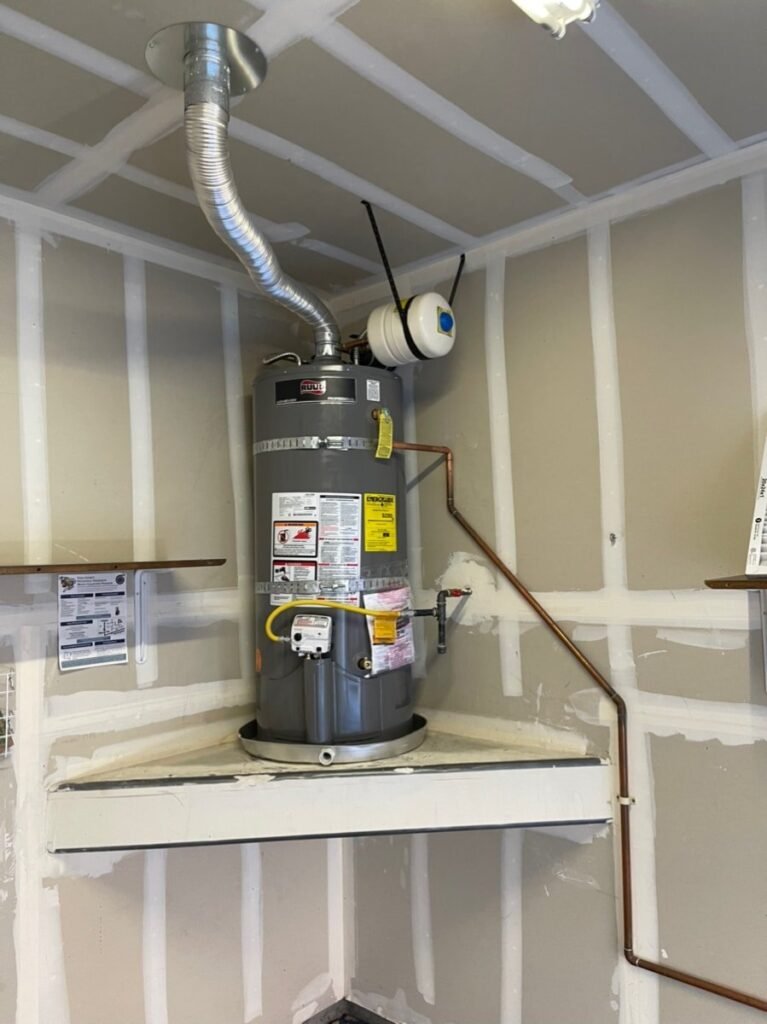
How Much Does a New Water Heater Cost Installed?
How Much Does a New Water Heater Cost Installed?
When the water heater dies, you find out fast — cold showers have a way of focusing the mind. A new water heater installed typically costs $900 to $3,000, but that range hides a lot of important choices: tank vs. tankless, gas vs. electric, and sizing.
Here’s what you’ll actually pay and how to avoid overpaying in a moment of desperation.
Standard Tank Water Heaters: $900 to $1,800 Installed
The traditional tank heater is still what most homes have. The unit itself costs $400 to $1,000 depending on size (40-gallon is standard for most families; 50-gallon for larger households) and fuel type. Installation labor runs $400 to $800, covering removal of the old unit, new connections, and bringing things up to current code.
Gas units cost more upfront than electric but are cheaper to run — about $250 to $350 a year in energy versus $450 to $600 for electric. If your old unit is gas, stick with gas; converting fuel types adds $500 to $1,500 in new venting or electrical work. Pro tip: measure your space before shopping. Taller, narrower models fit closets; short, wide ones fit crawl spaces. Buying the wrong shape means an expensive return.
Tankless Water Heaters: $2,000 to $4,500 Installed
Tankless units heat water on demand — endless hot water, no bulky tank, and 20+ year lifespans versus 10 to 12 for tanks. The units cost $800 to $2,000, but installation is where it jumps: $1,200 to $2,500 in labor because most homes need upgraded gas lines, new venting, or electrical panel work. Retrofitting tankless into a home built for a tank is the expensive part.
The math: tankless saves roughly $100 to $200 a year on energy, so the payback period on the premium is 7 to 12 years. It’s worth it if you’re staying long-term, want endless hot water, or are tight on space. It’s not worth it if you’re selling in a few years or your household’s hot water needs are modest. Get quotes that itemize the unit, the retrofit work, and permits separately — the retrofit line is where prices vary wildly between contractors.
What Affects Your Final Price
Code upgrades are the surprise line item. If your old heater predates current codes, the installer may need to add an expansion tank ($50 to $150), update the venting, install a drain pan, or bring the gas line up to spec — adding $200 to $600. Permits run $50 to $200 depending on your city, and yes, you want the permit; unpermitted water heater installs can void your homeowner’s insurance if something goes wrong.
Emergency replacement costs more. A plumber who comes out same-day for a dead heater charges a premium — sometimes 20% to 30% over a scheduled install. If your heater is over 10 years old, start getting quotes now instead of waiting for the failure. And always get three quotes: for the exact same scope, I’ve seen prices differ by $800. Ask each contractor for the unit model number so you’re comparing apples to apples.
Water Heater Replacement Checklist
Before you sign anything:
- Know your current setup: tank size, gas vs electric, and available space.
- Get 3 itemized quotes with the exact unit model number.
- Ask about code upgrades, permits, and old-unit disposal fees upfront.
- Tank installed: $900-$1,800. Tankless installed: $2,000-$4,500.
- Stick with your existing fuel type unless you have a strong reason to switch.
- If your heater is 10+ years old, shop now — not during an emergency.
- Confirm the warranty: 6 years is standard, 9-12 years available on better units.
The Bottom Line
Expect $900 to $1,800 installed for a standard tank water heater or $2,000 to $4,500 for tankless. The unit is only half the story — installation complexity, code upgrades, and emergency premiums shape the final bill.
If your heater is approaching 10 years old, get quotes while you have time to compare. Shopping calmly beats shopping with cold water coming out of the shower.
Extending Your Water Heater’s Life
Whether you buy tank or tankless, maintenance determines whether you get 8 years or 15 from the unit. For tank heaters, the single most important task is flushing sediment annually — hook a hose to the drain valve, flush until the water runs clear. In hard-water areas, sediment builds inches deep, forcing the burner to heat through insulation-like mineral crust (killing efficiency) and eventually overheating the tank bottom. Annual flushing takes 30 minutes and is the difference between a 10-year and 15-year lifespan.
Check the anode rod every 3-5 years ($30 part, the ‘sacrificial’ metal rod that corrodes so the tank doesn’t). When it’s depleted, the tank starts corroding — replacing a $30 rod beats replacing a $1,500 heater. Also test the temperature-pressure relief valve yearly (lift the lever briefly — water should flow, then stop), keep the area around the heater clear, and set the thermostat to 120°F (hot enough for needs, cool enough to slow sediment baking and prevent scalding). For tankless units, annual descaling with vinegar (DIY-able, $20 in supplies) is the equivalent critical maintenance — skip it in hard water and the heat exchanger chokes within years.
Know the failure warning signs so replacement is planned, not panicked: rusty water from hot taps, rumbling/popping sounds (sediment), water pooling at the base, or age past 10-12 years for tanks. A heater that fails catastrophically floods — a $30 water alarm on the floor beside it gives early warning, and a drain pan ($50) under the unit contains slow leaks. These tiny investments prevent the 2 a.m. basement flood that turns a $1,200 replacement into a $5,000 water damage claim.
Quick Answers
How long do water heaters last?
Tank: 10-12 years (15 with great maintenance). Tankless: 20+ years with annual descaling.
What temperature should my water heater be?
120°F — hot enough for household needs, prevents scalding, and slows sediment buildup.
Is a leaking water heater dangerous?
It can be — water damage is the main risk, but gas units with venting issues pose CO risks. Any active leak warrants prompt professional attention.
The disposal question catches people off guard: old water heaters are heavy, awkward, and often contain sediment and residual water — they’re genuinely miserable to move. Most installers include haul-away for $50-$100, and it’s worth every penny versus the DIY alternative (dolly rental, a friend’s truck, the scrap yard’s awkward hours). Some scrap yards pay $20-$40 for old heaters (steel and copper content), and some utilities offer rebates for upgrading to efficient models ($100-$500 depending on your area and the unit). Ask your installer about haul-away, check your utility’s rebate page, and factor both into the total cost math. The rebates alone sometimes cover the haul-away plus a nice dinner.
Further reading: Energy Star water heater buying guidance, the Department of Energy on water heating.