How Much Does It Cost to Start a Pressure Washing Business?
How Much Does It Cost to Start a Pressure Washing Business?

Pressure washing might be the most satisfying side hustle on earth — you point a wand at a filthy driveway and it transforms in minutes, and people pay hundreds for the privilege. How much does it cost to start a pressure washing business? Less than most businesses, but more than the TikTok gurus admit.
The realistic range: $2,000 to $6,000 for a proper setup. Here’s the full breakdown, what you can skip at first, and what the business actually earns.
How much does it cost to start a pressure washing business?
Equipment: Where the Money Goes
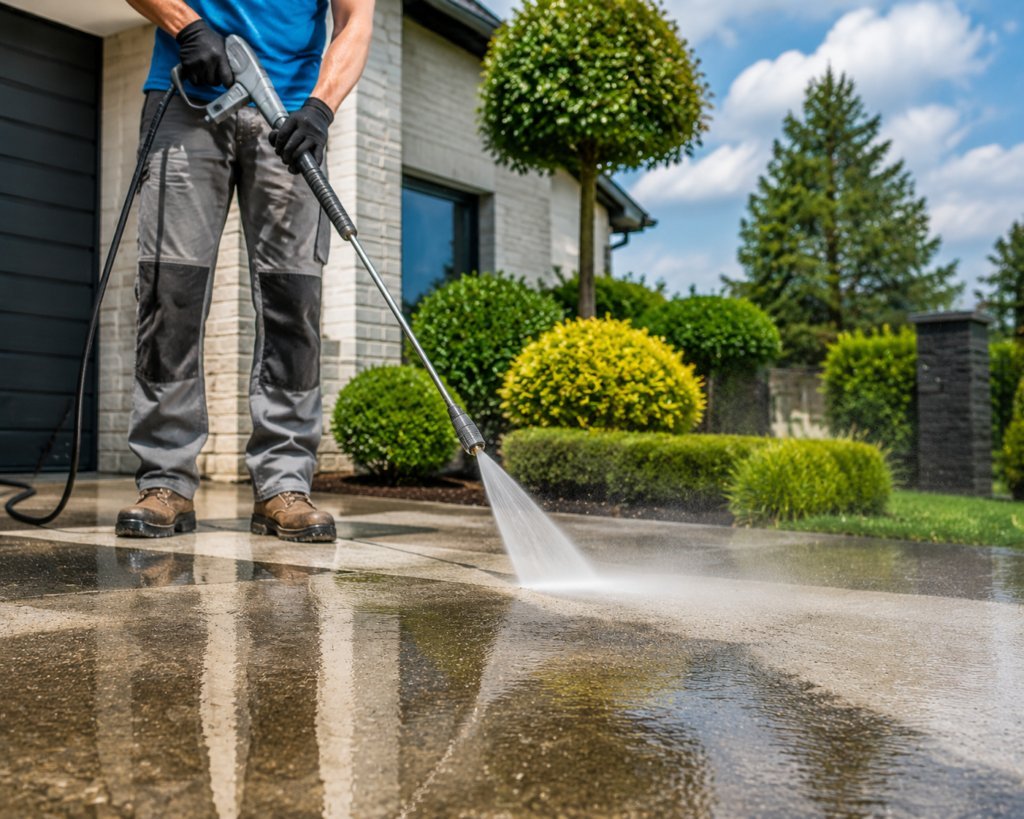
The pressure washer itself is the big purchase. For professional work, you need a gas-powered unit with 4+ GPM (gallons per minute) and 3,500+ PSI — the consumer electric washers from Home Depot won’t cut it for paid jobs. Expect $800–$1,500 for a solid commercial unit (Simpson, DeWalt, and Generac’s commercial lines are popular). Add a surface cleaner attachment ($80–$200 — this is what makes driveways fast and streak-free), extension wands, nozzles, hoses ($150–$300 total), and chemicals/soaps ($100–$200 to start).
You’ll also need water supply: most jobs use the customer’s spigot (standard practice), but a buffer tank ($200–$400) in your truck lets you work anywhere. Vehicle-wise, any pickup or SUV with a trailer hitch works to start — a dedicated trailer rig ($1,500–$3,000) comes later when you’re established. Total equipment for a capable starter rig: $1,200–$2,500.
The Non-Equipment Costs People Forget
Insurance isn’t optional — you’re spraying high-pressure water at people’s homes. General liability insurance for pressure washing runs $500–$1,200/year, and many commercial clients require proof of $1M coverage before hiring you. Skip this and one broken window or stripped paint job ends your business. Business license ($50–$150), and check local rules: some municipalities restrict wastewater runoff (you may need to reclaim water near storm drains — know the EPA-adjacent local rules).
Marketing to start is cheap: $200–$500 for yard signs, door hangers, a simple Google Business Profile (free and essential — see getting Google reviews), and magnetic truck signs. A basic website can wait; before/after photos on Facebook and Google do the selling. Budget $100–$200 for initial uniforms/shirts — looking professional on a $300 driveway job matters more than you’d think.
Realistic Earnings and Pricing
Residential pricing: driveways $150–$300, house washes $300–$600, decks $200–$400, roofs (soft wash) $400–$800. A solo operator does 2–3 jobs a day at $250 average — that’s $500–$750/day in revenue. Chemical and fuel costs run 10–15%, so the margins are excellent once you’re rolling. Realistic first-year part-time earnings: $20,000–$50,000; full-time established operators clear $60,000–$100,000+.
The catch: it’s seasonal in most climates (dead in winter up north), physically demanding, and competitive — every market has established washers. Your edge as a newcomer: responsiveness (answer the phone, show up on time — shockingly rare), great before/after photos, and reviews. Price confidently from the start; undercharging $99 for driveways attracts nightmare customers and burns you out. Track everything from job one with simple bookkeeping — equipment, mileage, and chemicals are all deductible.
Quick Answers
- Total startup: $2,000–$6,000 for a proper rig (washer, attachments, insurance, marketing).
- Pressure washer: $800–$1,500 gas-powered, 4+ GPM, 3,500+ PSI — skip consumer electrics.
- Must-have attachment: surface cleaner ($80–$200) for fast, streak-free flatwork.
- Insurance: $500–$1,200/year liability — non-negotiable.
- Pricing: driveways $150–$300, house washes $300–$600. Solo operators: $500–$750/day revenue.
- Marketing: Google Business Profile (free) + before/after photos beat everything.
- Watch for: seasonality, local wastewater rules, and underpricing yourself.
The Bottom Line
Starting a pressure washing business costs $2,000–$6,000 — a commercial-grade washer, surface cleaner, insurance, and basic marketing. It’s one of the best ROI service businesses: low startup, excellent margins, and visible results that sell themselves.
Buy capable equipment once (not twice), insure properly, price confidently, and let before/after photos do your marketing. The barrier isn’t money — it’s showing up consistently in a business where reliability is rarer than it should be.
Frequently Asked Questions
How much can I realistically make pressure washing part-time?
Weekends-only operators doing 4–6 jobs per weekend at $200–$300 average clear $800–$1,800/weekend in revenue — $3,000–$7,000/month in season, minus 10–15% in fuel and chemicals. That’s genuinely life-changing side income for 2 days a week. The constraint is seasonality (dead winters in cold climates) and your physical stamina. Many operators start weekends, then go full-time once the schedule fills — the demand is there if your marketing is.
Do I need special training or certification to pressure wash?
No legal certification is required in most places — it’s an unlicensed trade in most jurisdictions. But training matters practically: incorrect technique damages siding, strips paint, etches concrete, and injures people (pressure washers can cause serious lacerations). Learn on your own property first, watch professional technique videos, and understand which surfaces need soft washing (roofs, siding) vs. high pressure (concrete). One damaged house wipes out months of profit — skill is your real license.
What’s the difference between pressure washing and soft washing?
Pressure washing uses high-pressure water (2,500–4,000 PSI) for hard surfaces like concrete and brick. Soft washing uses low pressure plus specialized chemicals for roofs, siding, and painted surfaces — killing mold and algae without damage. Offering both doubles your service menu: house washes and roof cleans (soft wash, $300–$800) are higher-margin than driveways. Learn soft washing early; it’s where the premium pricing lives.
How do I price my first jobs without experience?
Start at market rate, not below it — check competitors’ pricing and match the middle. Underpricing signals inexperience and attracts price-shoppers who’ll never become good customers. For your first 2–3 jobs, offer a ‘founding customer’ discount in exchange for before/after photos and a review — you get marketing assets, they get a deal, and your public pricing stays intact. Never compete on price; compete on responsiveness, quality, and reviews.
What insurance do pressure washers need?
General liability ($1M/$2M) is the baseline — $500–$1,200/year — covering property damage and injuries. Many commercial clients require it before hiring you. Consider inland marine/equipment coverage for your $1,500 washer, and commercial auto if the truck is primarily for business. One broken window, one stripped deck, one injured bystander without insurance ends the business. It’s not optional; it’s the cost of operating. The SBA’s launch checklist covers the structural steps — licenses, insurance, business structure — that turn equipment into an actual business.
Pingback: Best Low-Cost Garage Businesses to Start (2026)