Is There Life in the Deep Parts of Lake Superior? (Deep Dive) down there.
Lake Superior holds 10% of the world’s surface fresh water. Its deepest point — 1,332 feet down — is a world of permanent darkness, near-freezing temperatures, and crushing pressure. For over a century, scientists assumed almost nothing could live down there. They were wrong. The deep parts of Lake Superior host a strange, sparse, fascinating ecosystem — and studying it is changing what we know about life in Earth’s largest lake.
What “Deep” Means in Superior
Superior’s average depth is 483 feet, but its eastern basin plunges past 1,000 feet into true abyssal territory — by freshwater standards. Below about 300 feet, sunlight is gone entirely. Temperatures hover just above freezing year-round (around 39°F, water’s densest point). Pressure at 1,300 feet exceeds 40 atmospheres. It’s as close to an alien environment as you can find without leaving the Midwest — and yet it’s teeming, by deep-water standards, with life.
The deep lake is also remarkably stable. Unlike shallow lakes that turn over seasonally, Superior’s depths change little year to year — the same cold, dark, low-nutrient conditions persisting for centuries. That stability has allowed specialized communities to evolve, fine-tuned to an environment that would kill most freshwater organisms in hours.
The Residents: Who Lives in the Dark
The deep benthos — the lake floor — is dominated by tiny crustaceans, especially amphipods like Diporeia, fingernail-sized shrimp-like creatures that carpet the deep sediments in astonishing numbers. These are the foundation of the deep food web, feeding everything above them. Alongside them: deepwater sculpins, strange bottom-dwelling fish with oversized heads; burrowing mayfly larvae; and microbial mats — bacterial communities that process the slow rain of organic matter drifting down from the sunlit surface.
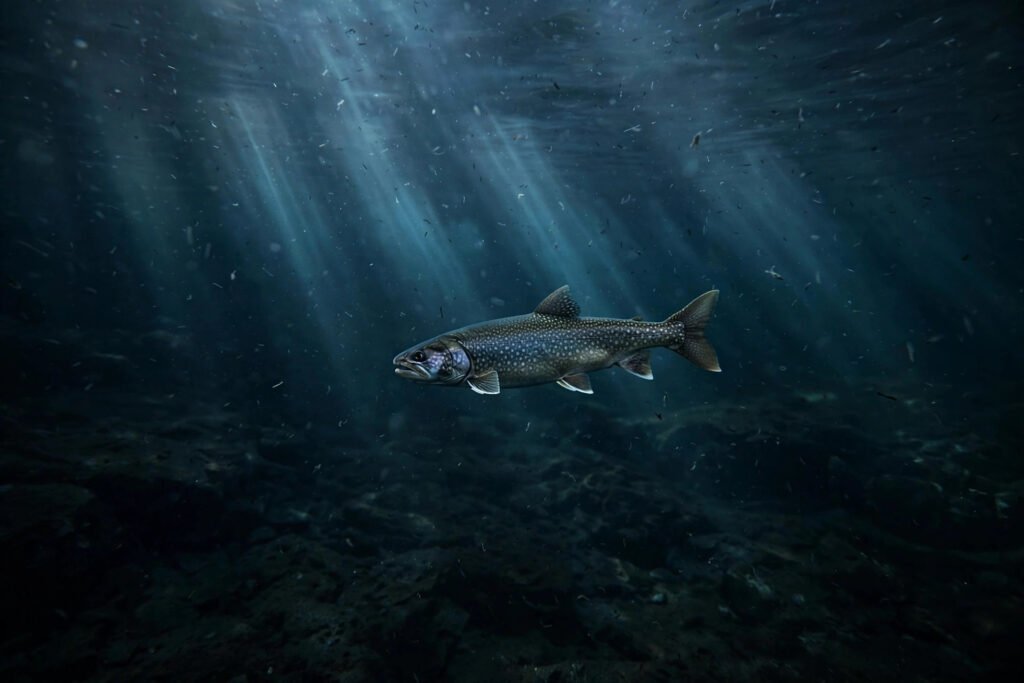
The fish are the charismatic residents. Lake trout — Superior’s native apex predator — roam the depths, including the deepwater “siscowet” morph, a distinct form with high fat content adapted to deep, cold water. Siscowets can live 50+ years, growing slowly in the frigid dark. Burbot (eelpout), deepwater ciscoes, and kiyi — a small, large-eyed cisco found almost nowhere else — complete a fish community shaped entirely by darkness and cold. NOAA’s Great Lakes research programs have documented these communities with deep-water trawls and submersibles.
How Anything Survives Down There
Deep Superior life runs on marine snow — the constant drift of dead plankton, fecal pellets, and organic debris sinking from the productive surface waters. It’s a meager ration: Superior is famously nutrient-poor (oligotrophic), so deep communities live in permanent famine. Adaptations follow: extremely slow metabolisms, long lifespans, delayed reproduction, and extreme efficiency. A deepwater sculpin burns energy at a fraction of the rate its shallow cousin does.
The darkness itself shapes bodies. Deep Superior fish tend toward large eyes (to catch the faintest bioluminescent or residual light), enhanced lateral-line senses for detecting vibration, and pale or translucent coloration — camouflage is pointless where there’s no light, so pigment is wasted energy. These are the same adaptations seen in ocean abyssal fish, evolved independently in a freshwater lake — a striking case of convergent evolution.
What Scientists Are Still Discovering
The deep lake keeps surprising researchers. Microbial ecologists have found diverse bacterial communities in deep sediments performing chemistry — methane cycling, sulfur processing — once thought to require ocean conditions. Submersible dives have revealed unexpected habitats: deep reefs, boulder fields, and even areas where groundwater seeps up through the lakebed, creating oases of slightly different chemistry.
Perhaps most intriguing: the deep lake as a climate archive. Sediment cores from Superior’s depths preserve thousands of years of environmental history in undisturbed layers — pollen, charcoal, chemical signatures of every drought, fire, and industrial era. The Environmental Protection Agency’s Great Lakes monitoring uses these archives to distinguish natural cycles from human impact. The deep lake isn’t just alive; it’s a library.
Threats to the Deep
Deep Superior seems invulnerable — too deep, too cold, too remote to harm. It isn’t. Invasive species are the top threat: quagga mussels, having colonized the shallower Great Lakes, filter enormous volumes of water and could eventually alter the deep food web by intercepting the marine snow everything depends on. Climate change is warming surface waters and could alter the lake’s mixing patterns, potentially reducing the oxygen delivery to depths.
There’s also a subtler threat: we barely monitor it. Deep-water research is expensive — ships, submersibles, specialized gear — so Superior’s depths are sampled far less than its surface. We may be missing changes until they’re advanced. The argument for deep-lake research funding is ultimately an argument about attention: you can’t protect what you don’t watch.
Life’s persistence in such extremes reframes what “habitable” means — a theme that echoes in surprising places, like how houseplants survive with almost no light, another story of life optimizing for darkness. And Superior’s surface world is worth knowing too — Niagara Falls may get the tourists, but Superior gets the superlatives.
The Siscowet: A Fish Like No Other
Of all Superior’s deep residents, the siscowet deserves its own spotlight. This deepwater morph of the lake trout is essentially a different animal from its shallow-water cousins: up to 50% body fat (an adaptation for buoyancy and energy storage in the food-scarce depths), slow-growing, and extraordinarily long-lived — individuals over 40 years old are documented. Commercial fishermen once rendered siscowets for their oil-rich flesh, and the fish’s fat content is so high it was historically used as lamp oil.
The siscowet’s existence raises a fascinating evolutionary question: how quickly can one species split into depth-specialized forms? Genetic studies suggest the siscowet diverged from shallow lake trout only after the last ice age — an eyeblink in evolutionary time. Superior’s depths didn’t just host life; they manufactured a new kind of fish in under 10,000 years, a reminder that extreme environments are evolution’s fast lane.
Conclusion
Yes, there is life in the deep parts of Lake Superior — amphipod carpets, deepwater sculpins, ancient siscowet trout, and microbial communities running on the faintest rain of organic matter, all adapted to permanent darkness, near-freezing cold, and crushing pressure. It’s one of Earth’s most extreme freshwater ecosystems, still yielding discoveries, and still vulnerable to invasions and warming from above. A thousand feet down in the dark, the largest lake in the world is very much alive.
Frequently Asked Questions
How deep is Lake Superior?
Maximum depth 1,332 feet, average 483 feet. It’s the deepest and largest (by surface area) of the Great Lakes, holding about 10% of the world’s surface fresh water.
What fish live in deep Lake Superior?
Lake trout (including the deepwater siscowet morph), burbot, deepwater sculpins, kiyi, and deepwater ciscoes — all adapted to darkness, cold, and low food availability.
Is there light at the bottom of Lake Superior?
No. Sunlight penetrates only the upper ~300 feet; below that is permanent darkness. Deep organisms rely on vibration sensing, smell, and extreme low-light vision instead.
What is a siscowet?
A deepwater morph of the lake trout found in Superior’s depths — extraordinarily fatty, slow-growing, and long-lived, with individuals documented past 40 years of age.
Has anyone explored the deepest part of Lake Superior?
Yes — research submersibles and remotely operated vehicles have surveyed the deep basins, documenting benthic communities, deep reefs, and sediment archives. But large areas remain unexplored; deep-lake research is expensive and sparse.