The Science Behind Seasonal Affective Disorder (SAD), Explained
Every October, without fail, Karen felt it arrive like weather: energy draining, sleep stretching longer, food tasting better than it should, motivation evaporating. By December she was a different person — heavier, slower, foggier — and every year she told herself it was just the holidays. Then a doctor asked two questions about the timing, and Karen learned the name for what she’d experienced for a decade: seasonal affective disorder. It wasn’t weakness or winter laziness. It was neurochemistry.
Seasonal affective disorder (SAD) affects millions of Americans, clustered heavily in northern states where winter daylight is scarce. The science behind it — how light reaches into the brain and rewires mood, sleep, and appetite — is one of the clearest demonstrations that our minds are, in a very real sense, solar-powered.
Light, the Brain’s Timekeeper
The core mechanism starts in the eye — but not the seeing part. Specialized retinal cells containing a pigment called melanopsin detect ambient light levels and report directly to the suprachiasmatic nucleus, the brain’s master clock. This clock orchestrates the daily rhythm of nearly every hormone in your body. When daylight shrinks in fall, the clock gets a weaker signal, and the whole orchestra drifts.
The most important downstream effect is on melatonin. In darkness, the pineal gland secretes melatonin to promote sleep; light suppresses it. Short winter days mean melatonin production runs long — the brain essentially thinks night is 14 hours instead of 8. The result is the classic SAD symptom cluster: oversleeping, daytime grogginess, and a leaden fatigue that coffee barely dents. It’s not that SAD sufferers are lazy; their brains are chemically convinced it’s still nighttime.
Serotonin: The Mood Connection
Sunlight also regulates serotonin, the neurotransmitter most associated with mood stability. Brain imaging studies show serotonin transporter activity varies with seasons — in winter, more transporters clear serotonin from synapses faster, effectively lowering its availability. Less available serotonin tracks closely with the low mood, irritability, and loss of interest that define SAD’s depressive symptoms.
This is why SAD responds to the same treatments as other depression: SSRIs raise synaptic serotonin, and they work for SAD too. But it’s also why light itself is therapeutic — bright light exposure appears to modulate both the melatonin and serotonin systems simultaneously, addressing the root seasonal disruption rather than just its symptoms. The National Institute of Mental Health’s research on SAD describes it as a subtype of major depression with a seasonal pattern, not a separate mild condition — a distinction that matters for taking it seriously.
Why Women, Why the North, Why Some People
SAD’s demographics are striking: it affects women at roughly four times the rate of men, typically begins in young adulthood, and its prevalence climbs with latitude — an estimated 1–2% of Floridians versus 9–10% of Alaskans experience it. Family history matters too; SAD runs in families with mood disorders, suggesting genetic vulnerability in the light-response pathways.
The latitude gradient is the smoking gun for the light hypothesis: less winter daylight, more SAD. But individual variation is huge — two people in Minneapolis can have completely different experiences, likely due to differences in retinal light sensitivity, clock-gene variants, and baseline serotonin function. Researchers are now investigating whether some people’s master clocks are simply more “light-hungry,” needing stronger signals to stay synchronized.
What Actually Works: The Evidence
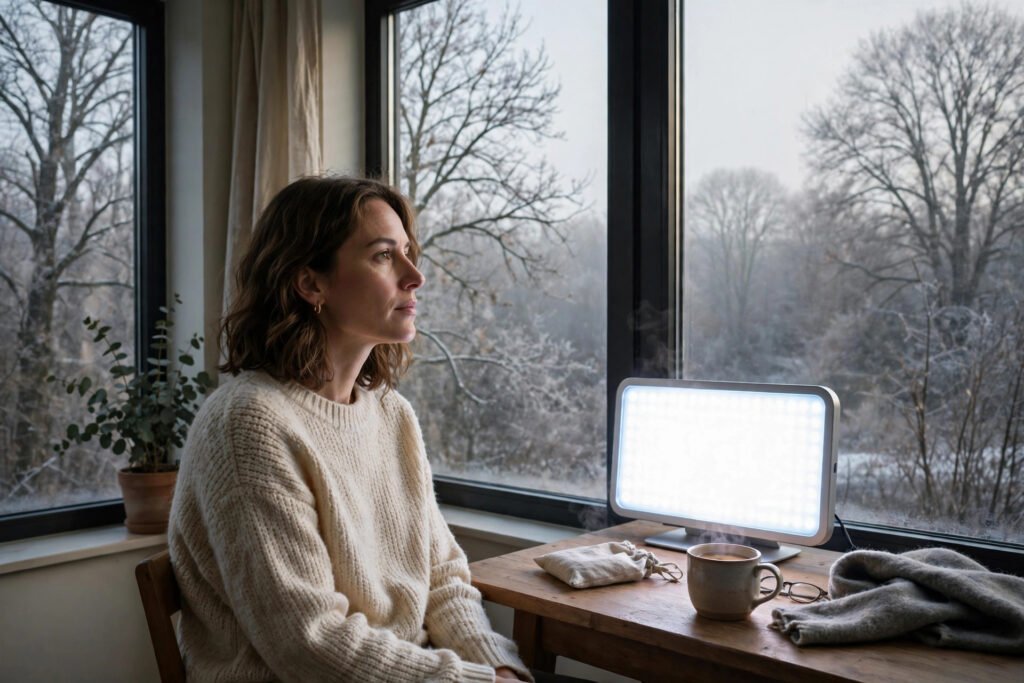
Light therapy is the first-line treatment, and the protocol is specific: 10,000 lux of broad-spectrum white light for 20–30 minutes within an hour of waking, sitting 16–24 inches from the box with eyes open (not staring into it). Most people feel improvement within 1–2 weeks. The mechanism is direct — strong morning light suppresses the overlong melatonin signal and resets the master clock. Timing matters enormously; evening light can actually worsen the clock drift.
Cognitive behavioral therapy adapted for SAD (CBT-SAD) shows effects comparable to light therapy, with better durability — it teaches people to challenge the seasonal thought patterns (“winter is unbearable, I can’t function”) that amplify the biology. Exercise helps, particularly outdoor morning exercise that combines light exposure with activity. Vitamin D is widely discussed but the evidence is mixed — low vitamin D correlates with SAD but supplementation trials show modest effects at best. Dawn simulators (alarm clocks that gradually brighten) help some people, especially for the oversleeping component.
Living With It: Practical Strategy
Karen’s management plan, built with her doctor: a light box on the breakfast table from October through March, a morning walk even on gray days (outdoor light, even overcast, dwarfs indoor lighting), strict sleep scheduling to anchor her clock, and permission to front-load demanding projects into summer and fall when her energy peaks. She also plans a February trip somewhere sunny — not as indulgence but as treatment, and it works.
One caution: SAD’s symptoms overlap with hypothyroidism, sleep apnea, and other conditions, so new or severe symptoms deserve a medical workup, not self-diagnosis. And SAD with severe depression — hopelessness, inability to function — needs professional treatment promptly, the same as any major depression. The Centers for Disease Control and Prevention’s mental health resources can help locate care. If sleep disruption is part of your pattern, learning how to fall asleep faster without sleep aids complements light therapy well — and understanding whether nightly melatonin is safe matters, since SAD already involves a melatonin system in overdrive.
SAD in Kids and Teens
Adults don’t have a monopoly on seasonal mood shifts. Children and teenagers can develop SAD too, and it often masquerades as school problems — falling grades in winter, irritability after school, withdrawal from friends. Because kids rarely articulate “my serotonin drops when daylight shrinks,” parents and teachers should watch for the seasonal pattern: a child who thrives September through November and struggles January through March, year after year, deserves evaluation, not just tutoring. Light therapy protocols exist for younger patients, and simply maximizing outdoor morning light — walking to school, outdoor recess — helps more than most families expect.
Conclusion
Seasonal affective disorder is what happens when the brain’s light-driven clock loses its signal: melatonin runs too long, serotonin runs too low, and mood, energy, and sleep all slide. It’s geography written into neurochemistry — which is why it responds to the most literal treatment imaginable: more light, at the right time. Karen still feels October arrive. But now she meets it with a light box, a walk, and a plan — and winter is a season again, not a sentence.
Frequently Asked Questions
What causes seasonal affective disorder?
Reduced winter daylight disrupts the brain’s master clock: melatonin production runs too long (causing fatigue and oversleeping) and serotonin availability drops (causing low mood). Genetics, latitude, and individual light sensitivity determine who is affected.
How is SAD different from regular depression?
SAD follows a seasonal pattern — symptoms arrive in fall/winter and remit in spring/summer for at least two consecutive years. Interestingly, SAD more often involves oversleeping and overeating, the reverse of typical depression’s insomnia and appetite loss.
Do light therapy boxes really work?
Yes — 10,000 lux for 20–30 minutes each morning is a first-line, evidence-based treatment with response rates comparable to antidepressants for SAD. Timing (morning) and consistency matter more than brand.
Can SAD occur in summer?
Rarely, yes — a small minority experience summer-pattern SAD with insomnia, agitation, and appetite loss, likely related to excessive light and heat disrupting sleep. Winter-pattern is far more common.