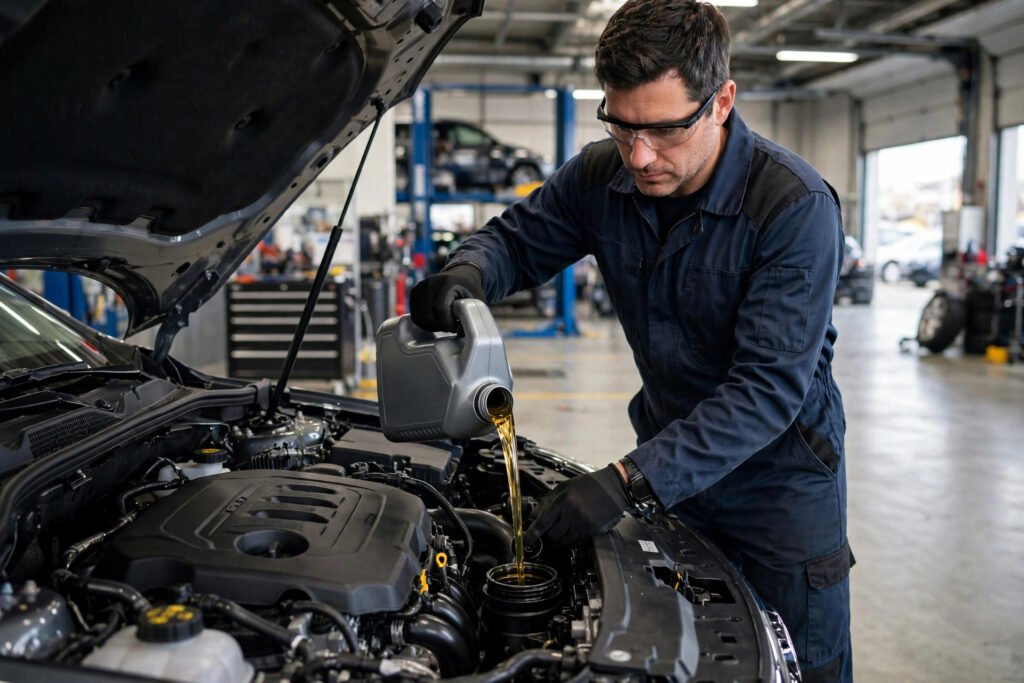
Dealership vs. Jiffy Lube Oil Change Cost (2026)
The humble oil change has become surprisingly complicated — and surprisingly expensive. What used to be a $25 quick-lube special now runs $60-$120+ depending on where you go and what your car needs. The dealership quotes one price, Jiffy Lube another, and the independent shop down the street a third. Are you paying for quality at the dealer, or just the free coffee?
This 2026 guide compares real oil change costs at dealerships versus Jiffy Lube — what drives the price, what you actually get for the money, when the dealer premium is worth it, and when you are better off elsewhere. By the end, you will know exactly where your car should go.
The Price Comparison: Real 2026 Numbers
At a dealership, a conventional oil change typically runs $50-$75, while full synthetic — which most 2015+ vehicles require — runs $80-$130, with luxury brands (BMW, Mercedes, Audi) reaching $150-$200+. Dealers charge more for labor ($120-$180/hour shop rates) and use OEM filters and manufacturer-spec oil.
At Jiffy Lube, conventional oil changes run $40-$60 and full synthetic $70-$100 in most markets — roughly 15-25% cheaper than dealers for equivalent service. Jiffy Lube’s posted prices are for up to 5 quarts; larger engines (trucks, SUVs) incur extra-quart charges of $5-$10 each that surprise people at checkout.
Independent shops generally fall between or below both: $45-$90 for synthetic, often with more experienced technicians than quick-lube chains. The AAA auto repair cost guides and YourMechanic’s price estimates confirm these ranges nationally.
What You Actually Get for the Money
Dealership advantages: factory-trained technicians who know your specific model, OEM parts and exact-spec oil, free multi-point inspections by people who see your car daily, service records that support warranty claims and resale value, and often a free car wash and loaner or shuttle. For vehicles under factory warranty, dealer service creates a clean paper trail if a warranty dispute ever arises.
Jiffy Lube advantages: speed (15-20 minutes, no appointment), convenience (drive in, drive out), lower price, and long hours including weekends. For a simple oil change on an out-of-warranty mainstream car, the service itself — drain oil, replace filter, refill — is fundamentally the same job.
The honest differences: quick-lube upselling is the industry’s open secret. The “$39.99 oil change” routinely becomes $120 after air filters, wiper blades, and fluid flushes you may not need. Dealers upsell too, but their recommendations are more likely tied to your actual maintenance schedule. Technician experience also differs: dealers employ career techs; quick lubes often employ entry-level workers with high turnover — which is where stripped drain plugs and forgotten oil caps come from.
When the Dealership Is Worth It
Pay the dealer premium when: your car is under factory warranty (documentation matters), you drive a European luxury vehicle requiring specific oil specs and procedures, your car needs the manufacturer maintenance schedule followed precisely (timing belt intervals, transmission services), or you have a service contract or prepaid maintenance plan that makes the dealer cheaper anyway.
Dealers also make sense for bundled maintenance: the 30k/60k/90k services that include inspections, fluid changes, and adjustments. An independent shop can do these, but the dealer’s model-specific checklists catch things generalists miss. And if you ever sell to a dealer or trade in, a full dealer service history modestly boosts your offer.
When Jiffy Lube (or an Independent Shop) Wins
Choose quick lube or independent when: your car is out of warranty, it is a mainstream make with standard oil requirements, you value speed and convenience, and you can firmly decline upsells. The job itself is simple; the risk is the upsell, not the oil change.
Actually, consider the independent shop as the sweet spot for most drivers: prices near quick-lube levels, technician quality near dealer levels, and honest advice from people who want your repeat business. Ask friends for recommendations — a good independent mechanic is one of life’s great finds. Jiffy Lube’s site lists current service pricing if you want to compare before you go.
One more option: DIY. A synthetic oil change costs $30-$45 in parts and takes 30 minutes once you learn. It is the cheapest option and oddly satisfying — though apartment dwellers and anyone without a driveway will find the logistics annoying.
The Upsell Defense Guide
Wherever you go, know your car’s actual maintenance schedule (it is in the owner’s manual, not the shop’s computer). Common unnecessary upsells: engine air filters at every visit (check it yourself — hold it to light; if you can see through it, it is fine), premature transmission flushes, fuel system cleanings on low-mileage cars, and wiper blades at triple retail. A good rule: if they recommend it, ask to see the old part and check your manual’s interval. If the manual says 60,000 miles and you have 25,000, decline politely.
Also watch the oil itself: make sure you are getting the grade your manual specifies. “Synthetic blend” upsells and premium-brand markups add cost without benefit for most cars. And if you are maintaining an older vehicle, keeping up with general car care with kids and pets matters as much as the oil — a clean, maintained car lasts longer and sells for more.
The bigger lesson applies to all car maintenance: learning basic car maintenance yourself — checking fluids, inspecting belts, testing the battery — turns mysterious breakdowns into manageable tasks and saves hundreds a year in diagnostic fees. An oil change is the perfect first skill: simple, safe, and immediately rewarding. Start with your owner’s manual maintenance schedule, invest in a basic socket set, and never skip the oil — it is the cheapest engine insurance ever sold.
Conclusion
Dealership oil changes cost $80-$130 for synthetic versus $70-$100 at Jiffy Lube — a real but modest gap. Pay the dealer premium for warranty vehicles, luxury cars, and complex scheduled maintenance; save money at quick lubes or (better) trusted independents for routine changes on mainstream cars. Wherever you go, know your manual’s schedule, decline the upsells, and change the oil on time — the cheapest engine repair is the one you prevent.
Frequently Asked Questions
How much is an oil change at a dealership in 2026?
Typically $80-$130 for full synthetic on mainstream brands, $150-$200+ for European luxury vehicles. Conventional oil changes run $50-$75 where still applicable.
How much is an oil change at Jiffy Lube?
About $40-$60 for conventional and $70-$100 for full synthetic (up to 5 quarts). Extra quarts, premium filters, and upsold services can raise the final bill significantly.
Is dealership oil better than Jiffy Lube oil?
Dealers use OEM-spec oil and filters matched to your car; Jiffy Lube uses quality aftermarket products that meet the same specifications. For most cars the functional difference is negligible — the bigger difference is technician experience and upsell pressure.
How often should I change synthetic oil?
Follow your owner’s manual — typically 7,500-10,000 miles for modern synthetic oils. The old 3,000-mile rule is obsolete for synthetic. Severe conditions (towing, extreme cold, short trips) may warrant shorter intervals.
Will getting oil changes outside the dealer void my warranty?
No. Federal law (the Magnuson-Moss Warranty Act) prohibits voiding warranties for using independent shops, as long as the service meets manufacturer specifications. Keep your receipts as documentation.