What Is Layer 2 and Why Does Ethereum Need It? Explained
Ethereum is the world’s most important smart-contract blockchain — and for years it was also one of the most expensive to actually use. During peak congestion, a simple token swap could cost $50 in fees, pricing out everyone except whales. The solution the ecosystem bet on is called Layer 2: separate networks that process transactions cheaply and quickly, then anchor their security to Ethereum’s main chain. In 2026, Layer 2s handle the majority of Ethereum-ecosystem activity, with fees often 100x lower than mainnet. If you use crypto at all, you will use Layer 2 — so here is what it is, why Ethereum needs it, which networks matter, and how to use them without getting burned. The optimization mindset here mirrors getting more speed from connections you already have — small tweaks, compounding gains.
The Problem Layer 2 Solves
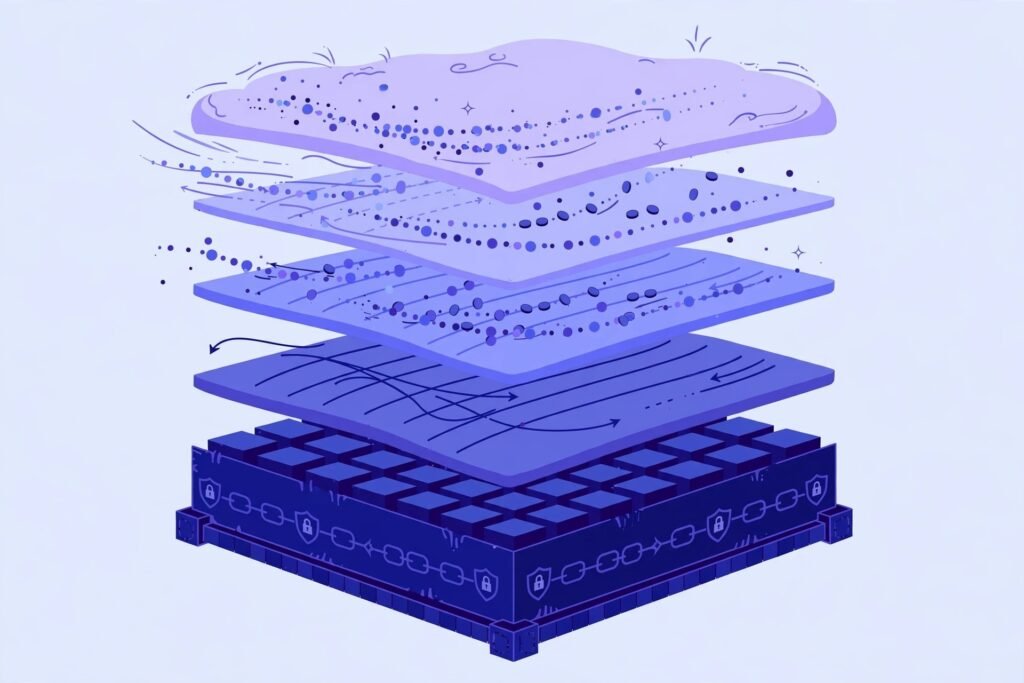
Ethereum’s main chain (Layer 1) processes roughly 15–30 transactions per second — a hard physical limit of its design. When demand exceeds that, users bid up gas fees to get included, and prices spike. This is not a bug; it is the cost of maximum decentralization and security. But it makes Ethereum unusable for everyday activity: nobody pays a $20 fee to swap $100 of tokens. Ethereum’s roadmap always planned to scale in layers — keep Layer 1 maximally secure and decentralized, and push high-volume activity to Layer 2 networks that inherit Ethereum’s security while offering radically cheaper, faster transactions. Think of it like the highway system: Layer 1 is the fortified interstate, Layer 2s are the express lanes built alongside it.
How Layer 2 Actually Works (Simply)
Layer 2 networks (primarily “rollups”) execute transactions off the main Ethereum chain, bundle hundreds or thousands of them together, and post a compressed summary back to Layer 1. Because posting one summary costs roughly the same as one transaction, the cost gets split across everyone in the bundle — hence fees of pennies instead of dollars. Two main flavors exist:
- Optimistic rollups (Arbitrum, Optimism, Base) — assume transactions are valid unless challenged during a dispute window (~7 days for withdrawals back to mainnet). Battle-tested and dominant today.
- Zero-knowledge rollups (zkSync, Starknet, Polygon zkEVM) — use cryptographic proofs to verify transactions instantly, enabling faster withdrawals. More cutting-edge, rapidly maturing.
The security inheritance is the key insight: because transaction data is posted to Ethereum, even if a Layer 2 operator misbehaves, users can reconstruct their balances and exit. You are trusting mathematics and Ethereum’s security, not a company’s promises.
The Layer 2s That Matter in 2026
- Base (Coinbase’s network) — the easiest on-ramp for Americans, deep Coinbase integration, huge app ecosystem. The default choice for beginners.
- Arbitrum — the largest by activity, deepest DeFi liquidity, most battle-tested. Where serious DeFi happens.
- Optimism — strong ecosystem, innovative governance, home to major apps. Technologically sibling to Base (both use the OP Stack).
- Polygon — evolved into a multi-chain ecosystem; its PoS chain remains popular for low-cost activity.
- zkSync / Starknet — the zero-knowledge frontier; worth watching as the technology matures.
You do not need to pick a “winner” — most wallets support switching between them in one tap, and activity naturally concentrates where the apps you want live.
Using Layer 2: A Beginner’s Walkthrough
- Get a wallet ready — MetaMask or Coinbase Wallet, with a small amount of ETH.
- Bridge to Layer 2 — use the network’s official bridge (bridge.base.org, bridge.arbitrum.io) to move ETH from mainnet to the L2. The bridge transaction itself pays mainnet gas once — do it during off-peak hours.
- Switch networks in your wallet (one tap) and transact — swaps, DeFi, NFTs — for pennies.
- To exit back to mainnet, bridge back; optimistic rollups impose a ~7-day withdrawal delay (the security challenge window), so plan ahead for large amounts.
That 7-day withdrawal delay surprises everyone once — it is a security feature, not a bug, and faster third-party bridges exist for those willing to pay a small premium. The same methodical troubleshooting mindset that helps when diagnosing streaming issues serves you well when learning new blockchain mechanics — slow down, verify each step.
Risks and Trade-offs Honestly Stated
Layer 2 is not free magic:
- Sequencer centralization: most L2s currently run a single sequencer ordering transactions — a centralization vector the ecosystem is actively decentralizing, but not yet solved everywhere.
- Bridge risk: bridges holding billions have been hacked before. Use official bridges, and do not leave large amounts sitting in bridge contracts.
- Fragmented liquidity: your assets spread across five L2s are harder to manage than one stack on mainnet. Consolidate deliberately.
- Upgrade risk: L2 code changes frequently; smart-contract bugs are possible. Prefer the most battle-tested networks for large amounts.
Layer 2 vs. Alternative Layer 1s: Why Not Just Use Solana?
A fair question: if the goal is cheap, fast transactions, why not skip Ethereum entirely and use Solana or another high-speed chain? The answer comes down to security budgets and ecosystem depth. Ethereum’s Layer 1 has the largest security budget and most battle-tested foundation in smart-contract crypto — Layer 2s inherit that while matching Solana on speed and cost. Meanwhile Ethereum’s ecosystem (developers, tooling, liquidity, institutional integrations) remains the deepest. Alternative Layer 1s compete well on raw performance, but Ethereum-plus-Layer-2 offers the rare combination of top-tier security and top-tier user experience. For most users, that combination wins — which is exactly why L2 activity has grown so explosively.
Why This Matters for Ethereum’s Investment Case
Critics once argued Layer 2s would “steal” value from ETH. The reality has been more nuanced: L2s pay fees to Ethereum for data posting (supporting ETH’s fee-burn mechanics), drive massive new user adoption that ultimately settles on Ethereum, and several L2 tokens’ ecosystems route value back to mainnet. Ethereum’s strategy — be the secure settlement layer for a constellation of fast execution layers — is working: combined L2 activity now dwarfs mainnet transaction counts. For ETH holders, thriving L2s are a feature, not a threat. Ethereum’s official Layer 2 documentation explains the roadmap, and L2Beat tracks every network’s security risks transparently.
Conclusion
Layer 2 is how Ethereum scales: rollup networks like Base, Arbitrum, and Optimism process transactions for pennies by bundling them and anchoring to Ethereum’s security. For users, the takeaway is practical — bridge once, then enjoy DeFi, swaps, and apps at 100x lower cost. Understand the trade-offs (withdrawal delays, sequencer centralization, bridge risk), stick to the established networks for meaningful amounts, and you will wonder how anyone ever paid $50 to swap tokens. Ethereum’s future is multi-layered, and now you know how to live in it.
Frequently Asked Questions
Is Layer 2 as safe as Ethereum mainnet?
Close, with caveats. L2s inherit Ethereum’s data security, but add their own risks: centralized sequencers, bridge contracts, and upgradeable code. Established L2s are considered safe for most use; mainnet remains the gold standard for maximum security.
Which Layer 2 should a beginner use?
Base — its Coinbase integration makes funding trivial for Americans, fees are pennies, and the app ecosystem is large. Arbitrum is the pick for deeper DeFi activity.
Why does withdrawing from Layer 2 take 7 days?
Optimistic rollups use a challenge period allowing anyone to dispute fraudulent transactions. It is a core security mechanism. Third-party “fast bridges” offer instant exits for a small fee.
Do I need ETH on Layer 2 to pay fees?
Yes — each L2 uses ETH (or its native token) for gas, but at pennies per transaction. Bridge a small amount of ETH over and it lasts hundreds of transactions.
Will Layer 2 fees stay cheap?
Ethereum’s ongoing upgrades (like data-availability improvements) are designed to keep L2 fees low even as usage grows 100x. Fee markets can still spike during extreme demand, but the structural trend favors cheap.