How to Spot a Crypto Pump and Dump Scheme Before You Buy
It starts with a message that feels like a gift: a Telegram group promising “100x signals,” a coin you have never heard of suddenly up 300% in an hour, influencers all posting about the same obscure token at once. Your finger hovers over the buy button. Stop. What you are watching is almost certainly a pump and dump — a coordinated scheme where insiders inflate a coin’s price and sell into the frenzy, leaving late buyers holding losses of 70, 80, 90 percent within hours. These schemes stole hundreds of millions from retail buyers last cycle, and they are running again in 2026 with slicker packaging. Here is how to spot one before your money becomes someone else’s exit liquidity.
How a Pump and Dump Actually Works
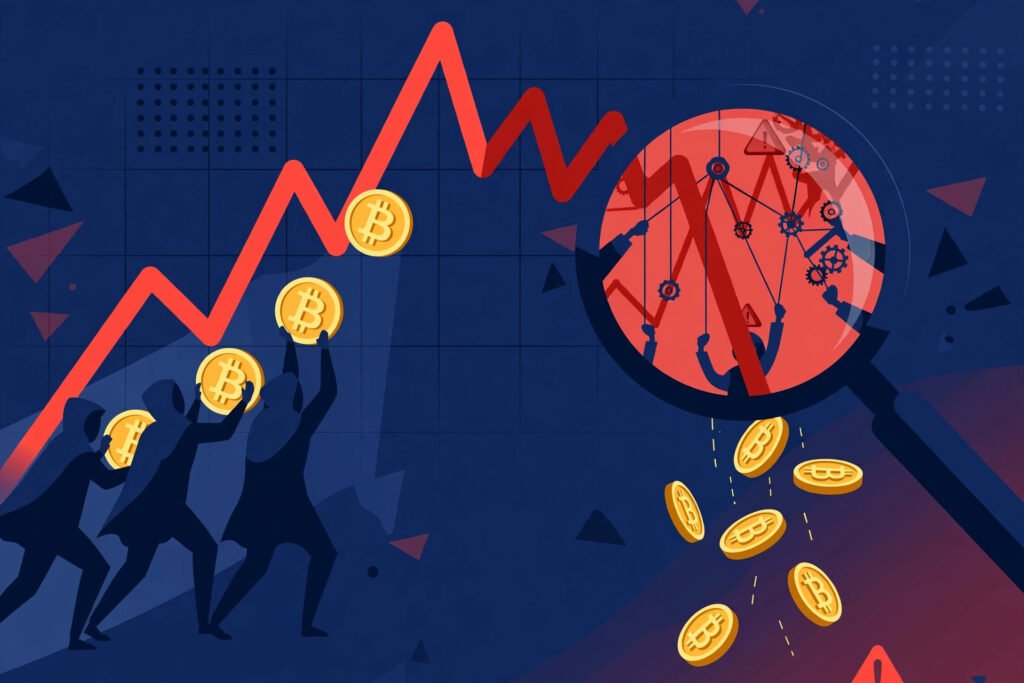
The mechanics are simple and ruthless. Organizers pick a low-liquidity coin — usually a tiny token with thin trading volume where even modest buying moves the price dramatically. Insiders accumulate quietly over days or weeks. Then comes the “signal”: at a coordinated time, the group blasts buy orders, social media shills flood in, and the price rockets. Newcomers see a vertical green candle and FOMO in. Within minutes to hours, the organizers sell everything into the buying frenzy. The price collapses, the group goes quiet or pivots to the next target, and late buyers are left with tokens worth a fraction of what they paid. The whole cycle can complete in under an hour.
Red Flag #1: The Coin Came Out of Nowhere
Legitimate projects build in public for months or years — GitHub commits, developer teams with real names, audits, a whitepaper with actual technical substance. Pump targets have none of this. Warning signs: the token launched days or weeks ago, the website is a template with vague promises (“revolutionary AI-powered DeFi ecosystem”), the team is anonymous with cartoon avatars, and there is no working product. If you cannot explain in one sentence what the token does besides “going up,” you are the product. Learning how to check whether online hype is fake is a directly transferable skill here — the same skepticism applies.
Red Flag #2: Coordinated “Signals” and Countdown Timers
No legitimate investment operates via countdown timers in a Telegram group. Phrases like “PUMP IN 10 MINUTES,” “signal dropping at 8 PM EST,” or tiered groups where “VIP members” get the coin name earlier than free members are the literal operating manual of a pump scheme. The tiering exists so organizers and paying members can buy before the free crowd — you, in the free tier, are not a member. You are the exit liquidity.
Red Flag #3: A Vertical Price Chart on No News
Open the chart. A healthy asset climbs with pullbacks, volume spread across days, and price moves tied to identifiable news. A pump looks like a hockey stick: flat for weeks, then a near-vertical spike on exploding volume, with no announcement, partnership, or upgrade to justify it. Check the token’s social channels during the spike — if the entire conversation is “to the moon” emojis and rocket GIFs rather than discussion of any fundamental development, the move is manufactured. Real breakouts have reasons you can find in ten minutes of reading; pumps have only excitement.
Red Flag #4: Influencer Pile-Ons and Paid Shills
When five crypto influencers with no prior connection all start posting about the same micro-cap token within the same 48 hours, that is not coincidence — it is a marketing budget. Organizers pay influencers in tokens or cash to create the illusion of organic excitement. Check whether the shillers disclose paid promotion (legally required in the U.S., rarely done). Check their history: do they have a trail of previously pumped tokens that all collapsed? The SEC has brought enforcement actions against celebrities and influencers for undisclosed paid crypto promotions — the practice is illegal, not just shady.
Red Flag #5: Locked Liquidity? Fake Volume? No Audits?
For the slightly more technical: check whether the token’s liquidity is locked (developers who can pull the liquidity pool at any moment can “rug pull” — the pump’s evil twin). Tools like DEXTools and CoinMarketCap show holder concentration — if the top ten wallets hold 80%+ of supply, a handful of insiders control the price. No smart-contract audit from a reputable firm is another warning. You do not need to be a developer to check these; fifteen minutes on a block explorer separates due diligence from gambling.
Red Flag #6: Pressure Tactics and “Last Chance” Language
“Last chance under a penny!” “Whales are accumulating!” “If you’re not in by midnight you’ll regret it forever!” Legitimate investments do not expire at midnight. Urgency is a manipulation tool borrowed straight from the scammer’s playbook — the same pressure you would recognize in a fake virus pop-up scam. Whenever someone tries to make you buy faster than you can think, the correct move is to close the tab.
What To Do If You’re Already In One
First, do not panic-sell into the absolute bottom out of shame — but do not hold hoping for a “recovery” either; pumped tokens almost never return to peak prices. Assess honestly: was there ever a fundamental reason to own this? If not, sell, take the lesson, and move on. Second, document everything — screenshots of the group, the shill posts, transaction records. The Consumer Financial Protection Bureau and the FTC accept fraud reports, and while recovery is unlikely, reports help enforcement. Third, tell someone. Shame keeps victims quiet, which is exactly what organizers count on.
How Legitimate Crypto Promotion Differs
Real projects announce development milestones, publish code, dox their teams, submit to audits, and build over quarters — not via countdown timers. Their communities discuss technology and usage, not just price. Their charts move on news you can verify independently. Before buying any small token, run the checklist: real team, real product, audited code, organic community, liquidity locked, no coordinated signal groups. If it fails two or more, walk away. There will always be another opportunity; there will not always be another paycheck to replace what a pump takes.
Conclusion
Crypto pump and dumps follow a recognizable script: an obscure coin, coordinated signals, vertical charts on no news, influencer pile-ons, and manufactured urgency. Learn the script and you become immune — the schemes only work on buyers who have never seen the playbook. Slow down, verify fundamentals, check holder concentration and audits, and treat every “guaranteed 100x signal” as what it is: an invitation to be someone else’s profit. In crypto, the most profitable skill is not picking winners. It is refusing to play rigged games.
Frequently Asked Questions
Are pump and dump schemes illegal?
Yes. Coordinated market manipulation violates federal securities and commodities laws, and the SEC and DOJ have prosecuted crypto pump organizers. The challenge is jurisdictional — many organizers operate from countries with lax enforcement — which is why prevention matters more than prosecution.
Can I make money by getting in early on a pump?
In theory, early participants profit; in practice, the organizers and VIP tiers buy before you ever see the signal, and the dump begins within minutes. Statistically, free-tier members lose money. It is a rigged game where you are not the player.
What’s the difference between a pump and dump and a rug pull?
A pump and dump manipulates the price of a token that continues to exist; a rug pull is when developers drain the liquidity pool or abandon the project entirely, taking everyone’s money at once. Both target the same victims, often in sequence.
How do I report a suspected pump and dump?
Report to the SEC (sec.gov/tcr), the CFTC, the FTC (reportfraud.ftc.gov), and the FBI’s Internet Crime Complaint Center (ic3.gov). Include screenshots, wallet addresses, and transaction hashes.
Do pump and dumps happen with big coins like Bitcoin?
Essentially no. Bitcoin and Ethereum have far too much liquidity and market depth for a Telegram group to move the price. Pumps target micro-cap tokens where a few thousand dollars of coordinated buying creates dramatic charts.