Why Some Lakes Freeze Completely and Others Don’t: Physics each year.
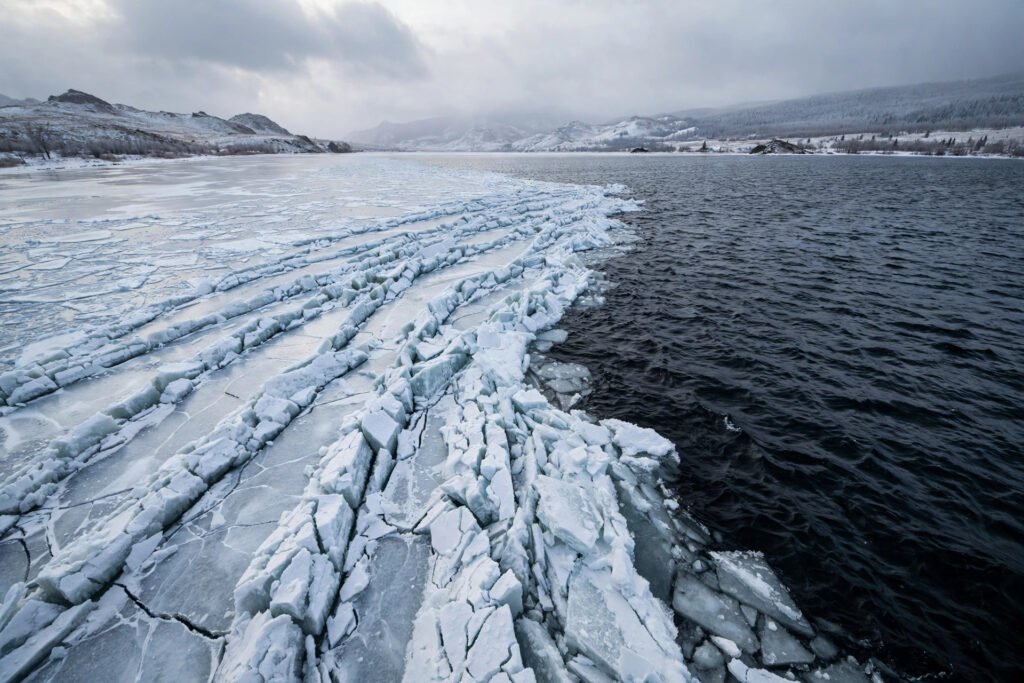
In February 2014, Lake Superior froze over 95% — a white expanse you could (foolishly) imagine walking across. That same winter, Lake Ontario barely skimmed over. And in any winter, the pond in your neighborhood locks up solid while the river running through town stays open. Why do some lakes freeze completely while others don’t? The answer is a beautiful collision of physics, geography, and weather — and it explains everything from ice-fishing seasons to why some winters bury the snowbelt and others don’t.
Depth Is Destiny: The Heat Reservoir Problem
The single biggest factor is depth. Water is densest at 39°F (4°C), and it freezes at 32°F — so a lake must cool its entire water column from summer warmth down through 39° and then to 32° before ice can form. A shallow lake holds little heat and surrenders it quickly; a deep lake holds an enormous thermal reservoir that must be exhausted first.
The numbers are stark: a 20-foot-deep lake can freeze solid in weeks of subfreezing weather. Lake Superior, averaging 483 feet deep, must dump an almost inconceivable amount of stored heat before ice even begins — which is why it freezes over completely only in the most brutal winters (a handful of times per century), while shallow Lake Erie freezes nearly every year. Depth is thermal inertia, and inertia resists change.
Size and Wind: The Mixing Problem
Big lakes fight freezing a second way: wind. On large lakes, wind-driven waves constantly mix the surface water with warmer water below, preventing the surface from sitting still long enough to freeze. Ice needs calm to form its initial crystal lattice; a wind-whipped surface keeps breaking it up. This is why even shallow large lakes freeze later than small ponds of the same depth — fetch (the distance wind travels over water) matters enormously.
Shelter changes everything. A small bay on a huge lake may freeze weeks before the open water, because surrounding land blocks the wind. Anyone who’s ice-fished knows this geography intimately: the protected coves freeze first, the main basin last, and the narrows with current may never freeze at all.
Moving Water Resists: Currents and Inflows
Current is ice’s enemy. Rivers rarely freeze completely because moving water mixes constantly and the kinetic energy resists crystal formation — only in extreme, prolonged cold do big rivers lock up, and even then the ice is treacherous where current runs beneath. Lakes with strong through-flow (short water-residence times) behave river-like: the St. Lawrence-influenced eastern end of Lake Ontario, for instance, resists freezing far longer than its depth alone would predict.
Groundwater and springs add another wrinkle. Springs feeding a lake deliver water at a constant ~50°F year-round — a local heat source that can keep patches of a small lake open all winter. Ice anglers know these spots as dangerous thin-ice zones; limnologists know them as winter refuges where fish congregate in the relatively warm upwelling.
Salt, Snow, and the Other Variables
Salinity lowers the freezing point — seawater freezes at about 28°F, which is why the ocean needs colder air to ice over. The Great Lakes are fresh, so this barely applies, but it’s the reason coastal saltwater bays behave differently from inland lakes at the same latitude. Snow cover is paradoxically an insulator: once a thin ice sheet forms, snow on top slows further thickening dramatically (ice conducts heat poorly, snow even worse). A snowy winter produces thinner ice than a clear, brutally cold one — counterintuitive, but every ice fisherman knows it.
Water clarity plays a subtle role too: clear water lets sunlight penetrate and warm deeper layers even in winter, slightly delaying ice formation, while turbid water absorbs solar energy at the surface. And altitude matters through air temperature — a mountain lake at 10,000 feet freezes months before a lowland lake at the same latitude. NOAA’s Great Lakes ice research tracks how all these variables interact across the five lakes each winter.
Why It Matters: Beyond Curiosity
Ice cover isn’t just scenery — it’s an ecological switch. Ice blocks wind mixing and light, changing the entire lake’s winter chemistry; it protects shorelines from erosion; it determines winter recreation economies (ice fishing alone is a multi-hundred-million-dollar Midwestern industry); and it feeds back into weather — frozen lakes shut off lake-effect snow, which is why the snowiest winters are often the ones where lakes freeze late, not early.
The long-term trend adds urgency: Great Lakes ice cover has declined over recent decades, with more winters of minimal ice. Less ice means more winter evaporation (potentially lowering lake levels), more lake-effect snow in early winter, and disrupted ecosystems adapted to reliable ice. The Environmental Protection Agency’s Great Lakes monitoring treats ice as a key climate indicator — a visible, measurable signal of a warming region.
For those who live with the consequences, preparation is practical: seeing Niagara Falls in winter means witnessing ice in its most dramatic form. And dressing for the frozen months is non-negotiable — how much to spend on a good winter coat is a question every Midwesterner answers through experience.
Reading Ice: What Thickness Tells You
Ice thickness is the practical output of all this physics, and the rules of thumb are worth knowing: 4 inches of clear ice for ice fishing on foot, 8–12 for a snowmobile, 12–15 for a car. But “clear” matters — white, bubbly ice (formed from slush) has roughly half the strength of clear blue-black ice. Early-season ice over deep lakes is especially treacherous because thickness varies wildly with underwater currents and springs. The physics that decides whether a lake freezes also decides whether it’s safe — and the answer is never uniform across a single lake.
Conclusion
Some lakes freeze completely and others don’t because of depth (thermal inertia), size and wind (mixing), currents (moving water resists), and secondary factors like snow insulation and inflows. Shallow, small, sheltered, still lakes freeze fast and hard; deep, vast, windswept ones may never fully ice over. It’s physics you can watch happen every winter — and in the Great Lakes, a front-row seat to how climate change is rewriting the rules.
Frequently Asked Questions
Why does a pond freeze but not the river next to it?
The pond’s still water lets ice crystals form undisturbed, while the river’s current constantly mixes warmer deep water upward and physically breaks up forming ice. Moving water needs much colder, longer cold snaps to freeze.
Has Lake Superior ever frozen completely?
Nearly — it reached about 95% ice cover in 2014 and similar levels in a few other brutal winters (1979, 1994, 2003). Complete 100% freeze-over is exceptionally rare because of the lake’s enormous depth and heat storage.
Does snow help or hurt ice formation?
Once initial ice forms, snow hurts further thickening — it’s an excellent insulator that slows heat loss from the water below. Clear, cold, snowless stretches build the thickest ice fastest.
How thick should ice be to walk on?
At least 4 inches of solid, clear ice for a person on foot. White or slush-formed ice needs double. Always check thickness with a spud bar as you go — ice varies across every lake.
Why is less lake ice a problem?
Reduced ice cover increases winter evaporation (affecting lake levels), extends the lake-effect snow season, disrupts ecosystems timed to ice cycles, and exposes shorelines to winter storm erosion.