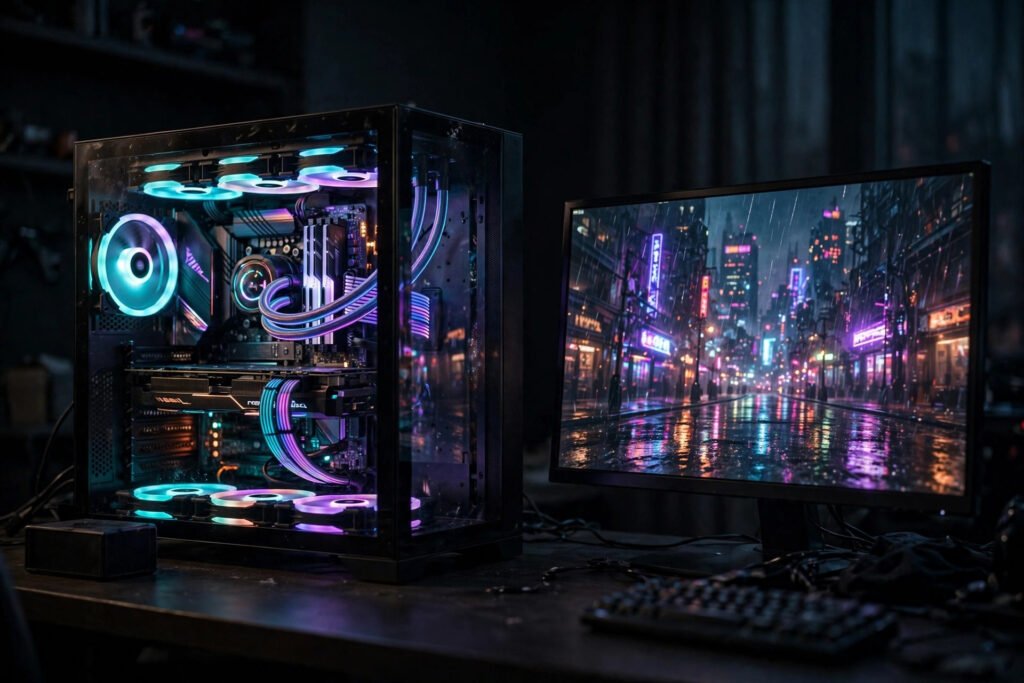
What Is Ray Tracing and Does It Matter? Explained for Gamers
Toggle ray tracing on in Cyberpunk 2077 and the game transforms: neon reflects in rain-slicked streets, sunlight bounces realistically through windows, shadows soften like the real world. Toggle it off and… it still looks great. So what is ray tracing, really — and does it matter enough to influence what GPU you buy or what settings you use? The answer is more interesting than the marketing, because ray tracing is simultaneously the biggest leap in real-time graphics in decades and, for most players, completely optional.
What Ray Tracing Actually Is
Traditional game rendering (rasterization) is a collection of clever cheats. It draws 3D scenes by projecting triangles onto the screen and faking light with approximations — shadow maps, screen-space reflections, baked lighting. These cheats are fast and, after decades of refinement, look fantastic. But they’re approximations, and approximations break: reflections show things that aren’t there, shadows have hard edges nature never makes, light doesn’t bounce.
Ray tracing replaces the cheats with simulation. It traces the path of light rays (in reverse, from the camera into the scene), calculating how each ray bounces, refracts, and gets absorbed. Reflections show the actual scene. Shadows soften with distance like real penumbrae. Light bounces off surfaces and illuminates others (global illumination). It’s how Pixar renders films — now happening in real time, 60+ times per second. NVIDIA’s RTX technology pages explain the hardware: dedicated RT cores that accelerate the ray-triangle intersection math that would crush a general-purpose GPU.
What It Changes Visually (and What It Doesn’t)
Ray tracing’s impact varies enormously by game and by effect. Ray-traced reflections are the showstopper — wet streets, mirrors, glass buildings transform completely. Ray-traced global illumination subtly but profoundly improves every indoor scene — light feels “right” in ways hard to articulate but easy to feel. Ray-traced shadows are the subtlest upgrade; most players wouldn’t notice without side-by-side comparison.
What it doesn’t change: art direction, texture quality, animation, or game design. A beautifully art-directed rasterized game (Hades, Elden Ring) beats a technically ray-traced but artistically flat one every time. Ray tracing is lighting simulation, not beauty itself — it makes good art direction more convincing, but it can’t create what isn’t there.
The Cost: Performance in Exchange for Beauty
Here’s the catch: ray tracing is enormously expensive. Enabling full ray tracing can halve frame rates or worse — the reason upscaling technologies (DLSS, FSR, XeSS) exist largely to claw back that performance. The current equilibrium: ray tracing at 1440p with DLSS Quality on a mid-range RTX card delivers a great experience; native 4K ray tracing remains flagship-GPU territory.
This creates the real decision matrix. Competitive players should leave ray tracing off — frame rate and latency beat prettier reflections in every ranked match. Single-player enthusiasts with capable hardware should try it — the immersion upgrade in the right game is genuine. Everyone in between: enable it selectively (reflections on, full global illumination off) or use it as a screenshot mode. AMD’s ray tracing implementations have narrowed the gap with NVIDIA, but NVIDIA still leads in RT performance per dollar — a factor in GPU buying decisions.
Does It Matter for Your Next GPU?
For GPU shopping, ray tracing matters as future-proofing more than present necessity. The trajectory is clear: each GPU generation makes ray tracing cheaper, more games implement it well, and the industry is converging on ray tracing as the eventual standard (the PS5 and Xbox Series consoles both support it, guaranteeing developer investment). Buying a GPU with weak ray tracing today means missing the visual standard of 2027’s games.
But don’t overpay for it now. The rational buy: the best rasterization performance per dollar in your budget, with ray tracing capability as a tiebreaker. A card that’s 20% faster in traditional rendering but 10% slower in ray tracing is the better buy today — most of your gaming hours will be rasterized for years. The exception: if you specifically play showcase RT titles (Cyberpunk, Alan Wake 2, Portal RTX), weight ray tracing heavily.
The Bigger Picture: Beyond Pretty Reflections
The most exciting ray tracing application isn’t visual — it’s developmental. Rasterization’s cheats require enormous artist labor: baking lightmaps, placing reflection probes, hand-tuning shadow cascades. Ray tracing automates all of it — artists place lights and the simulation handles the rest. This is why smaller studios are adopting it: it reduces the lighting labor that only AAA teams could afford. The long-term promise isn’t just better-looking games; it’s better-looking games from teams of twenty instead of two hundred.
And the technology keeps compounding: path tracing (full-scene ray tracing, no rasterization at all) is already playable in titles like Cyberpunk’s Overdrive mode on flagship hardware — a glimpse of the all-ray-traced future. For context on the visual pipeline generally, how AI image generation works covers the other revolution in computer graphics. And if your display is the bottleneck, troubleshooting smart TV streaming issues helps ensure your screen does the GPU justice.
Ray Tracing on Consoles: The Quiet Revolution
The PlayStation 5 and Xbox Series X|S both support hardware ray tracing, and their adoption has done more for the technology than any PC launch. Console ray tracing is typically selective — reflections here, shadows there, rarely full global illumination — because the fixed hardware budget demands trade-offs. But it guarantees that every major multi-platform game of this generation considers ray tracing in its design, which normalizes the technology for the entire industry.
For console players, the practical choice is usually a menu toggle: fidelity mode (ray tracing on, 30fps) versus performance mode (ray tracing off or reduced, 60fps). Most players choose performance once they’ve tried both — a telling data point about where ray tracing sits in the hierarchy of what actually matters moment-to-moment. The technology’s console future is assured; its per-game impact remains a case-by-case question.
Conclusion
Ray tracing is real-time light simulation replacing decades of rendering cheats — delivering dramatically better reflections, more natural global illumination, and subtler shadows at a steep performance cost. It matters as the industry’s clear future and as a genuine immersion upgrade in the right games, but it doesn’t matter for competitive play, and it shouldn’t dominate GPU buying decisions today. Toggle it on for the screenshot; toggle it off for the ranked grind. The technology will be waiting when you’re ready.
Frequently Asked Questions
What is ray tracing in simple terms?
Simulating how light rays actually travel and bounce in a 3D scene, instead of faking lighting with approximations. It produces realistic reflections, soft shadows, and natural bounced light — at high computational cost.
Does ray tracing make a big visual difference?
For reflections and global illumination, yes — dramatically in the right scenes. For shadows, subtly. It can’t fix weak art direction, but it makes good art direction far more convincing.
Is ray tracing worth the FPS loss?
For single-player immersion with upscaling enabled, usually yes. For competitive multiplayer, no — frame rate and latency matter more than lighting. Most players land in the middle: selective RT effects.
Do I need an RTX card for ray tracing?
NVIDIA RTX cards lead in ray tracing performance, but AMD’s RX 6000/7000 series and Intel Arc also support it, as do current consoles. The feature isn’t NVIDIA-exclusive — just NVIDIA-optimized.