Link Farming Examples: How to Spot Risky Backlinks in 2026
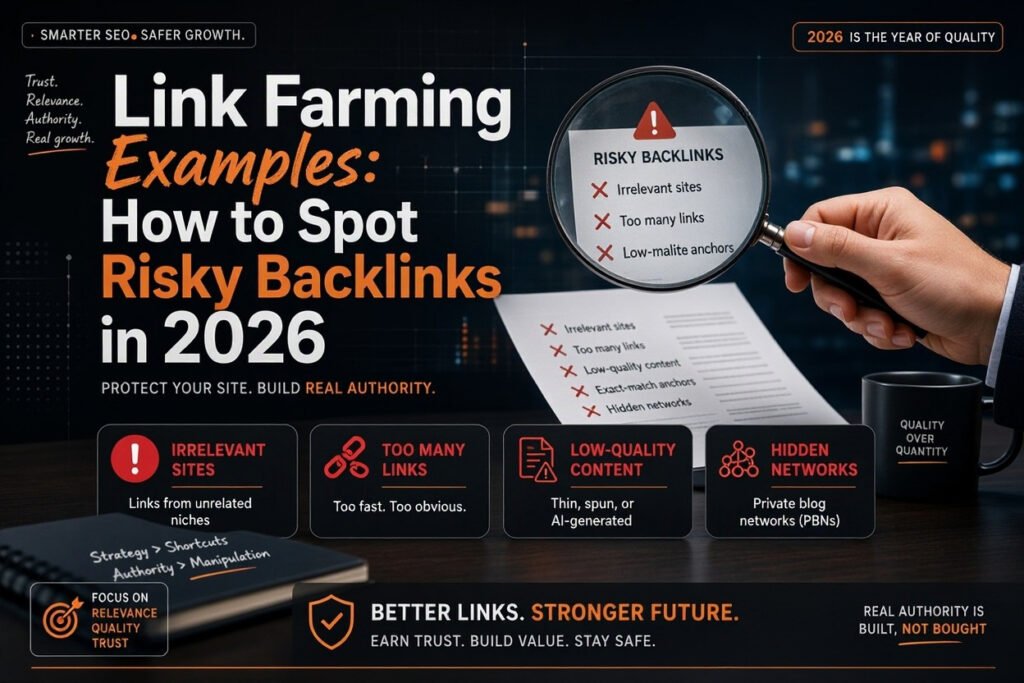
A sudden jump in backlinks can look like a marketing win, but the source matters more than the number. Link farming examples range from obvious pages packed with unrelated links to networks of ordinary-looking blogs built mainly to promote one another. For a business owner, creator or marketer, recognizing the difference helps protect a website’s reputation and keeps link-building effort focused on real readers.
What Is Link Farming?
Link farming is the practice of creating or using a group of websites primarily to generate links that influence search rankings. The sites may link to each other, sell placements, or publish large volumes of articles with links to unrelated businesses. Their common feature is that the links exist mainly for ranking signals, not because they help a reader discover useful information.
Not every directory, guest article or reciprocal link is a link farm. A local business directory can help people find a service, and a relevant guest article can introduce an expert to a new audience. The warning sign is a pattern of artificial links with little editorial judgment, audience value or connection between the page and the destination. For a more detailed overview of how to identify link farms, look at both the pages and the way they link.
Common Link Farming Examples
- Pages of unrelated outbound links: A site about home repairs suddenly publishes pages linking to payday loans, online games, supplements and app developers, with little useful discussion around them.
- Articles written around a link slot: Posts repeat generic advice, use awkward anchor text and insert a commercial link that has no clear reason to be there.
- Interlinked clusters of low-value sites: Several blogs share similar layouts, thin content and overlapping ownership details, while repeatedly linking to the same handful of pages.
- Automated or scraped pages: A site republishes text from elsewhere or generates pages at scale, often with links added to make the content appear commercially useful.
- Paid placements with no meaningful review: A publisher accepts almost any topic and destination as long as a fee is paid, without considering whether the article serves its audience.
One clue alone does not prove manipulation. A small site may have limited design resources, and a new blog may cover several subjects while finding its focus. Look for repeated patterns: thin pages, irrelevant links, identical article structures, and an apparent lack of actual readers or editorial standards.
How to Check a Website Before Accepting a Link
Start by reading several recent articles, not just the page where your link would appear. Ask whether the writing answers a real question, whether the site has a consistent topic or identifiable audience, and whether its links make sense in context. Check the outbound links too. If nearly every article points to a different commercial site using sales-focused wording, that is a stronger concern than a single sponsored post.
Look at the site’s history and quality, but do not treat a single SEO metric as a verdict. Traffic estimates and authority scores are third-party indicators, not proof of genuine readership. A more practical test is whether you would send a customer, colleague or friend to the page even if search engines did not exist. If the answer is no, the placement may not be worth pursuing.
For guest posting, evaluate the publisher as carefully as the article idea. A platform such as guest-posting opportunities may help you discover potential placements, but the responsibility to assess relevance and editorial quality remains yours. Avoid submitting the same thin article to many sites or forcing exact-match keywords into every link. Useful, original material and a natural citation are better signals to readers than a link inserted for its own sake.
Why Businesses Should Care
Search engines have policies against manipulative link schemes, and links that violate those policies can be ignored or lead to ranking consequences. Even without a formal penalty, low-quality placements can waste a marketing budget and send the wrong impression to potential customers. A backlink is part of your public footprint: people can click it, judge the surrounding article and decide whether your brand looks trustworthy.
This matters especially for businesses making larger digital investments. A founder budgeting for an app, for instance, may need to plan development and launch marketing together. Osdire’s mobile app cost breakdown can help frame development expenses; link promotion is a separate decision, and it should not be treated as a shortcut that guarantees visibility. Set aside time for useful product pages, clear documentation, customer stories and outreach to publishers whose readers might genuinely benefit.
A Safer Way to Build Backlinks
- Create something worth citing. Original research, a clear guide, a useful tool or a well-explained case study gives other writers a real reason to link.
- Choose relevance over volume. A handful of links from respected, topic-related publications can be more useful than hundreds from unrelated pages.
- Review every placement. Read the finished article, check the destination and make sure the link fits naturally for a human reader.
- Keep records. Track where links appear, what was promised and whether the content remains live. This makes it easier to review questionable placements later.
The Takeaway
Link farming often reveals itself through a combination of irrelevant topics, thin content, repetitive link patterns and little evidence of an audience. Do not judge a site by one metric or one imperfect article; assess its overall purpose and editorial standards. When a link adds context and helps readers, it can support discovery. When the link is the only reason the page exists, walk away and invest in work people would value even without a ranking benefit.