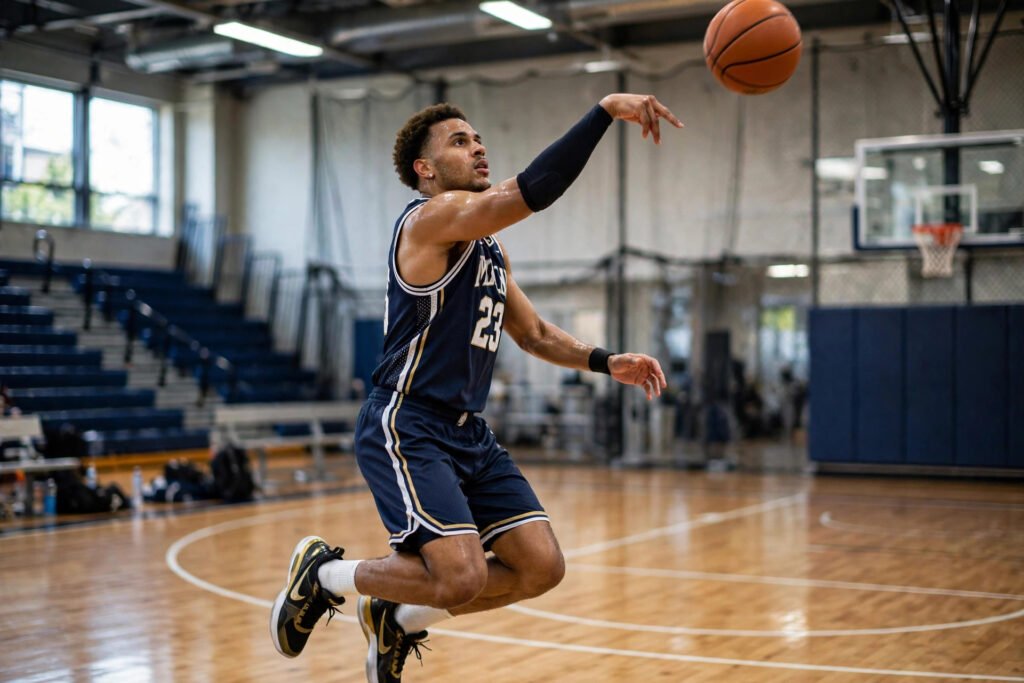
How to Improve Your Three-Point Shooting Form
The three-pointer has gone from novelty to necessity — at every level of basketball, the ability to shoot from deep stretches defenses and swings games. But most players practice the three-point shot completely wrong: launching rep after rep from NBA range with broken mechanics, grooving bad habits deeper with every miss. Range is built on form, not the other way around.
This guide breaks down how to improve your three-point shooting form with the biomechanics that actually matter, a progression that builds range safely, and the drills that turn practice into game shooting.
The Foundation: BEEF and the Kinetic Chain
Coaches have taught the BEEF principle for decades because it works: Balance, Eyes on target, Elbow under the ball, Follow-through. But modern shooting science frames it as a kinetic chain — power flows from the ground up. Your legs generate the force, your core transfers it, and your shooting arm directs it. Players who shoot “all arms” from deep inevitably develop flat, short, inconsistent shots.
Start with your base: feet roughly shoulder-width, shooting-side foot slightly forward, knees loaded. The dip — a slight downward motion as you catch or gather — is not wasted movement; it loads the legs like a spring. Watch the best shooters in the league and you will see the same rhythmic dip-and-rise on every jumper. NBA.com posts slow-motion shooting breakdowns that make this visible in a way real-time never does.
Hand Placement and the Guide Hand Problem
Your shooting hand goes under the ball, fingers spread, with the ball resting on the finger pads — not the palm. Palm contact kills touch and backspin. The guide hand sits on the side, and its only job is balance; it should fall away at release without influencing the shot. The guide hand “thumbing” the ball — pushing it sideways — is the most common mechanical flaw in amateur shooters and the hardest to self-diagnose because you cannot see it.
Film yourself from the front. If the ball veers left or right inconsistently, suspect the guide hand. The one-hand form shooting drill (below) exposes it immediately — without the guide hand, your shooting hand learns to do the work alone.
Arc, Backspin, and the 45-Degree Target
Physics favors arc. Research on shooting trajectories shows the optimal entry angle into the basket is around 45 degrees — a shot entering at 45 degrees “sees” a rim nearly twice as large as a flat shot. Most amateurs shoot far too flat from three-point range because they are muscling the ball there. The fix is counterintuitive: more legs, higher finish.
Backspin is the other half of the soft touch equation. Proper backspin — generated by the fingers rolling off the ball at release — makes the ball die on the rim instead of bouncing hard off it. You should see the seams rotating backward in flight. Finish every shot with your shooting hand in the cookie jar: wrist snapped down, fingers pointing at the rim, held until the ball hits something. The follow-through is not decoration; it is the mechanism of backspin.
The Range Progression: Earn Your Distance
Here is the progression that actually builds a three-point shot: Step 1: perfect form from 8–10 feet. Make 80%+ with textbook mechanics before moving back. Step 2: free-throw line extended, then the elbows of the key. Step 3: college three, then NBA three — only as far as you can shoot without changing your mechanics. The moment your form breaks down (leaning, jumping forward excessively, flat trajectory), you have gone too far. Step back in.
This feels slow, and it is — expect weeks, not days. But every great shooter built range this way. Rushing to NBA distance with bad form just teaches your body to shoot badly from far away. Strength matters too: a structured workout routine with leg and core strength work adds range far more safely than heaving up extra reps. Most players add reliable range in 6–10 weeks of consistent progression, not days — patience is the separator here.
Drills That Transfer to Games
Form shooting (daily): 50–100 makes from close range, one hand, perfect mechanics. Boring, non-negotiable, transformative. Spot shooting with a consequence: shoot 10 from five spots; you must make 7 of 10 to advance. Adds pressure that mimics games. Off-the-catch reps: have a partner pass as you step into the shot — game threes come off movement, not standing still. Fatigue shooting: sprint the court, then shoot two free throws or threes. Games are played tired; practice should include it.
The 100-make workout: track makes, not attempts, from game spots. Chart your percentages weekly — what gets measured gets improved. Practice at game speed weekly: shoot 50 threes alternating spots with a partner rebounding — the closest practice gets to real game rhythm. USA Basketball publishes excellent youth-appropriate shooting progressions that work just as well for adults rebuilding their shot.
Fixing the Common Flaws
Short everything: not enough legs — dip deeper and explode up. Inconsistent left-right: guide-hand interference or elbow flare — film from the front. Flat trajectory: finishing low — hold the follow-through high. Hitch or pause: usually from thinking mid-shot — shoot on rhythm with a quicker dip. Fading away: jumping backward to create space you do not have — square up and go straight up; range comes from legs, not lean.
One more: stop changing your shot every week based on the latest video. Pick sound mechanics, commit for a full month of deliberate practice, then evaluate. Constant tinkering is the enemy of the muscle memory you are trying to build. If you are cramming sessions around a packed schedule, our guide to exercising with a busy schedule and no gym shows how to fit meaningful practice into small windows.
The Bottom Line
Better three-point shooting is built, not wished for: legs generate power, the shooting hand directs with backspin, the guide hand stays out of the way, and range is earned step by step from close to far. Film yourself, drill form daily, track your makes, and give it a month. The arc will rise, the percentages will follow, and defenders will have to guard you out there — which changes everything. ESPN’s shooting analytics coverage is a great way to see how the best in the world apply these same principles.
Frequently Asked Questions
What is the ideal arc for a three-point shot?
Around 45 degrees of entry angle into the basket is considered optimal — it maximizes the effective size of the rim. Most amateur shooters shoot too flat, especially from deep; more leg drive and a higher follow-through add arc.
How long does it take to improve three-point shooting?
With daily deliberate practice (form shooting plus progressive range work), most players see meaningful improvement in 4–8 weeks. Rebuilding deeply grooved bad mechanics can take a full offseason.
Should I jump higher on three-pointers?
Not necessarily. Elite shooters use relatively modest vertical on set threes — the power comes from the leg drive and rhythm, not jump height. Excessive jumping usually hurts balance and consistency.
Why is my three-point shot inconsistent?
The most common culprits are guide-hand interference, inconsistent footwork/base, and shooting from beyond your true range. Film yourself from the front and side — the flaw is usually visible within a few shots.