How to Improve Your Guitar Fingerpicking Technique Fast
Fingerpicking is the guitar’s great divider: strumming gets you through songs, but fingerpicking gets you inside them — the rolling Travis patterns of folk, the classical precision of études, the percussive independence of modern fingerstyle. Every guitarist who has watched a fingerstyle player with envy knows the feeling: how do the thumb and fingers do different things at the same time without the brain melting?
The answer is that fingerpicking is not talent — it is a trainable motor skill with a specific learning sequence. This guide lays out that sequence: the hand mechanics, the foundational patterns, the practice method that builds independence, and the troubleshooting for the plateaus everyone hits.
The Mechanics: Hand Position First
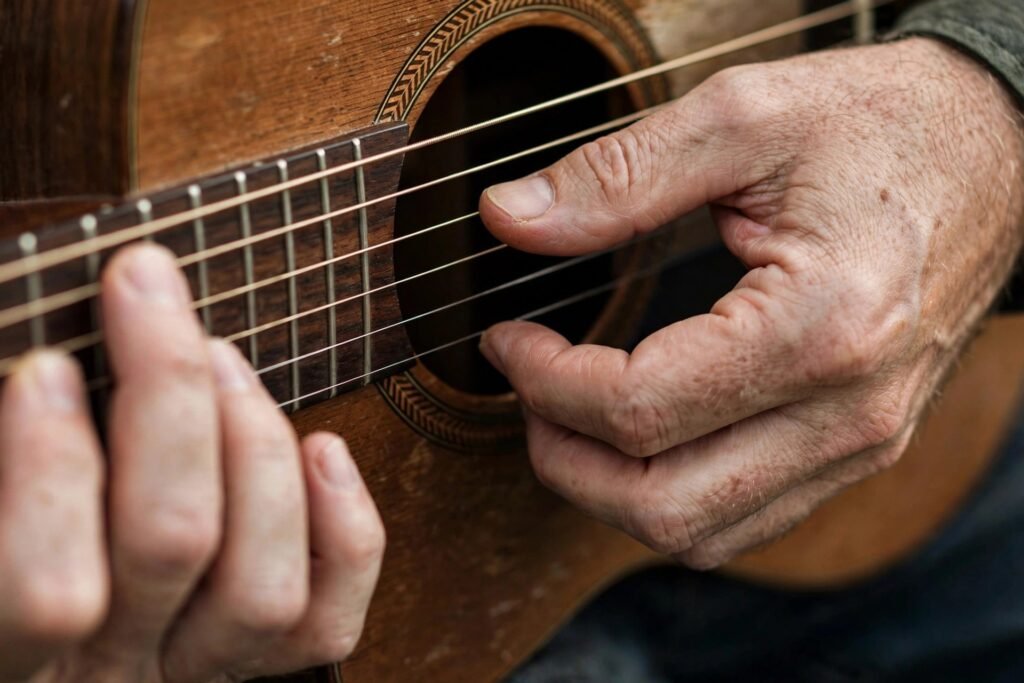
Everything downstream depends on setup. Right hand (for right-handed players): wrist slightly arched, hand floating above the strings near the soundhole — not anchored rigidly, not flopping. The thumb handles bass strings (E, A, D) with a relaxed downstroke motion from the big knuckle; index, middle, and ring fingers each take one treble string (G, B, high E) with an upward pluck that follows through into the palm slightly.
The classical assignments (PIMA): P (pulgar/thumb) → bass strings; I (indice/index) → G string; M (medio/middle) → B string; A (anular/ring) → high E. This one-finger-per-string mapping is the foundation — independence is built on it before patterns get fancy. Nails vs. flesh: classical players grow shaped nails for clarity and volume; folk/steel-string players often use flesh or fingerpicks. Flesh gives warmth, nails give definition — neither is wrong, but pick one and commit while learning, since the attack feel differs completely.
Left hand: fingerpicking exposes sloppy fretting mercilessly — every buzz and muted string rings clear without strumming to hide behind. Keep fingertips close to the frets, arch fingers to avoid touching adjacent strings, and fret with minimum pressure (excess tension migrates to the right hand and kills fluidity).
The Tension Audit
Tension is fingerpicking’s silent killer. Every few minutes, run the audit: shoulders down? Jaw unclenched? Breathing normally? Right-hand fingers curved and relaxed, not clawed? Thumb loose at the joint? Most plateaus are tension plateaus wearing a technique disguise. If a pattern will not clean up after a week, the problem is usually grip-of-death in the right hand, not the pattern.
The Foundational Patterns (In Order)
Learn these sequentially — each builds the independence the next requires:
1. Thumb isolation. Muted strings, thumb alone: steady quarter-note bass on E and A, alternating. Boring for three days, then automatic forever. The thumb must become a metronome that never stops, regardless of what the fingers do — this is the entire game.
2. Pinch pattern. Thumb + one finger together on beats (P+I, P+M, P+A). Teaches coordination without independence — the training wheels.
3. Alternating thumb with finger melody. Thumb keeps quarter notes while index plays a simple melody on the treble strings. The first real independence exercise — expect the thumb to follow the fingers for a week. It won’t, eventually.
4. Travis picking. The folk/country cornerstone: alternating thumb bass (E-A-E-A or root-fifth patterns) with syncopated finger melody on top. Start painfully slow (60 BPM) with a metronome; speed is a byproduct of accuracy, never the goal. Merle Travis, Chet Atkins, and a thousand folk songs run on this engine.
5. Arpeggio patterns (P-I-M-A-M-I). The classical gateway — rolling across chord shapes. Practice over simple chord progressions (C-G-Am-F), keeping volume even across all fingers (the ring finger is naturally weakest; give it extra attention).
The Practice Method That Actually Works
Slow is fast. Practice at half the speed where you can play perfectly — literally half. Speed built on sloppy foundations is just fast sloppiness; the nervous system myelinates whatever you repeat, including mistakes. Use a metronome always; increase tempo 4 BPM at a time only when the current tempo is effortless.
Isolate, then integrate. Can’t do the full pattern? Play just the thumb part until it’s unconscious. Then just the finger part. Then combine at half speed. Independence is built by making each layer automatic separately — the brain can only run one conscious process at a time.
Short, daily, focused. 20-30 minutes of deliberate pattern practice beats 2-hour weekend noodling. And “deliberate” means: one pattern, metronome on, attention on the specific weakness (usually the weak finger or the rushing thumb). Mindless repetition myelinates mindlessness.
Record yourself weekly. Phone recordings reveal uneven volume, rushing, and buzzing that your in-the-moment ears miss. The weekly recording is the most honest teacher you will ever have.
Structure your sessions the way good teachers structure lessons — our look at how teachers plan lessons covers the isolate-drill-integrate architecture that applies directly to practice design. And keep your ears growing alongside your hands: finding new music you love feeds the repertoire hunger that sustains years of practice.
Troubleshooting the Classic Plateaus
“My thumb follows my fingers.” Normal for weeks 2-6. Fix: exaggerate the separation — play thumb louder and fingers softer until the independence locks in, then rebalance volume.
“My ring finger is useless.” Anatomically normal — the ring finger shares a tendon with the middle finger. Fix: dedicated A-finger exercises (slow arpeggios emphasizing the ring finger, 5 minutes daily). It improves; it never fully equals the others, and every fingerstylist works around this.
“I rush the beat.” The metronome is not optional. Also: practice with the metronome clicking on beats 2 and 4 only (like a snare), which forces internal timekeeping on 1 and 3.
“It sounds uneven/muddy.” Usually nail/flesh inconsistency or fretting-hand muting. Fix: record, identify whether it’s attack (right hand) or clarity (left hand), and isolate that hand’s drill.
“I can’t sing and fingerpick simultaneously.” Nobody can at first — it’s genuine multitasking of two independent rhythmic layers. Fix: get the picking unconscious first (months), then add humming, then words. The picking must require zero conscious attention before the voice joins.
Repertoire: Songs That Teach
Learn patterns inside songs, not as abstract exercises: “Dust in the Wind” (Travis picking etude disguised as a hit), “Blackbird” (independence with melody), “Landslide” (thumb-finger coordination), “Tears in Heaven” (arpeggio control), classical: Carcassi’s Op. 60 études (graded fingerstyle curriculum in 25 pieces). Each song should be slightly above your level — the stretch zone, not the panic zone.
The GRAMMY site’s artist features regularly spotlight fingerstyle players worth studying, and Guitar World publishes technique lessons from touring fingerstylists.
Conclusion
Improving fingerpicking technique is a motor-learning project with a known sequence: lock in hand mechanics and kill tension, build thumb independence first, learn patterns in order (pinch → alternating → Travis → arpeggios), practice slow with a metronome in short daily sessions, isolate-then-integrate every new skill, and troubleshoot plateaus as the normal curriculum rather than personal failure. The thumb-finger independence that looks like magic is just myelination — your nervous system, given correct slow repetitions, will do the rest.
Frequently Asked Questions
How long does it take to learn fingerpicking?
Basic Travis picking: 2-3 months of daily practice. Comfortable independence across patterns: 6-12 months. Advanced fingerstyle fluency: 2+ years. The timeline compresses dramatically with slow, metronome-disciplined practice versus casual noodling.
Should I use nails or fingertips for fingerpicking?
Flesh gives warmth (folk/steel-string standard); shaped nails give clarity and volume (classical standard). Choose one while learning — the attack feel differs completely. Many steel-string players use a hybrid: short nails with flesh contact.
Why does my thumb follow my fingers when fingerpicking?
Normal for the first weeks — the brain initially treats the hand as one unit. Fix by exaggerating separation (thumb louder, fingers softer) at slow tempos until independence locks in, usually within a month of focused practice.
What is Travis picking?
An alternating-thumb bass pattern (root-fifth-root-fifth) with syncopated finger melody on top — the engine of folk, country, and much pop fingerpicking. Named for Merle Travis; start at 60 BPM with a metronome.
Can I learn fingerpicking without a teacher?
Yes, with discipline — the patterns and methods are well documented. But a teacher catches tension and hand-position problems months before you’d notice them yourself. Even monthly check-in lessons dramatically accelerate progress.