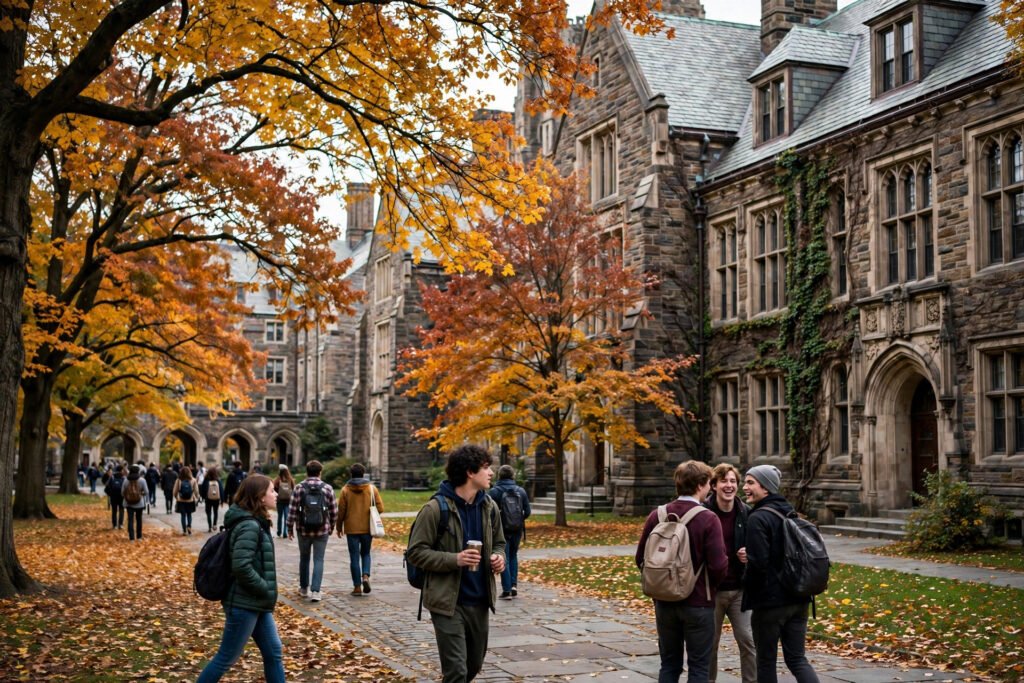
How to Get Into the University of Michigan as an Out-of-State Student
The University of Michigan is the crown jewel of public universities — a top-ranked research powerhouse with Big Ten athletics, a gorgeous Ann Arbor campus, and an alumni network that opens doors worldwide. It is also brutally competitive for out-of-state students. Michigan’s overall acceptance rate hovers around 18–20%, and the out-of-state admit rate is notably lower than the in-state rate, because the university is legally and culturally bound to serve Michigan residents first.
This guide explains exactly how to get into the University of Michigan as an out-of-state student: what the numbers really look like, what admissions officers prioritize, and how to build an application that stands out in the most competitive applicant pool in public higher education.
The Numbers: What You Are Up Against
Start with clear eyes. Michigan receives well over 90,000 applications for a freshman class of roughly 7,500, and out-of-state students face longer odds than Michiganders — the university targets roughly half its class from in-state. Admitted out-of-state students typically present GPAs in the 3.9+ range (unweighted) and SAT scores in the 1400–1540 band or ACT 32–35, though Michigan’s test-optional policy means strong scores help but are not strictly required.
The financial reality matters too: out-of-state tuition and fees run roughly $60,000+ per year before room, board, and expenses, pushing the total cost of attendance toward $80,000+ annually. Michigan does offer merit and need-based aid to non-residents, but it is less generous than for in-state students. Run the net price calculator on the U-M Office of Undergraduate Admissions site early — before you fall in love — so your family can plan honestly.
Academics: Rigor First, GPA Second
Michigan admissions officers read transcripts for rigor before anything else. A 3.8 with a brutal course load (AP/IB, dual enrollment, honors) beats a 4.0 in standard classes. For out-of-state applicants, the academic bar is the primary filter — you need to show you can thrive among students who were the top of their Michigan high schools.
Course selection should align with your intended major. Applying to the College of Engineering? They want to see calculus, physics, and chemistry at the highest level your school offers, with strong grades. Ross School of Business? Quantitative strength plus evidence of leadership and initiative. LSA (Literature, Science, and the Arts)? Breadth and depth across disciplines. Tailor your senior-year schedule to your story. If your school offers college-level courses, our guide to using AI tools productively for coursework can help you handle the heavier load.
The Essays: Where Out-of-State Applicants Win or Lose
When 90,000+ applicants have strong numbers, essays decide. Michigan requires the Common App personal statement plus U-M-specific supplemental essays, including the famous “Why Michigan?” essay. Generic praise (“world-class faculty,” “beautiful campus,” “school spirit”) is the fastest route to the rejection pile — every applicant writes that.
A winning “Why Michigan?” essay names specifics: a particular research lab, a professor whose work you have actually read, a unique program (like the Michigan Research and Discovery Scholars or a specific engineering project team), and connects it to what you have already done. Show the admissions officer you have done homework that goes beyond the viewbook. The same specificity principle applies to the personal statement — concrete stories beat abstract claims every time. For the practical side of getting ready for campus, see our guide to choosing the right laptop for college.
Extracurriculars: Depth Over Breadth
Michigan is not impressed by twelve clubs with no leadership. They are impressed by two or three commitments pursued with unusual depth: the student who built a nonprofit’s tutoring program to 50 volunteers, the debater who made nationals, the coder with a shipped app. Leadership, initiative, and impact are the currencies.
For out-of-state applicants, distinctive achievements help overcome the geographic disadvantage. National-level recognition in anything — athletics, music, research, entrepreneurship — signals that you will contribute to campus at a high level. And do not neglect the “community” essay angle: Michigan values students who build community, so evidence that you made your school or town better carries real weight.
Demonstrated Interest and Early Action
Michigan offers Early Action (typically a November 1 deadline) with decisions by late January, and applying Early Action is strategically smart: it signals strong interest, and the admit rate for Early Action has historically been more favorable than Regular Decision. Michigan does not track demonstrated interest in the traditional sense (no points for campus visits), but Early Action plus specific, well-researched essays functions as demonstrated interest in practice.
One caution: Early Action at Michigan is non-binding, so there is little downside. Get your application in early, and use the extra months to strengthen your senior-year grades — Michigan, like all selective schools, cares about mid-year reports. Check studentaid.gov for FAFSA timing, since financial aid deadlines are separate and unforgiving.
Letters of Recommendation and the Rest
Michigan requires one counselor recommendation and one teacher recommendation (with an optional second teacher rec). Choose teachers from junior year core academic subjects who know you as a thinker, not just a grade-earner. Give them a “brag sheet” — a one-page summary of your accomplishments, intended major, and key stories — at least a month before the deadline. Great recs describe specific moments; help your teachers remember yours.
Standardized tests remain optional, but strong scores (1500+ SAT, 34+ ACT) still help out-of-state applicants, particularly for Engineering and Ross. If your scores are below the middle 50%, withhold them — a test-optional application with a stellar transcript beats a mediocre score every time. College Board resources can help you decide whether retesting is worth it.
Paying for It: The Out-of-State Aid Picture
Be strategic about money. Michigan meets full demonstrated need for in-state students but is less comprehensive for out-of-state students — expect a gap. Merit scholarships for non-residents exist but are highly competitive. Apply for every external scholarship you can find starting junior year, and have an honest family conversation about the four-year total cost (easily $300,000+ at full price) versus your other options. A full ride at a strong state flagship versus full-price Michigan is a legitimate debate — do not let prestige make it for you.
Also consider: some out-of-state students establish Michigan residency after the first year to get in-state tuition, but Michigan’s residency rules are strict — you generally cannot gain residency while enrolled as a student. Do not plan your finances around it.
The Bottom Line
Getting into Michigan as an out-of-state student requires near-perfect academics in the most rigorous courses available, essays with genuine specificity, deep extracurricular impact, and an Early Action application. It is a reach for everyone — treat it as one, build a balanced list, and make your Michigan application the best-written one you submit. If you get in, you will have earned it.
Frequently Asked Questions
What GPA do you need to get into Michigan out of state?
Admitted out-of-state students typically have unweighted GPAs of 3.9+, with most of the class in the 3.8–4.0 range. Course rigor matters as much as the number — AP/IB-heavy transcripts are the norm.
Is it harder to get into Michigan as an out-of-state student?
Yes. Michigan prioritizes in-state applicants and aims for roughly half the class from Michigan, so out-of-state acceptance rates are lower than the published overall rate of around 18–20%.
How much is out-of-state tuition at Michigan?
Out-of-state tuition and fees are roughly $60,000+ per year, with total cost of attendance (including room, board, and expenses) around $80,000+ annually. Use the university’s net price calculator for your family’s estimate.
Does Michigan offer merit scholarships to out-of-state students?
Yes, but they are limited and highly competitive. Most out-of-state aid is need-based, and the university meets a smaller share of demonstrated need for non-residents than for Michigan students.