How to Find Manufacturing Jobs in the Midwest (2026 Guide)
The Midwest makes things — and despite decades of “manufacturing is dead” headlines, the region’s factories are hiring. From auto plants in Michigan and Ohio to food processing in Iowa, steel in Indiana, and advanced manufacturing across Illinois and Wisconsin, the Midwest holds roughly a third of U.S. manufacturing jobs. Many employers cannot fill openings fast enough, wages have risen sharply, and modern manufacturing looks nothing like the dark, dangerous stereotype. If you want stable, well-paid work without a four-year degree, this is one of the best opportunities in the American economy right now.
Here is how to find manufacturing jobs in the Midwest: where the jobs actually are, what employers are hiring for, the training paths that get you in the door, and how to stand out in the application process.
Where the Manufacturing Jobs Are
By state and sector
Michigan and Ohio anchor automotive — assembly plants, parts suppliers, and the EV battery plants reshaping the industry. Indiana leads in steel and RV manufacturing (Elkhart is the RV capital of the world). Illinois combines food processing, machinery, and fabricated metals around Chicago, Rockford, and Peoria. Wisconsin dominates in paper, food processing, and industrial equipment. Iowa and Minnesota lean toward food processing and agricultural equipment. Knowing your state’s clusters focuses the search enormously — the Bureau of Labor Statistics publishes state-level manufacturing employment data that shows exactly which sectors are growing where.
The advanced manufacturing wave
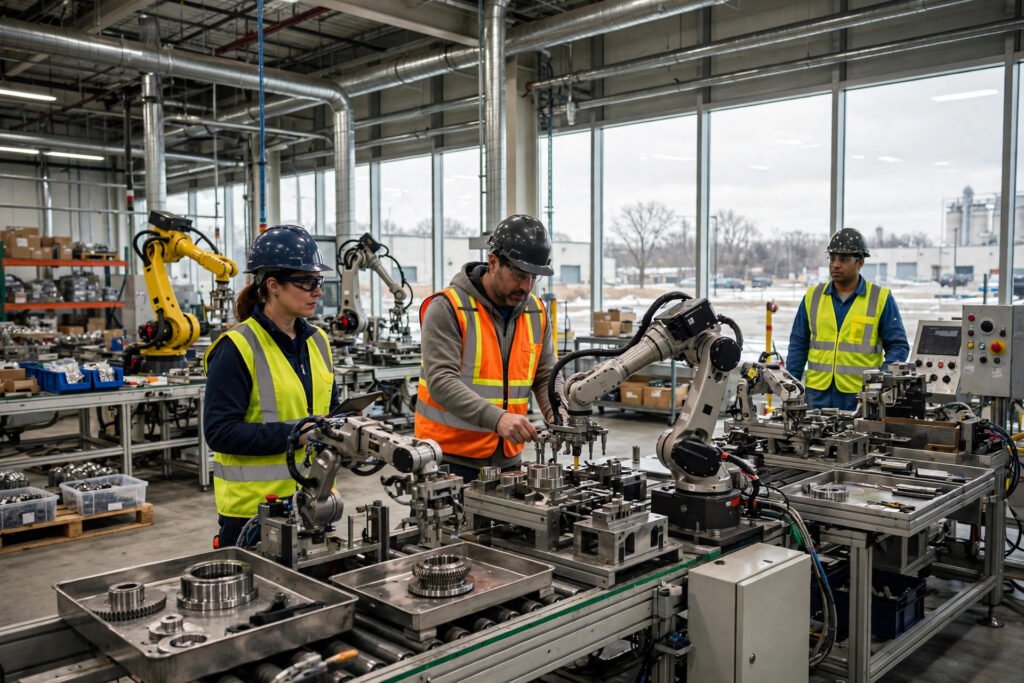
The fastest-growing segment is advanced manufacturing: robotics operation, CNC machining, industrial maintenance, quality engineering, and automation technology. These roles pay $25 to $40-plus per hour, require technical certificates rather than degrees, and face the worst labor shortages — which means the most negotiating leverage for qualified candidates. The stereotype of the assembly line is outdated; the modern plant floor runs on programmers and technicians.
What Employers Are Actually Hiring For
Entry-level production roles (assemblers, machine operators, material handlers) hire continuously with minimal requirements — reliability and willingness to work shifts matter more than experience. Skilled trades roles (welders, machinists, electricians, millwrights, HVAC techs) command the highest pay and the most competition for talent; these are the jobs where employers offer signing bonuses. Technical roles (quality technicians, automation specialists, maintenance techs) sit in the middle — certificate programs feed directly into them.
Across all levels, employers screen for the same things: consistent work history, basic math and measurement skills, safety mindset, and shift availability. Manufacturing runs around the clock — second and third shifts often pay premiums of $2 to $5 per hour, and willingness to work them opens far more doors.
Training Paths That Get You Hired
Community college certificates
The highest-ROI path for most people. Midwest community colleges offer 6-to-18-month certificates in welding, CNC machining, industrial maintenance, robotics, and mechatronics — often for a few thousand dollars, frequently with employer partnerships that lead directly to job offers. Many programs report placement rates above 80 percent. This is the single best investment a manufacturing job seeker can make.
Registered apprenticeships
Earn while you learn: apprenticeships combine paid on-the-job training with classroom instruction, typically over 2 to 4 years, ending in journeyman credentials. The U.S. Department of Labor’s apprenticeship finder lists registered programs by location — Midwest manufacturers in skilled trades run some of the strongest programs in the country.
Direct entry and temp-to-hire
Many plants hire entry-level production workers directly or through staffing agencies with temp-to-hire arrangements. It is a legitimate foot in the door: prove reliability for 90 days, get hired permanently, then access the company’s internal training and tuition programs. Do not dismiss staffing agencies — in manufacturing, they are a primary hiring channel, not a last resort.
How to Stand Out in Applications
Manufacturing resumes differ from office resumes: lead with measurable reliability (attendance records, tenure), certifications and technical skills (forklift, welding processes, blueprint reading, GD&T), and safety credentials (OSHA 10/30 cards impress hiring managers enormously). Quantify everything: “operated 5 CNC machines,” “maintained 99% attendance over 3 years,” “reduced scrap 12%.” A tailored resume for skilled roles follows specific conventions — the principles behind using AI to help write your resume can speed up drafting, but the content must be yours: real skills, real numbers, real reliability.
And consider the long game: manufacturing trades rank among the occupations least vulnerable to automation displacement — the jobs safest from AI automation are disproportionately the hands-on skilled trades, because robots still cannot weld a custom joint or troubleshoot a failing press. You are not just finding a job; you are entering one of the most automation-resistant career families in the economy.
Where to Look: Job Sources That Work
Beyond the big job boards: your community college’s career services (employers recruit directly from certificate programs), state workforce centers (free, underused, and connected to local manufacturers), union halls for skilled trades, manufacturer career pages directly (many plants hire only through their own sites), and staffing agencies specializing in industrial placements. Networking matters more than people expect — manufacturing is a relationship industry, and referrals from current employees carry enormous weight. Tell everyone you know you are looking; plant-floor referrals are the number-one hiring channel.
Interviewing for Manufacturing Roles
Manufacturing interviews differ from office interviews: expect practical assessment alongside conversation. Many employers include hands-on tests — reading a blueprint, measuring with calipers or micrometers, a welding coupon test, or a mechanical aptitude assessment. Practice the fundamentals before you arrive; the test is usually straightforward for anyone with real training, but rusty skills show immediately.
Behavioral questions focus on safety, reliability, and teamwork: “Tell me about a time you spotted a safety hazard,” “How do you handle conflict with a coworker on the line,” “Describe your attendance record.” Answer with specific examples and numbers — manufacturing managers trust quantified history over general claims. Ask about: the shift structure and overtime expectations, safety record and training programs, advancement paths (can operators become technicians?), and tuition assistance. Showing up 15 minutes early in clean work-appropriate attire (not a suit — neat jeans or khakis and a collared shirt) signals you understand the culture. The interview is partly a reliability test; treating it like one is the strategy.
Conclusion
Finding manufacturing jobs in the Midwest means targeting your state’s industry clusters, pursuing the certificate or apprenticeship path that matches your target role, leading applications with reliability and measurable skills, and working every channel from community college career services to staffing agencies to referrals. The jobs are there, the wages are rising, and the skilled-trades shortage gives qualified candidates unusual leverage. The factories are hiring — get the training, show up reliably, and build the career the headlines said was gone.
Frequently Asked Questions
Do I need experience to get a manufacturing job?
Not for entry-level production roles — reliability and shift availability matter most. Skilled roles need certificates or apprenticeships, but those programs are designed for beginners and often lead directly to job offers.
How much do manufacturing jobs pay in the Midwest?
Entry-level production: $17–$22/hour. Skilled trades: $25–$40+/hour. Technical roles: $22–$35/hour. Second and third shifts typically add $2–$5/hour premiums. Benefits are generally strong.
Is manufacturing a stable long-term career?
Skilled manufacturing trades are among the most automation-resistant occupations, with persistent labor shortages supporting wages. Entry-level assembly faces more automation pressure — which is why upskilling into technical roles is the smart long-term play.
What is the fastest way into manufacturing?
Temp-to-hire production roles hire fastest (weeks), while community college certificates (6–18 months) offer the best pay-to-time-investment ratio. Choose based on whether you need income now or can invest in training.