How to Explain Evolution to a Curious Kid: A By-Age Guide
“But where did the FIRST dog come from?” My nephew asked this at age six, holding his golden retriever’s face in both hands, and I watched his parents exchange the look — the one that says, how do we explain millions of years to someone who thinks last Tuesday was forever ago? Explaining evolution to a curious kid isn’t about dumbing down science. It’s about finding the right stories, because evolution is, at heart, a collection of the best stories biology has.
Kids are natural evolutionists. They already understand that puppies look like their parents, that some kids run faster than others, and that the world is full of weird animals. Evolution just connects those observations across deep time. Here’s how to explain it in ways that stick — by age, with analogies that actually work.
Start With What They Can See: Variation
Every kid understands that no two dogs — or people — are exactly alike. Start there. “Notice how your dog’s ears are floppier than the neighbor’s dog? And how you’re taller than your cousin? Living things come in varieties. That’s variation, and it’s the raw material of everything else.” Have them look at a litter of puppies, a handful of leaves from one tree, or their own classroom: variation is everywhere, and kids spot it instantly once you name it.
The key insight to plant: these differences aren’t just decoration — some of them help, and some don’t. A slightly thicker coat helps in winter. Slightly longer legs help outrun predators. Kids grasp this immediately because playground logic already works this way: the fastest kid wins the race. Nature is a race that never ends.
The Cookie Analogy: Natural Selection in 60 Seconds
For ages 5–8, try this: “Imagine a plate of cookies — some chocolate chip, some oatmeal. Now imagine a monster who only eats oatmeal cookies comes every night. After a while, which cookies are left?” Chocolate chip. “Now imagine the chocolate chip cookies can make baby cookies. What will the babies be?” Chocolate chip. That’s natural selection: the environment “eats” the ones that don’t fit, and the survivors pass on their traits.
Then connect it to something real: “A long time ago, there were no golden retrievers — people kept the friendliest, smartest puppies and let them have babies, over and over, until we got your dog.” That’s artificial selection, and it’s the perfect bridge: kids understand breeders choosing puppies, which makes nature “choosing” survivors intuitive. The Smithsonian’s human origins resources use exactly this domestication story as evolution’s most kid-friendly entry point.
For Older Kids: Deep Time and Evidence
Ages 9–12 can handle the two ideas younger kids can’t: deep time and evidence. Deep time is the hard one — millions of years are incomprehensible. Make it physical: stretch a 10-meter rope across the yard. “If this whole rope is Earth’s history, dinosaurs are in the last meter, and humans are the last centimeter.” Or unroll toilet paper across the house — one square per million years. Kids remember what they walk through.
Then show the evidence, because kids this age ask “how do you KNOW?” Fossils are the obvious answer — and the transitional ones are the showstoppers: Tiktaalik, the fish with wrist-like fins, caught in the act of becoming a land animal; Archaeopteryx, the dinosaur with feathers. But DNA is the quiet clincher: “You share about 60% of your DNA with a banana” gets a gasp every time, and it’s true — because all life uses the same genetic code, inherited from a common ancestor. UC Berkeley’s evolution education site has excellent kid-tested explanations of this evidence.
Handle the Tricky Questions Honestly
Kids ask the questions adults are afraid of. “Are we monkeys?” — No, but we share grandparents with them, millions of years back; we’re cousins, not children. “If evolution is true, why are there still monkeys?” — Because evolution isn’t a ladder with humans on top; it’s a branching bush, and monkeys are on their own successful branch. “Did people live with dinosaurs?” — No, and the rope/toilet-paper timeline makes the 66-million-year gap visceral.
If your family has religious beliefs, you don’t have to choose between them and science in one conversation. Many families treat evolution as the “how” and faith as the “why” — the mechanism and the meaning. What’s important is not letting the child feel they must reject evidence to belong. Curiosity and belief coexist in millions of scientists; kids can hold both too.
Make It an Adventure, Not a Lecture
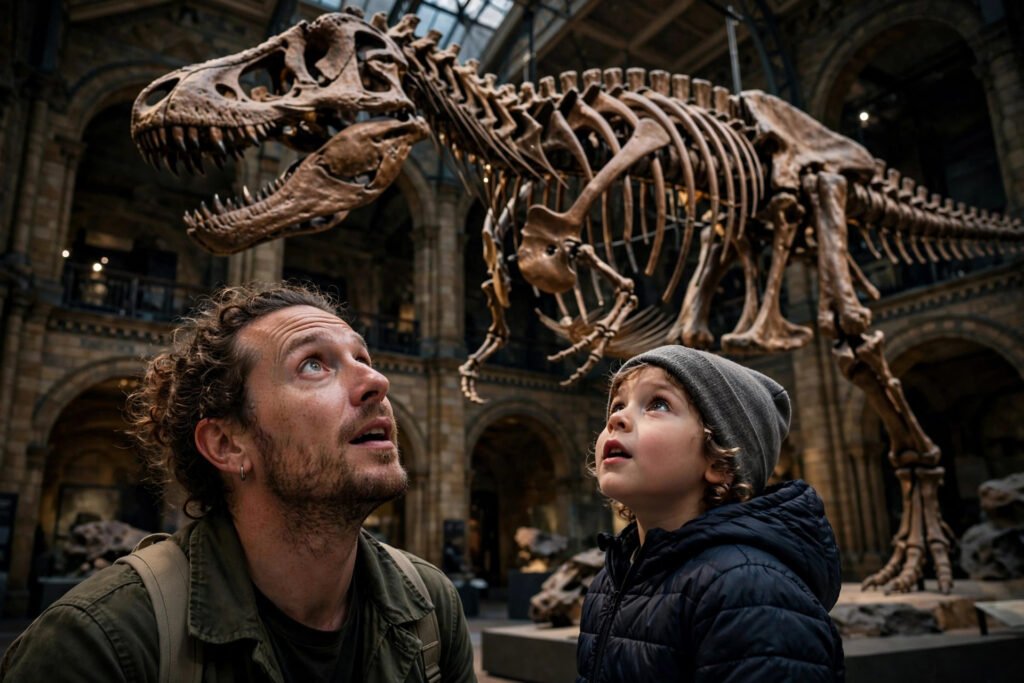
The best evolution education is fieldwork. Visit a natural history museum and let them stand under the dinosaur skeletons — scale teaches what words can’t. Go tide-pooling or fossil hunting; finding a 300-million-year-old brachiopod in a creek bed makes deep time personal. Watch nature documentaries together and narrate the selection pressures: “See how the chameleon’s tongue works? The ones with longer tongues caught more flies and had more babies.”
At home, run the “breeding” experiment with fast-growing plants or even digital simulations — evolving virtual creatures toward a goal in a free online simulator teaches selection pressure better than any diagram. And read together: there are wonderful picture books that tell evolution as story, because that’s what it is. For homework-age kids who want to explore on their own, using AI safely for homework help can extend the curiosity — and how teachers use AI to plan lessons shows the other side of the learning equation.
Conclusion
Explaining evolution to a curious kid works best as a sequence: start with the variation they can see, use the cookie analogy for natural selection, bridge through dog breeding, then add deep time and fossil evidence for older kids — and answer the tricky questions straight. You’re not lecturing; you’re handing them the greatest detective story in science, with themselves as one of the clues. My nephew now explains to anyone who’ll listen that his dog is “a wolf that got nice.” He’s not wrong.
Frequently Asked Questions
At what age can kids understand evolution?
The basics — variation and selection — click around ages 5–7 with good analogies. Don’t rush deep time; let the animal stories carry the early years and add the evidence as their questions get sharper. Deep time and evidence make sense around 9–12. There’s no need to wait; young kids absorb the core ideas through stories about animals.
What’s the simplest way to explain natural selection to a child?
The cookie/monster analogy: the environment removes what doesn’t fit, survivors have babies like themselves, and over many generations the population changes. Then connect it to dog breeds as artificial selection.
How do you explain fossils to kids?
As nature’s photo album: “These are the actual bones of animals that lived millions of years ago, turned to stone.” Let them touch real fossils if possible — the physical object beats any explanation.
What’s a good evolution book for kids?
Look for richly illustrated picture books that tell deep-time stories through animals — natural history museum gift shops curate the best ones, and librarians can point you to age-appropriate titles.
Should I correct a child who says “we came from monkeys”?
Gently, yes — it’s a great teaching moment. “Not exactly — we share ancient grandparents with monkeys. We’re more like very distant cousins.” The correction itself teaches how evolution branches.