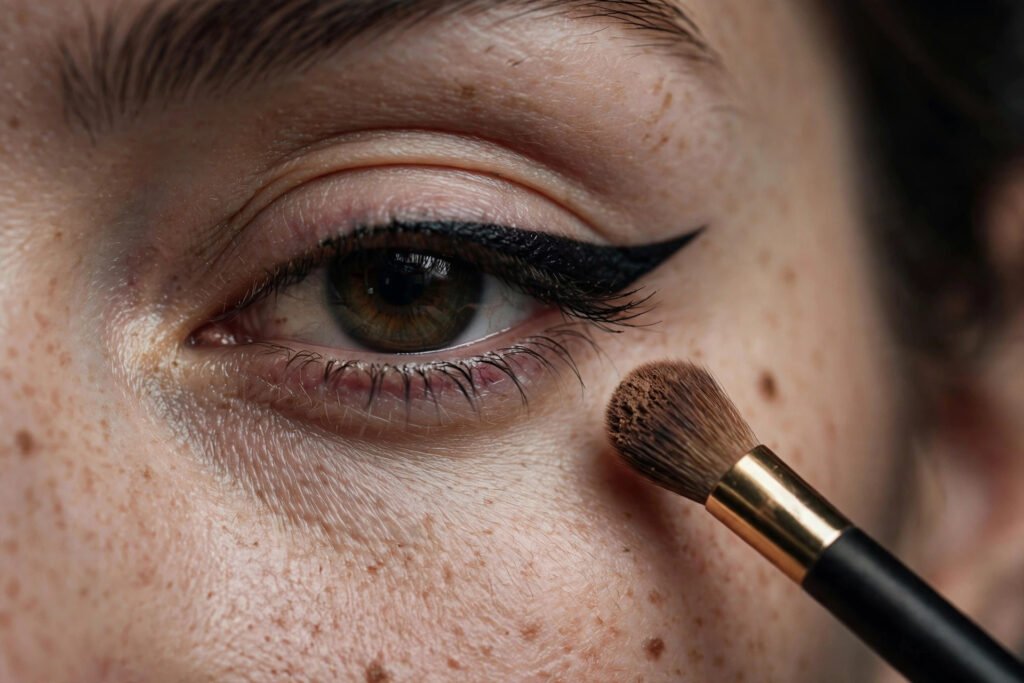
How to Do Winged Eyeliner on Hooded Eyes (2026 Guide)
Winged eyeliner is hard enough on standard eyes. On hooded eyes — where the lid crease is partially or fully hidden by an overhanging fold — the classic wing disappears the moment you open your eyes, smudges onto the hood within an hour, or migrates into a shape you did not draw. It is the most requested eye-makeup tutorial for a reason: the standard technique genuinely does not work on this eye shape. But a modified technique does, and it is not much harder once you know the adjustments.
Here is how to do winged eyeliner on hooded eyes: understanding your eye shape, the modified technique that keeps the wing visible, product choices that prevent smudging, and fixes for the specific problems hooded eyes cause.
Know Your Eye Shape First
Hooded eyes have excess skin folding down from the brow bone that covers part or all of the mobile lid — the crease may be invisible when eyes are open. This varies enormously: slightly hooded eyes lose a little lid space; deeply hooded eyes show almost no lid at all. The technique below scales to all of it, but knowing your degree helps you calibrate wing size and placement. Look straight into a mirror: if your crease disappears when your eyes are open, you are working with hooded eyes.
Important: draw with eyes open. Every standard liner tutorial draws on closed eyes, which is exactly why wings vanish on hooded lids — the geometry changes completely when the eye opens. Open-eye application is the foundational rule of hooded-eye liner.
The Hooded-Eye Wing Technique
Step 1: Map the wing with eyes open
Look straight ahead into the mirror. Mark the wing’s outer endpoint first: imagine a line extending from the outer corner of your eye toward the tail of your brow — place a small dot where you want the wing tip. For hooded eyes, angle the wing slightly more upward than standard; a wing that follows the lower lash line gets swallowed by the hood, while a lifted angle stays visible.
Step 2: Draw the wing, then connect
From the dot, draw a line back toward the outer corner of the eye, creating the wing’s top edge. Then draw from the outer corner up to meet the dot, forming the triangle. Fill it in. Only now, with eyes still open, draw along the lash line from the outer corner inward — but stop two-thirds of the way. Full-width thick liner eats the limited lid space hooded eyes have; keeping the inner portion thin preserves what lid shows.
Step 3: The straight-line trick
Here is the key modification: instead of following the curve of the lash line (which dips into the hood’s fold), draw the liner in a straighter line from the middle of the eye outward. When you open your eye, this straight line reads as a smooth wing rather than disappearing into the fold. It looks odd with eyes closed and perfect with eyes open — trust the mirror, not the closed-eye view.
Step 4: Set it
Hooded eyes press liner against the upper fold constantly, causing transfer. Set the liner by pressing matching eyeshadow over it with a small brush — this locks liquid and gel liners dramatically. Finish with an eye primer underneath everything; on hooded eyes, primer is not optional, it is structural.
Product Choices That Prevent Smudging
Waterproof liquid or gel liners are the hooded-eye standard — pencil liners transfer fastest on this eye shape. Quick-dry formulas matter: slow-drying liner stamps itself onto the hood before it sets. The FDA’s cosmetics safety guidance also reminds eye-makeup wearers to replace liquid liner every three months to avoid infection. Many hooded-eye wearers get their best results from gel liner applied with an angled brush (maximum control, excellent staying power) or a felt-tip liquid with a waterproof claim. Whatever you choose, the eyeshadow-setting step above does more for longevity than any formula upgrade.
For complete beginners, starting with eyeshadow as liner (dark shadow applied wet with an angled brush) is forgiving — mistakes blend away, and it teaches the hand movements before committing to liquid. Drugstore gel liners perform beautifully, which matters if you are learning to look stylish on a tight budget. As with any color cosmetic, the right shade and careful application matter more than the most expensive product.
Fixing Hooded-Eye-Specific Problems
The disappearing wing
Make the wing bigger and more upward-angled than feels natural — what looks dramatic with eyes closed looks correct with eyes open. Extend the wing tip slightly further out; hooded eyes need more length for the wing to register.
Transfer onto the hood
Primer plus eyeshadow-setting plus waterproof formula solves 90 percent of transfer. For the stubborn remainder, try “baking” a light layer of translucent powder on the hood area where transfer occurs — it creates a dry barrier the liner cannot stamp through.
Uneven wings
Hooded eyes are often asymmetrical — one hood heavier than the other — making matching wings genuinely harder. Draw both wings’ outer lines first (the dots-and-angles step), compare with eyes open, adjust before filling. Perfectionists: slight asymmetry is invisible to everyone but you.
Alternative: The Smudged and Graphic Options
Not every hooded eye needs a classic wing. A softly smudged liner (applied then blurred with a brush) is more forgiving and suits the eye shape beautifully — smudging hides in the fold naturally. Graphic liner — bold shapes drawn above the crease on the hood itself, visible with eyes open — turns the hood from obstacle into canvas. And tightlining (liner pressed into the upper waterline) defines eyes with zero lid-space cost — though the American Academy of Ophthalmology advises keeping liner outside the waterline if you wear contacts or have sensitive eyes, perfect for minimal-makeup days.
Conclusion
Winged eyeliner on hooded eyes works when you draw with eyes open, angle the wing upward from a pre-mapped outer dot, use the straight-line trick across the fold, keep the inner liner thin, and set everything with primer plus eyeshadow. Choose waterproof, quick-dry formulas, make wings bolder than instinct suggests, and remember the alternatives — smudged, graphic, tightlined — when the classic wing is not the day’s mood. Hooded eyes are not a liner limitation; they are just a different canvas. Keep experimenting affordable by folding liner purchases into how much you budget for monthly self-care.
Frequently Asked Questions
Why does my winged eyeliner disappear on hooded eyes?
Standard tutorials draw on closed eyes; when hooded eyes open, the fold covers the wing. Drawing with eyes open, angling the wing upward, and extending it further out keeps it visible.
What is the best eyeliner for hooded eyes?
Waterproof liquid or gel liner with quick-dry formula, applied over eye primer and set with matching eyeshadow. Gel with an angled brush offers the most control for beginners.
How do I stop eyeliner from transferring to my upper lid?
Eye primer underneath, waterproof formula, eyeshadow pressed over the liner to set it, and a light dusting of translucent powder on the hood area. This combination solves nearly all transfer.
Should the wing be thicker or thinner on hooded eyes?
Thicker at the outer wing, thinner along the inner lash line. Hooded eyes have limited visible lid space — thick liner across the full lid eats it all, while a bold outer wing with a thin inner line balances definition and openness.