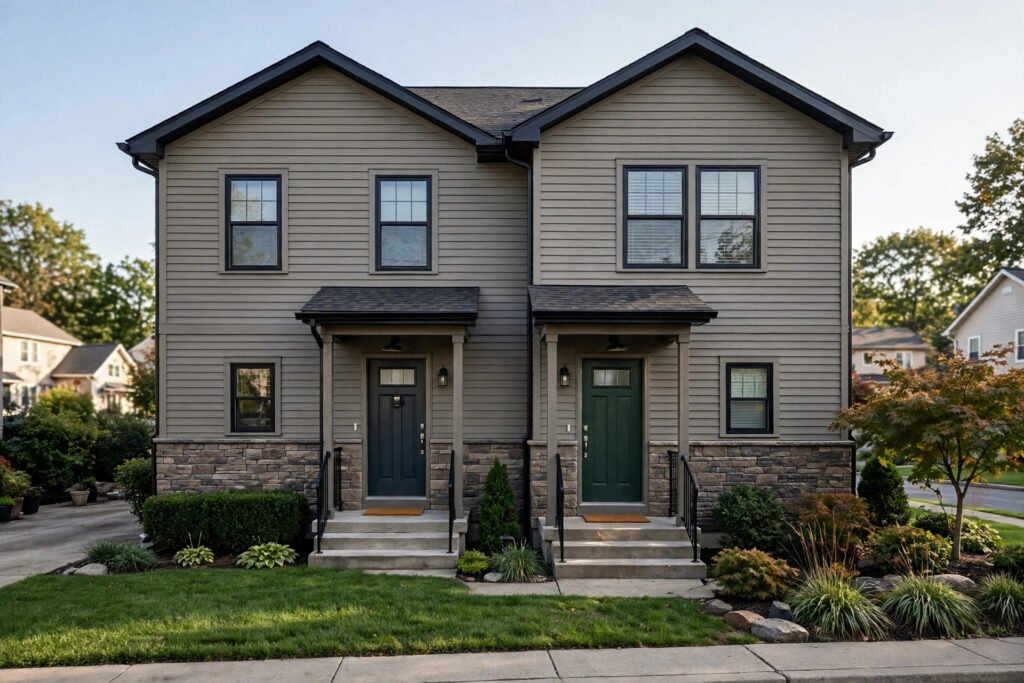
How to Buy a Duplex as Your First Investment Property
Ask experienced real estate investors how they started, and a remarkable number give the same answer: a duplex. Buying a two-unit property, living in one side, and renting the other — “house hacking” — is the closest thing to a cheat code for first-time investors. The rental income offsets your mortgage, you learn landlording with training wheels, and low-down-payment owner-occupant financing makes it accessible on a normal salary. But the strategy has real pitfalls, and the wrong duplex at the wrong price is just an expensive headache with tenants.
This guide walks through how to buy a duplex as your first investment property: the financing, the math, finding the right property, and managing it without losing your mind.
Why a Duplex Works for Beginners
The duplex hits a sweet spot other investments miss. Financing: because you will live in one unit, you qualify for owner-occupant loans — FHA at 3.5% down, conventional at 5%, sometimes 3% for first-time buyers — instead of the 20–25% down that investment properties require. On a $300,000 duplex, that is the difference between $10,500 and $75,000 out of pocket. Risk profile: with two units, one vacancy still leaves income flowing — unlike a single-family rental, where vacancy means zero income and full expenses.
Learning curve: you learn tenant screening, maintenance coordination, and bookkeeping at small scale, with yourself as the on-site manager. Scalability: after a year of owner-occupancy (the typical requirement), you can move out, rent both units, and repeat the strategy on the next property — this is how many investors build portfolios one duplex at a time. The Department of Housing and Urban Development site explains the FHA loan requirements that make this strategy possible.
The Math: Know Your Numbers Before You Fall in Love
Every duplex decision starts with the numbers. The 1% rule (screening): monthly rent for both units should be roughly 1% of the purchase price ($3,000 rent on a $300,000 duplex). It is a rough filter, not gospel — in expensive Midwest markets, 0.8% can work; below that, be skeptical. Calculate true cash flow: gross rent minus mortgage (PITI) minus vacancy allowance (5–8%), maintenance (1% of property value per year, more for older buildings), capital expenditures reserve (roof, HVAC, plumbing — budget monthly), property management (even if self-managing initially, underwrite 8–10% so the deal works if you later hire out), and utilities you will cover.
The house-hack test: does the other unit’s rent cover most of your total housing cost? If your all-in monthly cost is $2,200 and the rented unit brings $1,400, you are living for $800/month — likely far below market rent for your area. That monthly savings, redirected to the next down payment, is the wealth-building engine. Run these numbers conservatively; optimistic underwriting is how beginners lose money. BiggerPockets offers free rental calculators that force you to account for every expense line.
Financing: Your Options Ranked
FHA (3.5% down): the classic house-hack loan. Requires owner-occupancy for at least a year, mortgage insurance premiums (upfront and monthly), and the property must meet FHA condition standards — which rules out true fixer-uppers. Both units’ projected rents can count toward your qualifying income (typically 75% of market rent), which boosts your purchasing power enormously. Conventional (3–5% down): no upfront mortgage insurance premium (though PMI applies under 20% down, and it drops off at 20% equity — unlike FHA’s permanent MIP). Slightly stricter credit requirements.
203(k) renovation loan: FHA’s fixer-upper version — finances purchase plus renovation in one loan. Powerful for duplexes needing work, but bureaucratic; only for the patient. House-hacking with roommates: some buyers rent bedrooms in their own unit too, stacking income further — check local occupancy rules first. Whatever you choose, get pre-approved before shopping, and work with a lender experienced in multi-unit owner-occupant deals — the rent-income calculations trip up generalist lenders. Before buying any property, know what to inspect: our checklist for evaluating an older fixer-upper home applies directly to duplex hunting.
Finding the Right Duplex
Location first: prioritize neighborhoods with strong rental demand — near employers, universities, hospitals, or transit. Drive the streets at night and on weekends; the vibe at 10 p.m. Saturday matters. Check crime maps, school ratings (they affect resale even if you have no kids), and rent comps on Zillow and Rentometer. Configuration matters: side-by-side duplexes offer more privacy (and happier tenants) than up-down units; separate utilities and meters simplify everything; off-street parking is gold in most Midwest markets.
Condition: as a first-timer, favor cosmetic-fixers over structural projects. New roof, updated electrical, and functioning HVAC are worth paying for — beginners consistently underestimate renovation costs and timelines. Work with an investor-friendly agent: most residential agents do not understand cap rates or rent multiples; find one who owns rentals themselves. And when you are ready to think about professional help down the road, it is worth understanding how real estate agents actually earn their keep in an increasingly automated market.
Managing It: Landlording With Training Wheels
Screen tenants rigorously: credit check, income verification (3x rent is the standard), rental history, and references — applied equally to every applicant (fair housing laws are strict and unforgiving; learn them before you list). Use a real lease: state-specific, attorney-reviewed, covering every scenario (late fees, maintenance responsibilities, pet policies, notice periods). Set boundaries early: you live next door, which is convenient and potentially awful — establish professional communication channels (email/text for requests, not knocks on your door) from day one.
Build your team before you need it: a reliable handyman, a plumber, an HVAC tech, an electrician. When the furnace dies in January, you do not want to be Googling. Keep immaculate records: separate bank account, track every expense — your taxes and your sanity depend on it. Investopedia’s real estate investing guides are excellent for the ongoing education landlording requires.
The Bottom Line
Buying a duplex as your first investment property works when the math works: verify the 1%-ish rent ratio, underwrite every expense conservatively, use owner-occupant financing to minimize cash out of pocket, buy in a strong rental location in livable condition, and screen tenants like your investment depends on it — because it does. Do that, and your first property pays you to learn the business. The second one gets easier.
Frequently Asked Questions
How much down payment do I need for a duplex?
As an owner-occupant, 3.5% with FHA or 3–5% with conventional loans — roughly $10,500–$15,000 on a $300,000 duplex. Pure investors need 20–25% down, which is why house hacking is so powerful for beginners.
Can I use rental income to qualify for a duplex mortgage?
Yes — lenders typically count 75% of the market rent from the unit(s) you will not occupy toward your qualifying income, which significantly increases your purchasing power. You will need a rent schedule or appraisal supporting the figures.
What is the 1% rule in real estate?
Monthly gross rent should be about 1% of the purchase price ($3,000/month on a $300,000 property). It is a quick screening filter, not a final verdict — always run full cash-flow numbers including vacancy, maintenance, and reserves.
Should I hire a property manager for my first duplex?
Most house hackers self-manage initially to learn and save the 8–10% fee — you live on-site, so it is manageable. But underwrite the deal as if you pay for management, so it still works if you hire out later.