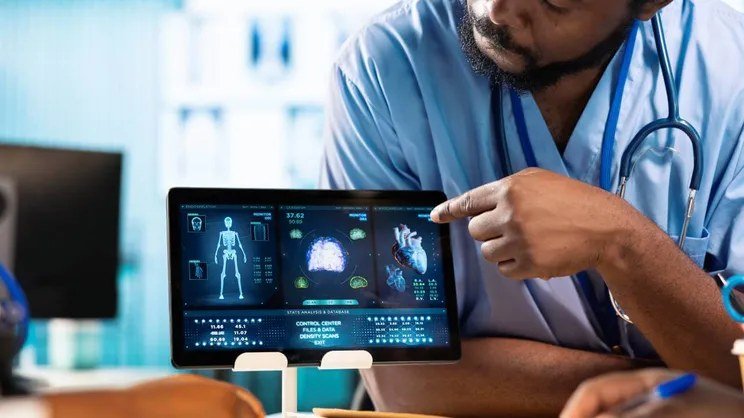
How is AI changing the way doctors diagnose patients
Your doctor looks at a scan. An AI has already looked at it too — flagging a subtle pattern the human eye might miss. This isn’t science fiction; it’s Tuesday in a modern radiology department. AI is changing the way doctors diagnose patients right now, and understanding how helps you be a better advocate for your own care.
How AI Is Changing Medical Diagnosis: Where It’s Working Today
Medical Imaging (The Most Mature Application)
- Radiology: AI detects lung nodules, breast cancer, brain bleeds, and fractures on scans — often matching or exceeding specialist accuracy in controlled studies. The model is AI as second reader: it flags regions of interest, the radiologist makes the call.
- Pathology: analyzing biopsy slides for cancer cells, grading tumors, predicting which will respond to which treatments.
- Ophthalmology: FDA-cleared AI screens for diabetic retinopathy from retinal photos — deployable in primary care offices without a specialist present.
- Dermatology: skin lesion analysis apps and clinical tools that triage concerning moles.
- Cardiology: ECG interpretation, echocardiogram analysis, predicting heart failure risk from routine data.
Beyond Images
- Early warning systems: hospital AI monitors vital signs and lab trends, predicting sepsis or deterioration hours before humans would notice. These systems save lives daily.
- Rare disease diagnosis: AI that cross-references symptoms against thousands of rare conditions — cutting diagnostic odysseys that once took years.
- Genomics: interpreting genetic variants to predict disease risk and guide treatment.
- Clinical documentation: ambient AI scribes that listen to appointments and write notes — giving doctors their attention back.
What This Means for You as a Patient
The Good News
- Catch things earlier: AI second-readers reduce missed findings. Earlier detection means better outcomes, especially in cancer.
- Faster answers: AI triage prioritizes urgent scans, cutting wait times for critical results.
- Access: AI screening in primary care brings specialist-level detection to places without specialists.
- More face time: AI scribes mean your doctor looks at you instead of a keyboard.
Stay Proactive Anyway
- AI assists; doctors decide. If something feels wrong, say so — even if “the scan was clear.” False negatives happen with humans and AI alike.
- Ask about it: “Was AI involved in reading my scan?” It’s a reasonable question, and the answer tells you about your facility’s capabilities.
- Keep your records: AI systems improve with data; your complete history helps every clinician (human or AI) who sees you.
- Understand the limits: AI excels at pattern matching in data-rich domains. It doesn’t replace clinical judgment, physical examination, or knowing you as a person.
The Honest Limitations
- Bias in training data: AI trained mostly on one population performs worse on others. Dermatology AI historically underperformed on darker skin — a real equity issue the field is working to fix.
- The “last mile”: a diagnosis is the start of care, not the end. Treatment decisions, patient communication, and complex judgment remain deeply human.
- Over-reliance risk: automation bias — humans trusting AI outputs too much — is a genuine clinical concern.
- Regulation lags: the FDA clears specific applications, but the pace of deployment challenges oversight frameworks.
For the consumer side of AI health tools (and their limits), see our guide to AI symptom checkers — the clinical-grade systems above are a different world from chatbots.
AI in Medical Diagnosis: Frequently Asked Questions
Will AI replace radiologists?
No — but it’s changing what radiologists do. AI excels at flagging abnormalities on scans; radiologists excel at integrating findings with clinical context, communicating with referring doctors, and making judgment calls on ambiguous cases. The emerging model is AI as an untiring first reader plus human as the accountable decision-maker — a combination that outperforms either alone. Radiologist demand remains strong; the job description is evolving. The National Institutes of Health funds extensive research on clinical AI applications if you want to follow the science directly.
Can I ask for AI-assisted analysis of my scans?
You can ask whether your facility uses AI-assisted reading — many major hospitals do now, though they may not advertise it. You generally can’t request a specific AI product as a patient; it’s a clinical tool the radiology department chooses. What you can do: ask for a second reading if you’re concerned (your right as a patient), keep copies of your imaging, and make sure concerning findings get appropriate follow-up. The technology assists; your advocacy still matters.
Is my medical data safe with AI diagnostic systems?
Clinical AI operates under HIPAA like everything else in healthcare — your scans and data are protected health information with strict handling requirements. This is a different world from consumer chatbots: hospital AI systems don’t train on your data for public models, and access is logged and audited. If you’re sharing health details with consumer AI tools (symptom checkers, chatbots), that’s where privacy caution applies — see our AI privacy guide for the distinction.
What if the AI and the doctor disagree?
The doctor’s judgment governs — AI is advisory, and ultimate responsibility sits with the licensed physician. Disagreements are actually the system working as designed: the AI flags something, the doctor evaluates it in full clinical context, and the better answer wins. If you disagree with your doctor’s conclusion, get a second opinion from another human physician. That’s your right regardless of what any algorithm said.
How accurate is AI diagnosis compared to doctors?
In narrow, well-defined tasks (detecting diabetic retinopathy, flagging lung nodules, classifying skin lesions), top AI systems match or slightly exceed specialist accuracy in studies. But “narrow tasks” is doing heavy lifting there — real diagnosis involves history-taking, physical examination, clinical judgment, and patient communication, where AI assists rather than leads. The honest summary: AI is a powerful specialist tool, not a doctor replacement.
The Bottom Line on AI Diagnosis
How is AI changing the way doctors diagnose patients? As an untiring second reader for medical imaging, an early warning system in hospitals, a rare-disease detective, and a documentation assistant — catching things earlier and giving doctors more time with patients. The future isn’t AI replacing doctors; it’s AI-armed doctors outperforming either alone. As a patient, welcome the assistance, stay engaged in your care, and remember: the most powerful diagnostic tool remains a doctor who listens — now with better instruments.