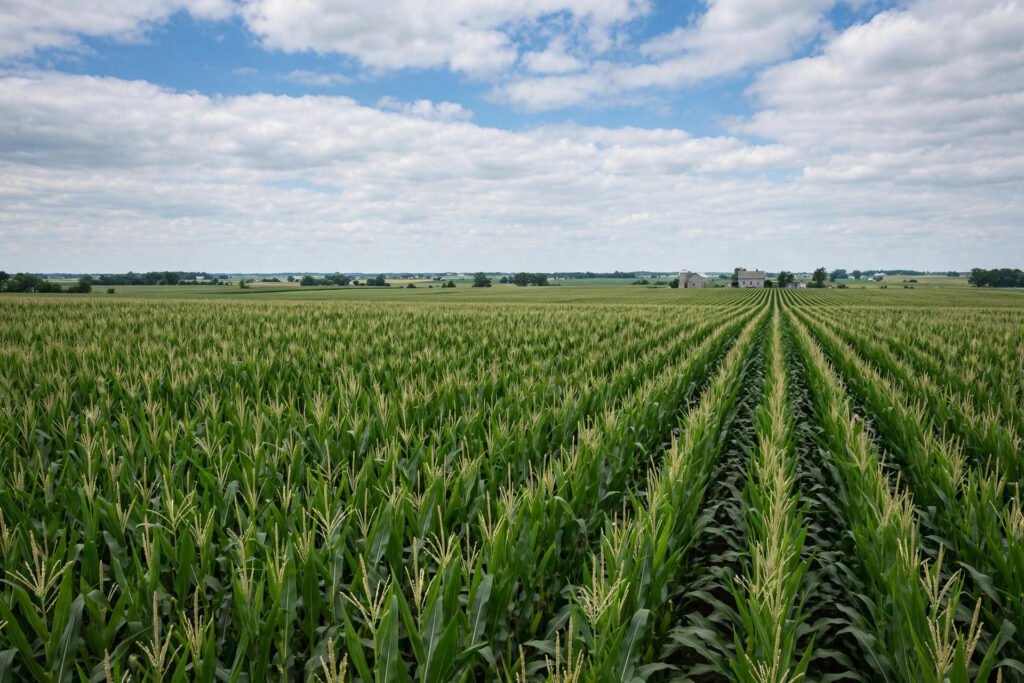
How Corn Grows So Fast in Iowa Fields: The Science Behind It
Drive across Iowa in late June and the corn is already waist-high, a green ocean rolling to every horizon. By August it’s ten feet tall. Visitors from the coasts always ask the same thing: how does corn grow so fast here? The answer involves a plant that’s essentially a solar-powered sugar factory running at the theoretical limit of photosynthesis, planted in some of the best soil on Earth, in a climate that gives it exactly what it needs for exactly as long as it needs it. Iowa doesn’t just grow corn — it’s the best place on the planet to do it.
Corn Is a C4 Photosynthesis Machine
The core reason corn outgrows almost everything is biochemistry. Most plants use C3 photosynthesis, which wastes energy in a process called photorespiration — especially in heat. Corn is a C4 plant, with a specialized leaf anatomy that concentrates CO2 around the photosynthetic enzymes, nearly eliminating that waste. In hot, bright conditions, C4 photosynthesis is dramatically more efficient: corn converts sunlight to biomass at rates approaching the theoretical maximum for any plant.
What that means in practice: on a sunny July day, an acre of Iowa corn can add hundreds of pounds of dry matter — the fastest sustained growth rate of any major crop. The plant is quite literally built for speed, a trait inherited from its wild ancestor teosinte, a scraggly Mexican grass that humans transformed over 9,000 years of selection into the most productive grain plant on Earth.
The Soil: A 10,000-Year Head Start
Iowa sits on some of the world’s great soils — deep, dark Mollisols built by millennia of prairie grasses. Every year for thousands of years, prairie roots grew deep, died back, and added organic matter, building topsoil in places over two feet deep with organic matter content that farmers elsewhere can only envy. This soil holds water like a sponge, supplies nutrients steadily, and warms quickly in spring.
The glaciers helped too: the Des Moines Lobe’s retreat left behind level, stone-free, tile-drainable land — ideal for mechanized farming at scale. The USDA’s soil surveys consistently rank Iowa’s Clarion-Nicollet-Webster soil association among the most productive agricultural soils on the planet. Corn’s speed in Iowa starts underground, in dirt that took the last ice age to prepare.
The Climate Window: Exactly Enough, Exactly on Time
Corn needs roughly 2,700–3,000 growing degree days — a measure of accumulated warmth — and Iowa delivers them in a near-perfect package: warm (not scorching) summers, adequate rainfall concentrated in the growing season (30–36 inches annually, most falling April–September), and long summer days at 42°N latitude providing intense solar radiation during the critical grain-fill period.
The timing matters as much as the totals. Corn’s most vulnerable moment is pollination — a 10-day window in July when each silk must catch pollen. Iowa’s climate reliably delivers warm days and adequate moisture during that window in most years. Too hot (sustained 95°F+) and pollen dies; too dry and silks desiccate. Iowa threads the needle with remarkable consistency, which is why the state’s corn yields are the envy of the world — routinely 180–200+ bushels per acre on good ground.
Human Engineering: Hybrids, Density, and Precision
Modern Iowa corn isn’t just lucky — it’s engineered. Hybrid seed, the product of a century of breeding, gives today’s plants traits their grandparents lacked: upright leaves that capture light efficiently at high planting densities, stalks strong enough to stand in wind, root systems that scavenge nutrients aggressively. Planting densities have roughly tripled since the 1960s — from 12,000 to 34,000+ plants per acre — and yields tripled with them.
Precision agriculture multiplies the advantage: GPS-guided planters place each seed at exact depth and spacing, variable-rate applicators feed each zone of the field what soil tests say it needs, and drainage tile keeps the famously wet Iowa springs from drowning seedlings. Iowa State University Extension’s corn production research has driven much of this optimization. The plant’s biology sets the speed limit; Iowa farmers spend their careers raising it.
Why It Matters Beyond Iowa
Iowa alone produces roughly 15–18% of America’s corn — and America produces about a third of the world’s. That corn becomes feed, ethanol, sweeteners, starches, and exports that feed livestock worldwide. The speed of Iowa corn isn’t agricultural trivia; it’s a pillar of the global food system. When drought hits Iowa in July, corn futures spike in Chicago within hours and food prices shift globally within months.
It also makes Iowa the front line of agriculture’s biggest questions: can yields keep rising? (Probably, but slower.) Can it be done with less fertilizer runoff? (The state’s nutrient-reduction strategy says it must.) What happens as the climate shifts the corn belt north? Those questions will be answered first in Iowa’s fields. In the meantime, the kitchen-table version of this story is simpler — the easiest homemade bread recipe starts with grain not so different from what grows outside Des Moines. And understanding the food system helps with meal planning for a family on a budget, where corn-derived staples stretch dollars furthest.
The Night Shift: What Corn Does After Dark
Here’s something most people never consider: corn grows fastest at night. During the day, the plant photosynthesizes furiously, stockpiling sugars. After dark, it spends them — driving cell expansion, root growth, and the construction of new tissue. Warm Iowa nights in the 60s–70s°F are ideal for this nocturnal construction work; nights that stay too hot increase respiration losses, burning sugars the plant worked all day to make. Farmers watching overnight lows during grain fill aren’t being fussy — they’re monitoring the factory’s night shift.
Conclusion
Corn grows so fast in Iowa because a C4 photosynthesis engine meets the world’s best corn soil, a near-perfect climate window, and a century of human optimization — hybrids, density, and precision farming stacked on a 10,000-year soil inheritance. It’s not one advantage but the compounding of all of them, in the one place where they align. Drive across Iowa in August, look at ten feet of green in every direction, and you’re looking at evolution, geology, and agronomy agreeing with each other.
Frequently Asked Questions
How fast does corn actually grow?
At peak in July, corn can grow 2–4 inches per day — you can almost watch it. From emergence to maturity takes roughly 100–120 days, with most biomass added in a furious 60-day stretch.
Why is Iowa the top corn state?
The combination of deep prairie soils, ideal summer warmth and rainfall timing, flat farmable land, and a century of agricultural infrastructure and research. No other state stacks all four advantages as completely.
What is C4 photosynthesis?
A specialized photosynthetic pathway that concentrates CO2 around the key enzyme, minimizing wasteful photorespiration. C4 plants like corn, sugarcane, and sorghum dramatically outperform C3 plants in hot, bright conditions.
Does corn grow at night?
Yes — fastest, in fact. Daytime photosynthesis stockpiles sugars; nighttime cell expansion spends them. Warm nights in the 60s–70s°F are ideal; excessively hot nights waste sugars through respiration.
How many corn plants are in an Iowa acre?
Modern plantings run 32,000–36,000 plants per acre — roughly triple 1960s densities. Higher density is one of the main drivers of the yield gains of the last half-century.