How to Actually Spend Less Time on Your Phone (Without Deleting Everything)
How to Actually Spend Less Time on Your Phone (Without Deleting Everything)
How can I spend less time on my phone every day? Here’s the real deal, based on what actually works rather than what sounds good.
My screen time report once said 5 hours and 42 minutes. In a single day. That's a part-time job I wasn't getting paid for, spent mostly watching strangers argue in comment sections.
I didn't go full flip-phone — that's not realistic for most of us. Instead I made a series of small changes that cut my usage nearly in half. No dramatic detox, no deleting everything. Just friction in the right places.
What really matters
Turn off all notifications except humans
This is the big one. Every non-human notification — news, shopping, games, social media likes — gets disabled. Only calls, texts, and messages from actual people come through. App developers employ teams of psychologists to steal your attention; notifications are their front door. I went from 90+ notifications a day to about 12, and the phantom urge to check dropped within a week.
Make your phone boring on purpose
Move social apps off the home screen into a folder on page three. Turn on grayscale mode in the evening (it genuinely makes scrolling less appealing). Delete the apps you can use on desktop instead. Every extra tap between you and the dopamine is a chance for your better judgment to kick in. Boring phones get checked less — it's that simple.
Related reading: Rainy Weekend? 15 Actually-Good Things to Do at Home
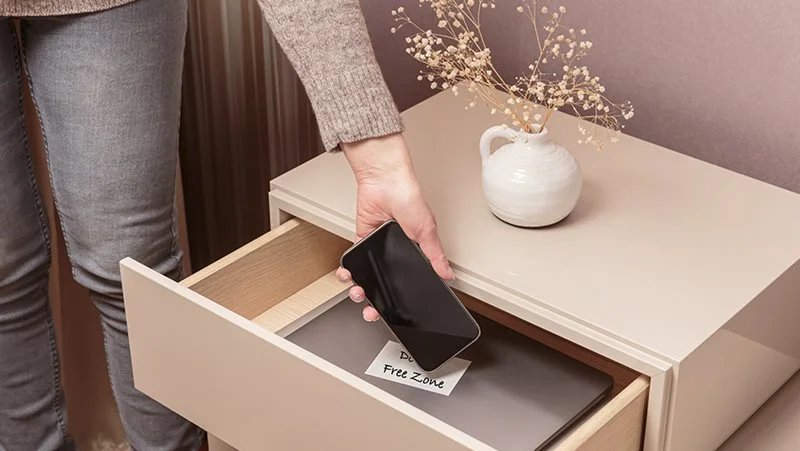
Charge it outside the bedroom
The phone is the last thing you see at night and the first thing you see in the morning when it lives on your nightstand. Move the charger to the kitchen and buy a $12 alarm clock. My mornings went from 40 minutes of bed-scrolling to actually getting up, and my sleep improved because I wasn't mainlining blue light at midnight.
Set app limits — and make someone else the gatekeeper
Screen Time (iPhone) and Digital Wellbeing (Android) let you cap apps at, say, 30 minutes a day. The trick: have a partner or friend set the passcode. Self-imposed limits fail because you know the code. Outsourced limits work because you'd have to explain yourself, which is wonderfully embarrassing motivation.
Replace, don't just remove
Deleting TikTok creates a vacuum, and vacuums get filled. Decide in advance what fills the phone-shaped hole: a book on the nightstand, a podcast for the commute, a hobby you keep 'not having time for.' The people who succeed at cutting screen time almost always point to what they added, not just what they removed.
My honest take
The bedroom charger move was my breakthrough. I'd tried app limits three times and bypassed them every time. But physically not having the phone nearby at night and morning cut 90 minutes a day with zero willpower required. Environment beats discipline every time.
FAQs: How can I spend less time on my phone every day?
Here are the questions I hear most often about this topic:
What's a realistic daily screen time goal?
Under 2 hours of non-work use is a solid target for most people. Don't aim for zero — aim for intentional.
Does grayscale mode really help?
Surprisingly, yes. Studies and tons of anecdotal reports show color is a big part of what keeps us scrolling; grayscale makes feeds feel flat and less rewarding.
Should I delete social media entirely?
Only if you want to. Most people do better with limits and friction than cold turkey, which tends to end in a dramatic reinstall at 11pm.
The bottom line
You don't need a digital detox retreat — you need a boring phone, a charger in the kitchen, and notifications only from humans. Start with the charger tonight. It's the smallest change with the biggest payoff, and your mornings will thank you by the weekend.
For deeper background, check out NerdWallet's digital wellness resources — both are solid, reputable resources worth bookmarking.
More from Daily Magazine 24
- Rainy Weekend? 15 Actually-Good Things to Do at Home
- House Cleaner Costs in 2026: What You'll Actually Pay Monthly
One more thing worth knowing
Finally, give any change a fair trial before judging it. Three weeks is my minimum — the first week you're fighting old habits, the second you're adjusting, and only in the third do you see the real payoff. I've almost abandoned routines on day five that became favorites by day twenty. Commit to the trial period upfront, evaluate honestly at the end, and keep what earns its place.
One more thing worth knowing
One more practical note: take a 'before' snapshot — a photo, a quick note about how things feel now. We adapt to improvements fast and forget how far we've come, which makes it tempting to abandon systems that are quietly working. Six months from now, that before-photo will remind you why you started. Progress you can see is progress you'll protect.
One more thing worth knowing
And if you take one mindset shift from all of this, let it be this: small, consistent beats big and occasional in every domain I've ever tested it. Ten minutes daily outperforms a monthly marathon. One habit at a time outperforms twelve resolutions. The tortoise doesn't just win the race — the tortoise is the only one still running in year two.
One more thing worth knowing
One thing I've noticed after years of tweaking my own routines: the best system is the one you'll actually maintain on your worst week, not your best one. Grand plans collapse under real life — kids get sick, work explodes, motivation evaporates. So whatever you take from this guide, shrink it down to the smallest version you could do exhausted on a Tuesday night. If that tiny version still helps, you've found your keeper. You can always scale up later; you can't scale up from quitting.
One more thing worth knowing
It's also worth saying: don't try to implement everything at once. Pick the one tip that resonated most and do just that for two weeks. I call it the 'one-thing rule,' and it's how I've built every lasting habit I have. Our brains rebel against overhauls but accept single tweaks gracefully. Two weeks from now, add tip number two. In three months you'll have transformed the whole area without ever feeling overwhelmed — slow change is the only change that sticks.