Make Your Small Bathroom Feel Twice as Big (12 Tricks)
Make Your Small Bathroom Feel Twice as Big (12 Tricks)
How can I make my small bathroom feel bigger? I dug into this properly, and what I found surprised me — here’s the no-fluff version.
My bathroom is so small I can touch both walls at once. For a year it felt like a submarine. Then I learned the visual tricks designers use, and now guests ask if I renovated. (I did not. I spent about $80.)
Small bathrooms feel cramped for fixable reasons. Here are the fixes, cheapest first.
The complete breakdown
Light it brightly — dimness shrinks rooms
Small bathrooms are chronically under-lit, and dim light makes walls close in. Upgrade to the brightest bulbs your fixture allows (daylight 5000K reads as spacious), add a light over the mirror if you can. My $15 bulb swap was the single biggest change — the room felt 30% bigger overnight. Light is square footage you can buy.
Go big with the mirror
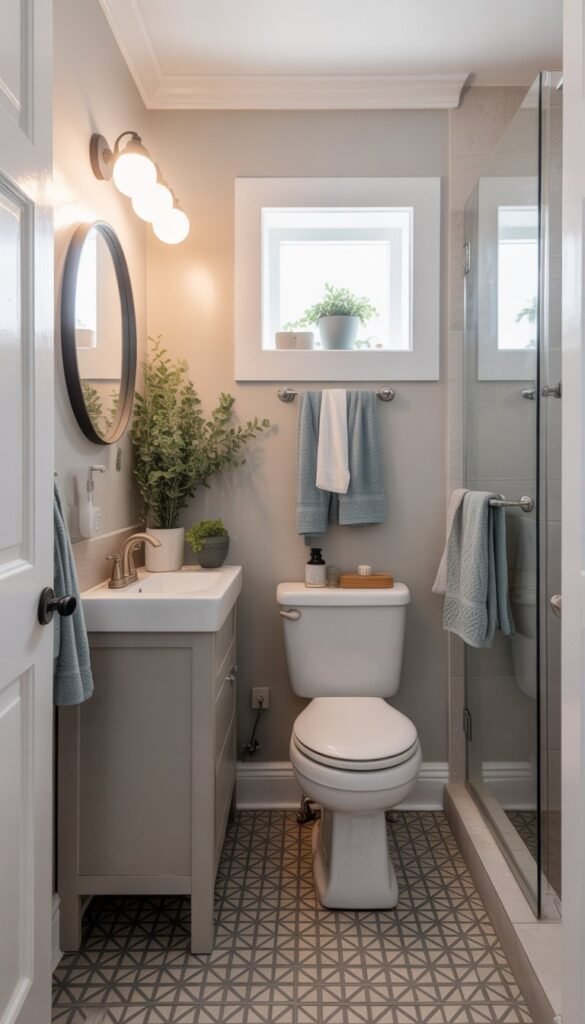
A large mirror — ideally spanning the vanity wall — doubles visual space by reflecting the room back at itself. Frameless or thin-framed reads largest. If you rent, a big leaning mirror works too. This is the oldest designer trick because it works: my wall-to-wall mirror made the room feel twice as deep.
Related reading: The Work-From-Home Routine That Keeps You Sane and Productive
Light colors, continuous surfaces
Pale walls, matching grout and tile, a shower curtain in the wall color — visual continuity makes boundaries blur, which reads as space. Dark colors and busy patterns chop the room into pieces. You don't need all-white; soft blues, warm grays, and pale greens all expand. The rule is low contrast, not no color.
Float everything you can
Wall-mounted vanities, floating shelves instead of cabinets, pedestal sinks — visible floor space is the strongest spaciousness signal. Even swapping a bulky vanity for a pedestal sink (if storage allows) opens the room dramatically. I mounted my storage on the wall and gained visible floor I didn't know I was missing.
Declutter the surfaces ruthlessly
A small bathroom with clear counters feels twice the size of one with 20 bottles out. Corral daily items into one tray or cabinet; store the rest. This costs nothing and the effect is instant. My rule: if I don't use it daily, it lives behind a door. The clear counter alone made the room feel renovated.
My honest take
The mirror and the bulb swap cost me $60 total and did 80% of the work. I'd been researching $3,000 renovations when the actual problem was $15 of lighting and a cluttered counter. Start cheap — the expensive fixes are rarely the effective ones.
FAQs: How can I make my small bathroom feel bigger?
Here are the questions I hear most often about this topic:
What color makes a small bathroom look bigger?
Light, low-contrast colors: whites, pale blues, soft grays, warm beiges. Keep walls, tile, and textiles in the same family for maximum expansion.
Should I use a shower curtain or glass door?
Clear glass doors win — they remove a visual wall. If you have a curtain, match it to the wall color and hang it high and wide.
Does a small bathroom need an exhaust fan?
Yes — moisture damages small bathrooms fast. Run it during showers and 20 minutes after. It's a maintenance essential, not a luxury.
The bottom line
Bright light, a big mirror, pale continuous colors, floating fixtures, and clear counters. That's the whole formula — most of it under $100, none of it requiring a contractor. Your submarine bathroom can feel like a spa; it just needs better lighting and less stuff.
For deeper background, check out Good Housekeeping's small bathroom ideas — both are solid, reputable resources worth bookmarking.
More from Daily Magazine 24
- The Work-From-Home Routine That Keeps You Sane and Productive
- Hiring a Professional Organizer for One Room: Worth It?
One more thing worth knowing
It's also worth saying: don't try to implement everything at once. Pick the one tip that resonated most and do just that for two weeks. I call it the 'one-thing rule,' and it's how I've built every lasting habit I have. Our brains rebel against overhauls but accept single tweaks gracefully. Two weeks from now, add tip number two. In three months you'll have transformed the whole area without ever feeling overwhelmed — slow change is the only change that sticks.
One more thing worth knowing
A quick word on perfectionism, because it derails more good intentions than laziness ever does. You don't need the perfect version of this — you need the done version. The slightly messy attempt beats the flawless plan that never leaves your head. I've seen people research the ideal approach for months while doing nothing; meanwhile the person who just started imperfectly is already reaping benefits. Start ugly, refine later.
One more thing worth knowing
If you live with other people, get them on board early — not with a lecture, but by making the new way easier than the old way. Systems that depend on everyone caring equally will fail; systems where the right choice is the lazy choice succeed. Put the thing where it belongs, remove friction from the good habit, add friction to the bad one. Design beats discipline, especially in shared spaces.
One more thing worth knowing
Budget-wise, remember that most of these improvements cost little or nothing — the expensive part is usually indecision, not implementation. I've spent more money 'thinking about' solutions than on the solutions themselves. Set a small budget, pick the highest-impact move, and do it this weekend. Future-you, enjoying the results, will wonder why you waited.
One more thing worth knowing
Finally, give any change a fair trial before judging it. Three weeks is my minimum — the first week you're fighting old habits, the second you're adjusting, and only in the third do you see the real payoff. I've almost abandoned routines on day five that became favorites by day twenty. Commit to the trial period upfront, evaluate honestly at the end, and keep what earns its place.