How to Keep Your Garage Organized on a Tight Budget
How to Keep Your Garage Organized on a Tight Budget
The garage is where organization goes to die — the bikes, the paint cans, the box you haven’t opened since 2019. But a chaotic garage wastes your time and money (how many duplicate tools have you bought because you couldn’t find the first one?). The fix doesn’t require a $2,000 storage system.
Here’s how to organize any garage for under $200, using zones and vertical space.
Start With Zones, Not Products
Before buying a single bin, empty one section at a time and sort everything into zones: tools, automotive, sports/outdoor, garden, seasonal/holiday, and donate/trash. Most garages are 30% stuff that should leave — broken items, dried paint, mystery boxes. Be ruthless; the cheapest organization is owning less.
Assign each zone a wall or section. Tools near the workbench, sports gear near the door you’ll carry it through, seasonal stuff in the hardest-to-reach spots (you touch it twice a year). This costs nothing and it’s the entire secret — every item gets a home address. Label the zones with painter’s tape temporarily; you’ll formalize later. Without zones, any shelving you buy just becomes organized chaos.
Go Vertical: The Budget Storage Arsenal
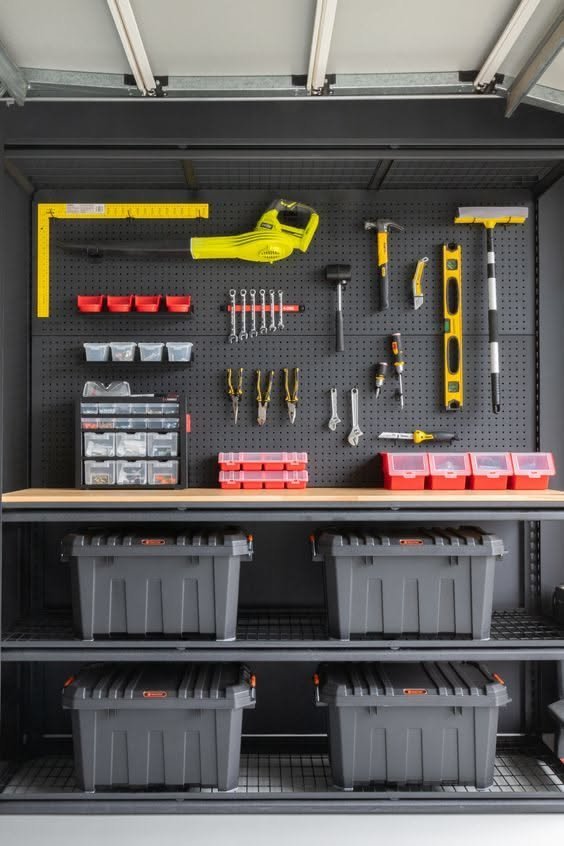
Floor space is precious; wall space is free. The budget arsenal: heavy-duty freestanding shelving units ($40 to $70 each at warehouse stores — the 5-tier metal ones hold 300+ lbs per shelf), pegboard for hand tools ($20 for a 4×4 sheet plus $10 in hooks), and screw-in wall hooks for bikes, ladders, and extension cords ($2 to $5 each). Two shelving units and a pegboard wall transform most two-car garages for about $150.
DIY upgrades that cost almost nothing: screw short lengths of 2×4 to studs as brackets for long items like lumber and trim; mount old kitchen cabinets (free on marketplace listings constantly) for enclosed storage; use 5-gallon buckets screwed under a shelf as parts bins; hang a magnetic strip for drill bits and small metal tools. Clear plastic bins ($5 to $10 each) beat cardboard — you can see contents, they stack, and they don’t grow mold. Label everything with a $20 label maker or just masking tape and a marker.
Maintain It or Lose It
Organization systems fail from entropy, not design flaws. The maintenance rules that actually stick: the one-in-one-out rule for tools and gear, a 10-minute weekly reset (put everything back Sunday evening — set a timer), and a labeled “donate” bin that lives in the garage permanently so departures are frictionless.
Seasonal rotation twice a year: in spring, move winter gear to the back and pull forward summer stuff; reverse in fall. It takes 30 minutes and keeps daily items accessible. Keep the floor clear as a religion — everything on walls, shelves, or ceiling racks. A clear floor means you can sweep in five minutes, park both cars, and actually find things. If something hasn’t been used in two years and isn’t seasonal or sentimental, it leaves. No exceptions, no “maybe someday” shelf.
Budget Garage Organization Plan
Total budget: under $200:
- Sort everything into zones; donate/trash 30% first (free).
- Assign each zone a wall or section — every item gets an address.
- Two heavy-duty shelving units: $80-$140.
- Pegboard + hooks for hand tools: $30.
- Wall hooks for bikes, ladders, cords: $10-$20.
- Clear bins + labels for small items: $30-$50.
- 10-minute weekly reset and twice-yearly seasonal rotation.
The Bottom Line
Keeping your garage organized on a tight budget is about zones first, vertical storage second, and maintenance always. Two shelving units, a pegboard, and some hooks — under $200 — handle most garages.
The real cost isn’t money; it’s the afternoon of sorting. Do that honestly, and the cheap storage actually works. Skip it, and even expensive systems become expensive clutter.
DIY Storage Projects That Cost Almost Nothing
Some of the best garage storage is built, not bought. A French cleat wall ($30 in plywood strips) creates infinitely reconfigurable tool storage — hang shelves, bins, and tool holders on the cleats, rearranging anytime. It’s the system serious woodworkers use, and it costs less than one store-bought organizer. Build it in an afternoon with a circular saw and a level.
Overhead storage exploits the most wasted space in garages: the ceiling. DIY overhead racks from 2x4s and plywood ($40-$60 in lumber) hold seasonal bins, luggage, and rarely-used items above the cars. Keep them 4-6 inches below the garage door’s travel path and within weight limits (spread loads across joists, not drywall). For lighter items, large hooks screwed into joists hold bikes, kayaks, and ladders overhead — a $20 pulley hoist system makes lifting bikes effortless.
Repurposed storage is free storage: old kitchen cabinets (check marketplace listings — people give them away during remodels), dressers for small parts, filing cabinets for hardware (the drawers are perfect for sorted screws and nails), and pallets for firewood or bulk storage. A coat of paint unifies mismatched free furniture into intentional-looking storage. The garage doesn’t need matching systems; it needs everything off the floor with a labeled home.
Quick Answers
What’s the cheapest way to organize a garage?
Declutter first (free), then two metal shelving units ($40-$70 each) and pegboard ($30). Under $200 transforms most garages.
How do I store bikes in a small garage?
Wall hooks ($5 each) or ceiling pulley hoists ($20) get bikes off the floor entirely — the single biggest floor-space win.
Should I use open shelving or cabinets?
Open shelving for frequently-used items (visibility = actually using the system); cabinets or bins for dusty, rarely-used, or unsightly items.
One more budget trick for garages: the ‘landing strip’ concept. Designate one small area near the door into the house as the daily landing strip — keys, bags, shoes, the stuff that otherwise migrates across every surface. A $15 wall-mounted key rack, a boot tray ($12), and two hooks contain the daily chaos that makes garages feel messy even when the big storage is organized. When the landing strip has a place for everything, the rest of the garage stays calm because the high-frequency clutter never spreads.
And don’t underestimate lighting in a garage makeover. Most garages have a single dim bulb that makes the space feel like a cave — and you can’t organize what you can’t see. A $30 pack of LED shop lights (linkable, plug-in, no wiring needed) transforms visibility and motivation. Bright light makes the garage feel bigger, cleaner, and safer, and it makes you far more likely to maintain the organization. People organize well-lit spaces; they abandon dark ones. Light is the cheapest renovation in the room.
Further reading: the EPA on disposing of household hazardous waste, Energy Star on garage energy efficiency.