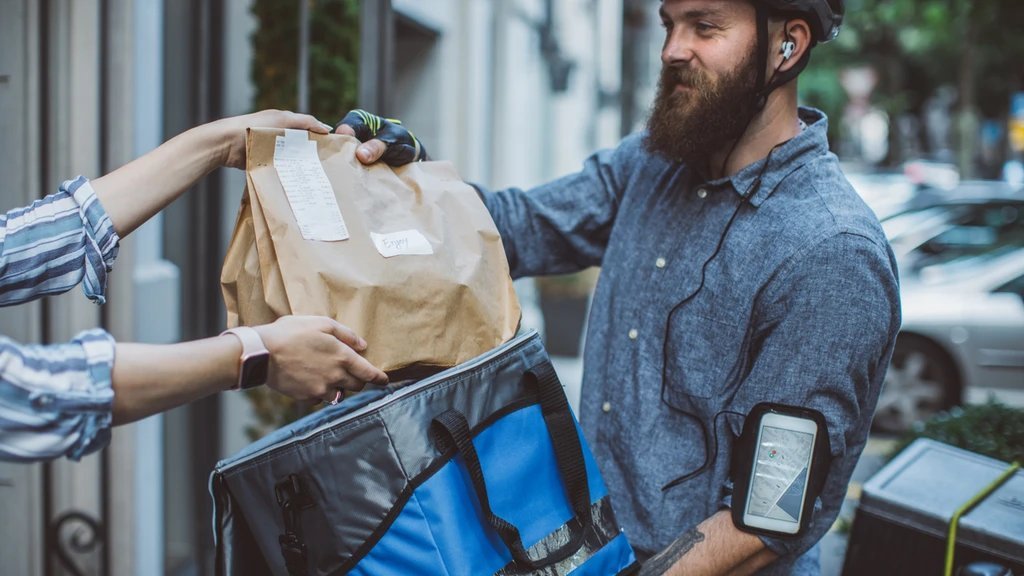
How Much Should You Really Tip for Food Delivery? (2026)
How Much Should You Really Tip for Food Delivery? (2026)
How much should I tip for food delivery? Good news: it’s more doable than it looks. Here’s what actually works.
The delivery app suggests $2 on a $40 order and my conscience suggests something very different. Food delivery tipping has gotten genuinely confusing — fees, service charges, and 'driver pay' line items all blur together.
Here's the straightforward etiquette most Americans actually follow, plus the edge cases (bad weather, huge orders, wrong items) that nobody explains.
Breaking it down
The standard: 15-20%, with a $5 minimum
For typical restaurant delivery, 15-20% of the pre-tax subtotal is the accepted range, and most drivers will tell you $5 is the real minimum for short trips. On a $25 order, that's $5. On a $60 order, $9-12. The app's suggested $2-3 is widely considered too low by drivers who depend on tips as most of their pay.
Tip on the subtotal, not the fees
Delivery fees, service fees, and 'small order fees' mostly go to the app, not the driver. Calculate your percentage on the food subtotal before taxes and fees. If an app bundles everything into one number, mentally subtract 20-25% first — or just pick a flat amount that feels right for the distance.
Related reading: Robot Vacuum in a Small Apartment: Worth It or Waste of Money?
Bad weather, long distance, or stairs = tip more
Rain, snow, extreme heat, a fifth-floor walk-up, or a 20-minute drive all deserve a bump — think 20-25% or an extra $3-5. Drivers are doing gig work with real costs (gas, wear, time). The $2 you save isn't worth someone's soaked evening. I add $5 automatically in bad weather and never regret it.
Pre-tip, and don't lower it over restaurant mistakes
Pre-tipping gets your order accepted faster — drivers see the payout before accepting. And if the restaurant messes up your order, that's not the driver's fault; punishing their tip for a kitchen error is misdirected. Complain to the restaurant or app support instead.
Cash tips are still king when you can
Apps can take a cut or use tips to offset base pay on some platforms. Cash handed at the door goes 100% to the driver with no middleman. I keep a few fives by the door for this exact reason — it's the most direct way to say thanks.
My honest take
I used to agonize over the exact percentage until a driver friend told me the truth: what matters is hitting that $5 floor and bumping for bad conditions. Now I do 20% or $5 minimum, whichever's higher, and add for weather. Simple rule, zero guilt.
FAQs: How much should I tip for food delivery?
Here are the questions I hear most often about this topic:
Do I tip on top of the delivery fee?
Yes. The delivery fee goes to the app, not the driver. Tip separately — 15-20% of the food subtotal is standard.
Should I tip for pickup orders?
It's optional but appreciated — 10% or a couple of dollars for careful packaging is a nice gesture, especially for large or complicated orders.
What if delivery is late?
If it's the driver's fault (multiple stops, dawdling), a small reduction is fair. If it's the restaurant or app, keep the tip intact.
The bottom line
The rule is simple: 15-20% of the subtotal, minimum $5, more for bad weather or long hauls. Tip the driver for the drive, blame the restaurant for the food, and keep a few cash fives by the door. Everybody wins.
For deeper background, check out NerdWallet's money etiquette guides — both are solid, reputable resources worth bookmarking.
More from Daily Magazine 24
- Robot Vacuum in a Small Apartment: Worth It or Waste of Money?
- Rainy Weekend? 15 Actually-Good Things to Do at Home
One more thing worth knowing
If you live with other people, get them on board early — not with a lecture, but by making the new way easier than the old way. Systems that depend on everyone caring equally will fail; systems where the right choice is the lazy choice succeed. Put the thing where it belongs, remove friction from the good habit, add friction to the bad one. Design beats discipline, especially in shared spaces.
One more thing worth knowing
Budget-wise, remember that most of these improvements cost little or nothing — the expensive part is usually indecision, not implementation. I've spent more money 'thinking about' solutions than on the solutions themselves. Set a small budget, pick the highest-impact move, and do it this weekend. Future-you, enjoying the results, will wonder why you waited.
One more thing worth knowing
Finally, give any change a fair trial before judging it. Three weeks is my minimum — the first week you're fighting old habits, the second you're adjusting, and only in the third do you see the real payoff. I've almost abandoned routines on day five that became favorites by day twenty. Commit to the trial period upfront, evaluate honestly at the end, and keep what earns its place.
One more thing worth knowing
One more practical note: take a 'before' snapshot — a photo, a quick note about how things feel now. We adapt to improvements fast and forget how far we've come, which makes it tempting to abandon systems that are quietly working. Six months from now, that before-photo will remind you why you started. Progress you can see is progress you'll protect.
One more thing worth knowing
And if you take one mindset shift from all of this, let it be this: small, consistent beats big and occasional in every domain I've ever tested it. Ten minutes daily outperforms a monthly marathon. One habit at a time outperforms twelve resolutions. The tortoise doesn't just win the race — the tortoise is the only one still running in year two.
One more thing worth knowing
One thing I've noticed after years of tweaking my own routines: the best system is the one you'll actually maintain on your worst week, not your best one. Grand plans collapse under real life — kids get sick, work explodes, motivation evaporates. So whatever you take from this guide, shrink it down to the smallest version you could do exhausted on a Tuesday night. If that tiny version still helps, you've found your keeper. You can always scale up later; you can't scale up from quitting.