Can AI help me write a speech for a wedding toast
Your best friend is getting married. You’ve been asked to give a toast. You’re honored — and terrified. Public speaking already ranks above spiders on most fear lists, and now you need to be heartfelt, funny, and brief in front of 100 people. Deep breath. AI can help you write a wedding toast speech — not by replacing your feelings, but by giving structure to them.
The blank page is the enemy of every toast-giver. AI eliminates it in minutes, leaving you the real work: adding the stories, the specifics, and the heart that no chatbot has. Here’s the process.
Can AI Help You Write a Wedding Toast Speech? The Step-by-Step Method
Step 1: Feed It the Raw Material
AI can’t invent your relationship with the couple — and generic toasts are the worst kind. Before prompting, jot down: how you know them, 2–3 specific memories (the funnier and more specific, the better), what you admire about their relationship, and any details (how they met, the proposal story, running jokes). The more specific raw material you provide, the less generic the output.
Step 2: Generate Structure, Not a Script
Prompt: “I’m the [best man/maid of honor/friend] giving a 3-minute wedding toast. Here are my stories and notes: [paste]. Create an outline with: a warm opening, 2 story beats with punchlines, a sincere turn about their relationship, and a closing toast.”
The classic structure that works: open with warmth (who you are, how you know them), tell 1–2 short stories (funny but kind — never embarrassing), pivot to sincerity (what their love taught you), raise the glass (short, clear closing line).
Step 3: Generate Options for the Hard Parts
Openings and closings are where toast-givers freeze. Ask for options: “Give me 5 opening lines for a best man speech — warm, slightly funny, not cheesy.” Having options breaks the paralysis.
Step 4: Ruthlessly Personalize
Replace every generic line with something only you could say. “Sarah is amazing” becomes “Sarah is the person who drove 40 miles at midnight because my car died — and brought snacks.” AI gives you the rhythm; you supply the truth.
Step 5: Time and Rehearse
Three minutes is roughly 400 words. Ask AI to trim: “Cut this to 350 words without losing the stories.” Then read it aloud — twice, minimum. Time it. The difference between a good toast and a great one is one rehearsal.
The Toast Rules (AI Can’t Teach You These)
- Keep it under 4 minutes. The audience’s goodwill is finite. Short and sweet always wins.
- Funny, not roasting. Gentle teasing is fine; embarrassing stories, exes, and inside jokes nobody gets are not.
- Don’t get drunk first. One drink maximum before speaking.
- Talk about the couple, not yourself. Your stories should illuminate them.
- End clearly. “Please raise your glasses to…” — then stop.
- Bring notes. A phone or index card beats a memorized speech that evaporates mid-sentence.
Sample Prompts for Common Toast Situations
- Best man, funny: “Write a best man toast outline: I’ve known the groom since college, he’s notoriously bad at [funny trait], but he’s the most loyal person I know. 3 minutes, roast lightly, end sincerely.”
- Maid of honor, emotional: “Help me structure a maid of honor speech about my sister: we fought as kids, she supported me through [hard time]. Heartfelt, minimal cheese.”
- Parent of the couple: “Draft a father-of-the-bride toast: proud, brief, welcoming the new family member, one childhood story, under 3 minutes.”
Delivery Tips: How to Actually Deliver Your Toast
Great words die with bad delivery. Here’s how to land them:
- Slow down. Nerves make everyone rush. Consciously speak at 70% of your normal pace — it feels weirdly slow to you and perfectly normal to the audience.
- Eye contact over reading. Glance at your notes, then look up and speak to the couple. Reading word-for-word puts the audience to sleep; speaking from bullet points keeps you human.
- Pause for laughs. After a punchline, stop. Let the laugh happen. Rushing past it kills the next line.
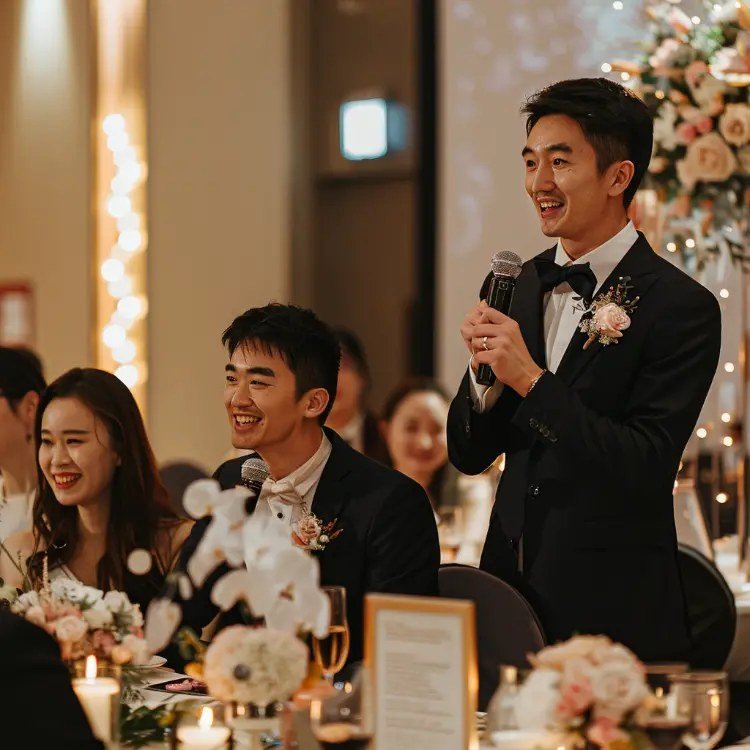
- Hold the mic correctly: 2–3 inches from your mouth, slightly below your chin. Test it before the reception starts if you can.
- Stand still. Pacing, swaying, and jingling keys in your pocket distract from your words.
- Breathe. One deep breath before you start. Your voice will shake less than you think — adrenaline lies about how nervous you sound.
Common Toast Mistakes to Avoid
- Inside jokes nobody gets: if it needs three minutes of backstory, cut it. The audience should laugh with you, not watch you laugh alone.
- Mentioning exes: never. Not even as a joke. Not even if “everyone knows.”
- Reading a 10-minute epic: the 4-minute rule exists because attention is finite. Edit brutally.
- Props and slideshows: they almost always flop technically and slow your momentum. Your words are enough.
- Apologizing for being nervous: “I’m so bad at this” makes the audience uncomfortable. Just start — confidence is a performance, not a feeling.
- Forgetting the actual toast: end with glasses raised and the couple’s names. It’s called a toast because of the ending — don’t trail off.
Quick Answers: Wedding Toast FAQs
How do I handle stage fright before the toast?
Arrive early, hold the mic during a quiet moment to get comfortable, and take one slow breath before speaking. Remember: the audience wants you to succeed — nobody came to judge the best man’s delivery. If your hands shake, hold your notes with both hands or set them on the table. One glass of liquid courage max — alcohol steadies nerves until it doesn’t, and slurred toasts are remembered forever.
Can AI help with other wedding speeches too?
Yes — the same method works for maid-of-honor speeches, parent toasts, and even vows: AI for structure and options, you for stories and heart. The key skill underneath it all is prompting well — our prompt-writing guide teaches the techniques that make AI a genuinely useful writing partner. For background on the technology itself, Wikipedia’s AI overview is a solid starting point.
The Bottom Line on AI Wedding Toasts
Can AI help you write a speech for a wedding toast? Absolutely — as a brainstorming partner, structure-builder, and editor that turns your scattered memories into a coherent, timed toast. But the magic ingredient is irreplaceable: your specific stories, your genuine emotion, your voice. AI handles the architecture; you bring the heart. Follow the structure, keep it short, rehearse once, and you’ll do great. For the broader wedding-planning picture, see planning a wedding on a budget with AI.