How are banks using AI to detect fraud on my account
You’re on vacation. You buy a coffee in another state. Thirty seconds later, your phone buzzes: “Did you make this purchase?” Annoying? Maybe. But that text is banks using AI to detect fraud on your account — a silent guardian that evaluates every transaction you make in milliseconds. Given that Americans lose billions to fraud yearly, it’s worth understanding how this invisible shield works, and how to work with it instead of against it.
How Banks Use AI to Detect Fraud: The Machinery
Real-Time Transaction Scoring
Every card swipe, online purchase, and ATM withdrawal gets a fraud score in under a second. The AI weighs dozens of signals simultaneously:
- Your behavioral baseline: where you usually shop, typical amounts, normal hours. A $2,000 electronics purchase at 3 AM from a new device looks nothing like your Tuesday grocery run.
- Location intelligence: transactions in two distant cities within an hour are physically impossible — classic fraud signal.
- Merchant risk profiles: certain merchant categories have higher fraud rates; transactions there get extra scrutiny.
- Device and network signals: new device, VPN, or known-fraud IP ranges all raise the score.
- Velocity patterns: five rapid transactions suggest a thief testing a stolen card.
Score too high? The transaction is declined, or you get the verification text. The whole system processes millions of transactions with false-positive rates low enough that you mostly never notice it.
Beyond Transactions: The Full Fraud Arsenal
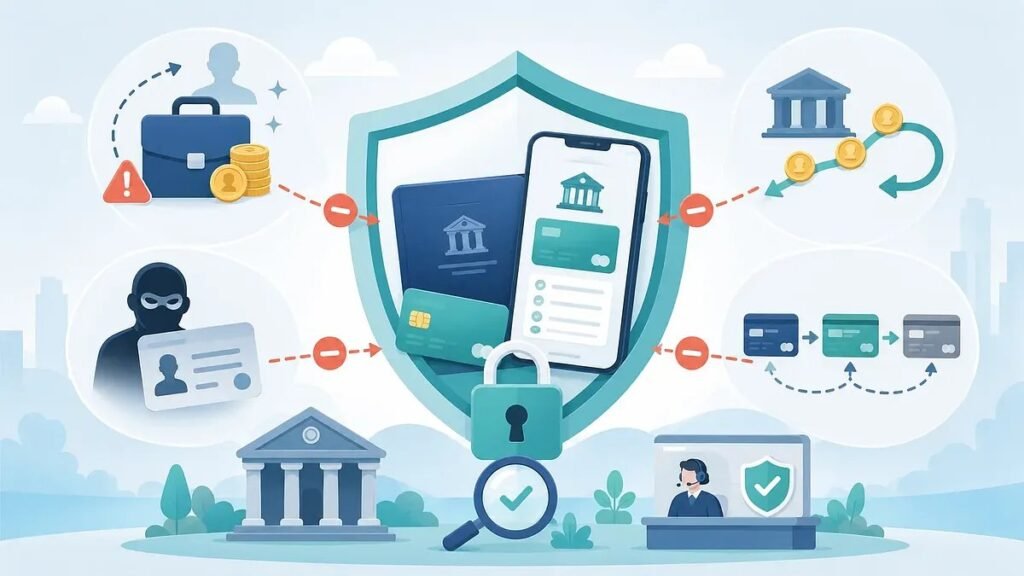
- Account takeover detection: AI monitors login patterns — new device + password reset + immediate wire transfer is the classic takeover sequence. Behavioral biometrics (how you type, hold your phone) add another layer.
- Check and deposit fraud: AI analyzes check images for alterations and flags unusual deposit patterns.
- Money mule detection: network analysis finds accounts connected to known fraud — money moving through chains in patterns humans would never spot.
- Phishing defense: AI filters fraudulent emails and texts impersonating banks, and analyzes reported scams to warn other customers.
- Credit application fraud: synthetic identity detection — catching applications combining real and fake personal data.
Why Your Legitimate Transactions Get Flagged
False positives are the price of the system working. Common triggers: travel (the #1 cause), large unusual purchases, new merchants or categories, and online vs. in-person shifts.
How to minimize hassle: set travel notifications in your banking app (takes 30 seconds), keep your phone number current, respond to fraud alerts promptly (a quick “yes, that was me” trains the system), and consider using one primary card while traveling.
What AI Can’t Catch (Your Part)
AI is excellent at catching transactional fraud but weak against social engineering — scams where you authorize the transfer. The fastest-growing fraud in America is authorized push payment scams: fake bank callers, romance scams, investment fraud, where victims willingly send money. No algorithm can stop you from being convinced.
Your defenses: never send money based on unsolicited contact. Banks will never ask you to move money to “protect” it. Establish family code words against voice-cloning scams (see our robocall guide). Enable every alert your bank offers — real-time transaction notifications mean you spot fraud the bank missed.
What to Do When Fraud Happens
- Act fast: call your bank immediately — use the number on your card, not from any message. Speed limits the damage.
- Freeze and replace: freeze the compromised card in your app, request a replacement, and update autopay accounts.
- Document everything: dates, amounts, case numbers. You’ll need them for disputes.
- Check your credit reports: fraud on one account can signal broader identity theft. Pull free reports and consider a freeze.
- File reports: with the FTC at IdentityTheft.gov and local police for significant cases.
Your Rights and Liability Limits
Under federal law, your liability for unauthorized credit card fraud is capped at $50 (most banks waive even that — $0 liability is standard). Debit cards have weaker protections, so use credit cards for purchases when possible. Report fraud immediately — delays can increase your liability on debit transactions. The FTC’s identity theft resources walk through recovery step by step.
AI Fraud Detection: Frequently Asked Questions
Why did my bank decline a legitimate purchase?
The fraud score tripped on something: unusual location, atypical amount, new merchant category, or velocity patterns. It’s annoying, but it’s the system working — the same algorithm that blocked your $400 purchase also blocks thousands of actual fraud attempts daily. Respond to the verification text immediately (“Yes, that was me”) and the block usually lifts within minutes. For future travel, set a travel notification in your banking app — 30 seconds that prevents most false declines.
Can scammers fool the bank’s AI?
Sometimes — particularly with social engineering, where you authorize the transfer. AI excels at spotting anomalous transactions but can’t tell that the “bank representative” on the phone is an impostor talking you into a wire transfer. The fastest-growing fraud category is authorized push payment scams: fake investment platforms, romance scams, impersonation calls. No algorithm protects you from being convinced — that’s what skepticism and verification habits are for.
Should I use a credit card or debit card for purchases?
Credit, whenever possible. Federal law caps your liability for unauthorized credit card fraud at $50 (and most issuers offer $0 liability), while debit card protections are weaker and fraudulent debits drain your money while you dispute. Credit cards also put the bank’s money at risk instead of yours during the investigation. Use debit only for ATM withdrawals. This single habit is the highest-ROI fraud protection available.
What are behavioral biometrics?
The way you interact with your devices — typing rhythm, swipe patterns, how you hold your phone, even walking gait measured by your phone’s sensors. Banks use these as a passive authentication layer: if someone steals your password but types nothing like you, the system flags it. It’s invisible, continuous, and surprisingly hard to fake. You don’t need to do anything — it’s already running on most banking apps.
The Bottom Line on AI Fraud Detection
Banks use AI to detect fraud through real-time transaction scoring, behavioral analysis, and network-level pattern detection — systems that silently block billions in fraud yearly. Work with the system: set travel notices, keep contact info current, respond to alerts, and use credit over debit. But remember the system’s blind spot is you — no AI stops a scam you’re talked into. The algorithm guards your account; only skepticism guards your judgment. For more on AI working invisibly in your life, see AI in everyday life.