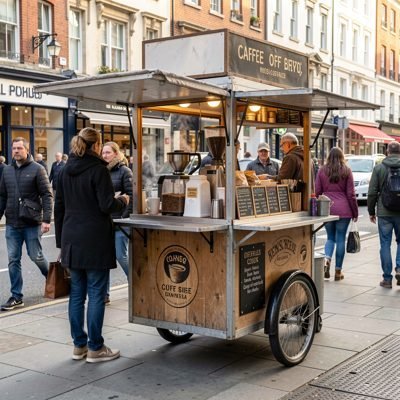
How Much Does It Cost to Open a Small Coffee Cart?
How Much Does It Cost to Open a Small Coffee Cart?

A coffee cart is the food truck’s scrappy little sibling — lower startup, simpler operations, and some carts clear six figures from a busy corner. How much does it cost to open a small coffee cart? Realistically $15,000 to $50,000 all-in, which makes it one of the most accessible food businesses. Here’s where every dollar goes.
How much does it cost to open a small coffee cart?
The Startup Cost Breakdown
The cart itself ($3,000–$15,000): a basic new vending-style cart runs $3,000–$8,000; a custom-built attractive cart $8,000–$15,000; used carts $1,500–$5,000 (inspect carefully — water damage and worn equipment hide in used carts). Espresso machine ($2,000–$8,000): this is your engine — a used La Marzocco or new Nuova Simonelli in the $3,000–$5,000 range is the sweet spot; cheap machines produce cheap-tasting shots and break under volume. Grinder ($500–$1,500): don’t skimp — grind quality determines shot quality more than the machine does.
Everything else ($3,000–$8,000): water system and filtration ($500–$1,500 — water quality makes or breaks espresso), initial inventory (beans, milk, cups, syrups: $1,000–$2,000), smallwares and backup supplies ($500–$1,000), signage and branding ($300–$1,000), POS system ($0–$60/month — Square’s free tier works). Permits and licenses ($500–$3,000): health permit, business license, food handler certs, and possibly a commissary kitchen arrangement ($300–$800/month in many jurisdictions — check your health department first). Insurance ($800–$1,500/year): see liability insurance costs — required by most locations.
Location: The Make-or-Break Factor
The cart is cheap; the location is everything. Prime options: office building lobbies (negotiate with building management — revenue share of 5–15% is common), farmers markets ($25–$100/day booth fees, great for building a following), college campuses, hospital entrances, transit stations, and event catering (weddings and corporate events pay $500–$2,000 per event — the highest-margin coffee there is). Each has different permit requirements — a sidewalk needs a street vending permit; private property needs the owner’s agreement.
Do the location math before buying anything: a good cart does 100–200 drinks/day at $4–$6 average. At 150 drinks × $5 × 25 days = $18,750/month gross. COGS (beans, milk, cups) runs 25–35%, location fees 0–15%, leaving healthy margins — if the foot traffic exists. Visit prospective spots at 7–9 AM on weekdays and count pedestrians. No foot traffic, no business — the cart can’t create demand, only serve it.
Operations Reality and Profitability
A realistic first-year: $60,000–$150,000 gross revenue for a well-located solo cart operating weekdays. Net margins of 30–50% are achievable because labor (you) and rent (a corner, not a lease) are low — but price your own labor honestly when evaluating. The work is physical and early: 5 AM setups, hauling water, standing all day. Seasonal in cold climates unless you’re indoors.
Growth paths: add a second cart/location (the model replicates well), pivot into event catering (higher margin, flexible schedule), or graduate to a brick-and-mortar café with an existing customer base (the cart as market research). Common failures: undercapitalization (no reserve for slow months), bad location (signed a cheap spot with no traffic), and menu bloat (12 drinks you make badly beats 4 you make brilliantly — master the classics first). Run the numbers like the food truck planning guide suggests, keep clean books, and the cart can fund its own expansion.
Quick Answers
- Total startup: $15,000–$50,000 (cart, espresso setup, permits, inventory, insurance).
- Don’t skimp: espresso machine ($3–5K sweet spot) and grinder ($500–$1,500) — they determine quality.
- Water filtration ($500–$1,500) is non-negotiable for good espresso.
- Location is everything: count foot traffic at 7–9 AM before committing.
- Best spots: office lobbies, farmers markets, campuses, hospitals, events ($500–$2K/event catering).
- Realistic year one: $60K–$150K gross, 30–50% net margins at a good location.
- Start narrow: master 4 classic drinks before expanding the menu.
The Bottom Line
Opening a small coffee cart costs $15,000–$50,000 — dramatically less than a café or food truck — with realistic first-year gross of $60,000–$150,000 at a good location. The equipment matters (don’t cheap out on the machine and grinder), but location matters more.
Count the foot traffic before you spend a dollar, keep the menu tight, and treat the cart as a real business from day one. It’s one of the few food businesses where a solo operator can genuinely thrive — if the corner is right.
Frequently Asked Questions
Espresso cart vs. full coffee shop — which is better to start?
The cart, for almost everyone: $15K–$50K startup vs. $200K–$500K for a shop, simpler operations, and you learn the business before committing to a lease. Many successful café owners started with carts — it’s market research that pays you. The shop makes sense when you’ve outgrown the cart (consistent lines, catering demand, need for seating). Start mobile, prove the concept, then go fixed. The cart is the low-risk MBA in coffee business.
How do I find a good location for my coffee cart?
Foot traffic count is everything: visit prospective spots 7–9 AM on weekdays and literally count pedestrians. Target 200+ per hour for viability. Best sources: office building managers (pitch the amenity value), farmers market organizers, event planners, and property owners with dead retail frontage. Negotiate terms clearly: flat fee vs. revenue share (5–15%), hours, exclusivity. Get it in writing — handshake location deals evaporate when a higher bidder appears.
What licenses does a coffee cart need?
Typically: business license, health department permit (with cart inspection), food handler certifications for operators, commissary kitchen agreement (required in most jurisdictions), and location-specific permits (street vending, event permits). Budget $500–$3,000 and weeks-to-months of processing. The health department is your first call — requirements vary wildly, and some jurisdictions make carts difficult. Know before you buy equipment.
Can one person run a coffee cart alone?
Yes — most carts are solo operations, and that’s the economic magic (no labor cost). But solo means: you do everything (setup, service, breakdown, restocking, bookkeeping), morning rushes are intense, and sick days close the business. Throughput caps around 60–80 drinks/hour solo for espresso. Many operators add a second person for peak seasons or events. Price your own labor honestly when evaluating profitability — ‘I pay myself nothing’ isn’t a business model, it’s a hobby with revenue. The fundamentals of espresso are worth studying — drink quality is the product, and the cart owner is the barista.