Inside Diana Ross’s $350 Million Fortune: Six Decades at the Microphone
Inside Diana Ross’s $350 Million Fortune: Six Decades at the Microphone
Diana Ross at a Glance
| Diana Ross at a Glance | Details |
|---|---|
| Born | 26 March 1944, Detroit, Michigan |
| Age | 82 |
| Height | 5 ft 4 in (1.63 m) |
| Net Worth | $350 million (Celebrity Net Worth) |
| Weight | No reliable published figure |
| Partner | No current partner publicly confirmed |
| Children | Five: Rhonda (b. 1971), Tracee (b. 1972), Chudney (b. 1975), Ross (b. 1987), Evan (b. 1988) |
| @dianaross |
A Detroit Girl Raised in Public Housing
Diana Ross entered the world on 26 March 1944 in Detroit, Michigan, and grew up in the city then building a new sound for popular music. Her parents, Fred Ross Sr. and Ernestine Ross, born Moten, raised the family in public housing projects, in circumstances modest by any measure. Her mother died in 1984, just as the solo career reached its second peak. Her father lived until 2007 and watched his daughter become one of the most recognizable performers on earth.
Detroit in her youth ran on factory shifts and church choirs, and the neighborhoods produced singers in numbers far beyond their size. Ross sang at school and in church, took a job at a department store, and joined friends in a vocal group called the Primettes. The group worked the local circuit, learned harmony discipline in small rooms, and pressed its case on the young Motown label until Berry Gordy’s company signed it. The label renamed the act the Supremes, reshaped its presentation, and waited. The first records made little impression, and insiders joked about an act long on promise and short on hits. Ross and her group mates kept rehearsing. The distance from a Detroit project to a fortune counted in hundreds of millions starts exactly there, in those unglamorous rehearsal years.
How Where Did Our Love Go Made the Supremes Stars
1964 — Where Did Our Love Go
The breakthrough arrived in 1964. Where Did Our Love Go reached number one, and Baby Love and Come See About Me followed in rapid order. The Supremes had found a formula: Ross’s light, precise lead voice set against a polished group sound, records built for radio and delivered with immaculate presentation. Within a year the group stood as the most commercially successful act on its label and one of the biggest in the world.
1965 — Stop! In the Name of Love
The run continued through 1965 and 1966 with a sequence of number one records few groups in any era have matched: Stop! In the Name of Love, Back in My Arms Again, I Hear a Symphony, and You Can’t Hurry Love among them. The Supremes filled concert halls and topped variety bills on both sides of the Atlantic. Ross, as the voice and face of the act, became the member the public knew by name, and that prominence set up everything that followed.
1969 — Presenting the Jackson 5
By the end of the decade Ross held such standing inside Motown that the label used her to introduce its next great act. In 1969 she presented and championed the Jackson 5, and the young group’s first records carried her endorsement into the market; readers following that introduction can consult Michael Jackson’s net worth profile for the record of the singer who emerged from that group. The moment reads in retrospect as one era handing the spotlight to the next, inside a single company.
1970 — The Solo Break
Ross left the Supremes at the start of 1970 and released her first solo album, Diana Ross, the same year. Its centerpiece, Ain’t No Mountain High Enough, reached number one and settled the central question of her career: the voice that carried the group could carry a solo record just as completely. Reach Out and Touch (Somebody’s Hand) had already shown the direction, and the song became a standard of her live performances for decades.
1973 — Touch Me in the Morning
The solo catalogue deepened through the 1970s. Touch Me in the Morning delivered another number one in 1973, and the albums of the period, Everything Is Everything and Surrender among the earlier ones, built a solo identity distinct from the group years: slower, more intimate records alongside the uptempo singles. Theme from Mahogany (Do You Know Where You’re Going To) added a further number one mid-decade, and the pattern held for the rest of her career: ballads and dance records alternating, both in the same unmistakable voice.
1980 — Upside Down and I’m Coming Out
The album Diana (1980) marked the commercial peak of her solo years. Chic’s producers built it in a contemporary dance style, and it produced Upside Down, a number one single, and I’m Coming Out, a record whose life long outlasted its chart run. Sixteen years after her first hit, Ross met the current sound of popular music on its own ground and topped it, a feat very few of her contemporaries managed even once.
1981 — Endless Love and the RCA Contract
Endless Love, her 1981 duet with Lionel Richie, spent weeks at number one and became one of the best-selling singles of its period. The same year she left Motown, the label that had built her, and signed with RCA in a contract reported at around $20 million. Headlines treated the sum as a fortune in itself; this profile records it accurately as an earnings event, a reported contract value, and never as a measure of her wealth then or now. The move itself mattered more: the defining artist of one company walked away at the height of her value.
1982 — Chain Reaction and the Later Records
The RCA years and the decades after produced a steadier flow of records rather than another single peak. Michael Jackson wrote Muscles, and the song reached the top ten in 1982. Chain Reaction topped the British chart in the middle 1980s and gave her a late solo number one in the market that embraced the Supremes earliest. Albums continued into the following decades, and the combined catalogue, group and solo together, settled into the position it still holds: a body of work every later generation of singers in her field must reckon with.
2026 — Diana in Motion
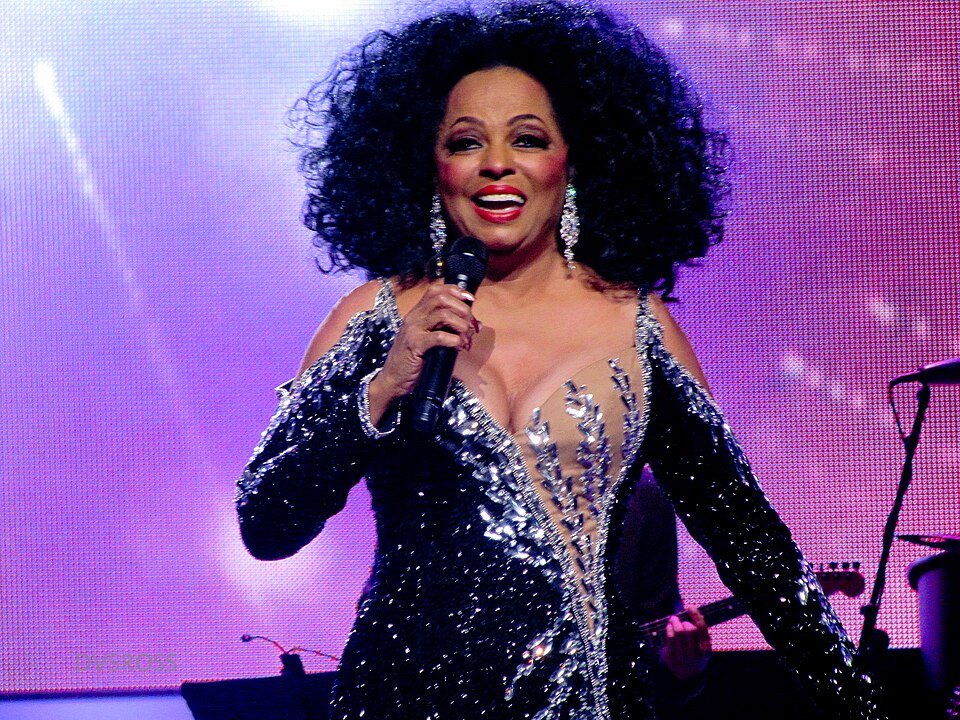
The most recent chapter runs on the road. Her Diana in Motion tour carried dates through 4 October 2026 and closed in Las Vegas. At eighty-two, more than sixty years after her first hit record, Ross still headlines major rooms, still sings the catalogue live, and still draws audiences spanning three generations. Longevity at that level stops looking like nostalgia and starts looking like a discipline she simply never dropped.
1967 — Reflections and the Final Supremes Years
The Supremes’ later records deepened the catalogue that still pays her. Reflections in 1967, Love Child in 1968, and Someday We’ll Be Together in 1969, her final number one with the group, showed a harder, more contemporary sound than the early hits, and the group placed twelve number one singles on the main chart across the decade, a total no other group of the era matched. Ross sang lead on nearly all of them, and the label billed the act under her name from 1967 onward, a public acknowledgment of where the commercial weight sat. Those records form the foundation layer of the fortune: recordings she made before she turned twenty-six that still stream, license, and sell sixty years later.
1976 — Love Hangover and The Boss
The middle 1970s added a second solo peak. Her 1976 album Diana Ross carried Love Hangover, a number one single that moved between ballad and dancefloor in a single take and announced her fluency in the disco era before the era fully formed. Ashford and Simpson wrote and produced The Boss; the album followed in 1979, and it restored her chart momentum at the decade’s end and set up the 1980 commercial summit. Across the two decades she placed solo hits in every format her industry invented, from 45s to albums to the dance charts, and each format change paid the catalogue again.
1991 — The Force Behind the Power
Her later recording career found a particularly loyal audience in Britain and Europe. The Force Behind the Power (1991) sold strongly in the British market and produced When You Tell Me That You Love Me, a top-five single there that a later generation of performers covered as a duet with her blessing. Take Me Higher followed in 1995 with another British top ten run. The pattern of her sixth decade repeated the pattern of her third: when one market cooled, another warmed, and the catalogue’s global spread smoothed every transition.
Two Marriages, Five Children and No Partner Now
No current partner stands publicly confirmed for Diana Ross, and the Daily Record above records the position in exactly those terms. Her two marriages belong to the history of her life, and this section tells them as history. Her first marriage, to music business manager Robert Ellis Silberstein, began in January 1971 and ended in divorce in 1977. The marriage coincided with the first great phase of her solo career, when she proved the Supremes’ success could travel under her name alone. Three of her children arrived during that marriage: Rhonda in 1971, Tracee in 1972, and Chudney in 1975. All three built public careers of their own, Tracee most visibly, as an actor with a long and successful run in comedy and drama series.
Her second marriage, to Arne Næss Jr., a Norwegian shipping magnate and mountaineer, began in 1986 and ended in divorce in 2000. Næss died in 2004. Two sons arrived during that marriage: Ross in 1987 and Evan in 1988. Evan works as an actor and musician and carries the family name into a third generation of performers. In total Ross has five children and seven grandchildren, as the verified record stands. The family spreads across two marriages and three decades, and its members appear in public largely on their own terms and for their own work. Her parents anchor the earlier record: Fred Ross Sr., who died in 2007, and Ernestine Ross, who died in 1984 and never saw the full length of the solo career she helped make possible. This profile records the documented structure and goes no further into private matters.
Motown Hits, Solo Stardom and a $350 Million Fortune
Celebrity Net Worth estimates Ross’s fortune at $350 million, in a page snapshot dated 6 November 2026, and this profile attributes the figure to that source at every mention. A lower figure of around $250 million circulates in general coverage, but no allowed source stands behind it, and the profile sets it aside rather than splitting any difference. No Forbes or Sunday Times Rich List total competes on the record.
The build-up rests on sixty years of catalogue. The Supremes’ records sell and stream in every format each era invents, and Ross’s solo catalogue adds a second library on top of the first. Songwriting and publishing interests, the RCA contract era’s earnings, and decades of arena touring all fed the total, and careful retention across six decades did the rest. The 1981 contract figure of around $20 million belongs in the earnings column, as this profile has recorded it, and the tour grosses of recent years belong there too. The $350 million estimate describes accumulated and retained wealth, and it reflects a career that never stopped earning long enough for the total to erode. No reliable published inventory of her property or other holdings exists on the record this profile uses, and the profile states that absence plainly instead of assembling one from listings coverage.
The Template Every Pop Star Still Studies
Ross’s career supplies the template her industry still studies. A group singer became a solo star, the solo star became a catalogue, and the catalogue became a fortune that outearns most active careers. She achieved each transition at full commercial scale, in public, across six decades of changing taste, and she still closes tours in Las Vegas at eighty-two.
The fortune, $350 million by the Celebrity Net Worth estimate, prices only part of that. The rest sits in the influence: the presentation standards she set for every vocal group after the Supremes, the solo path she proved a group frontwoman could take, and the professional generosity that presented the Jackson 5 to the world in 1969. The voice remains unmistakable, the catalogue remains in daily use, and the record, from a Detroit housing project to the top of her industry, remains entirely her own.