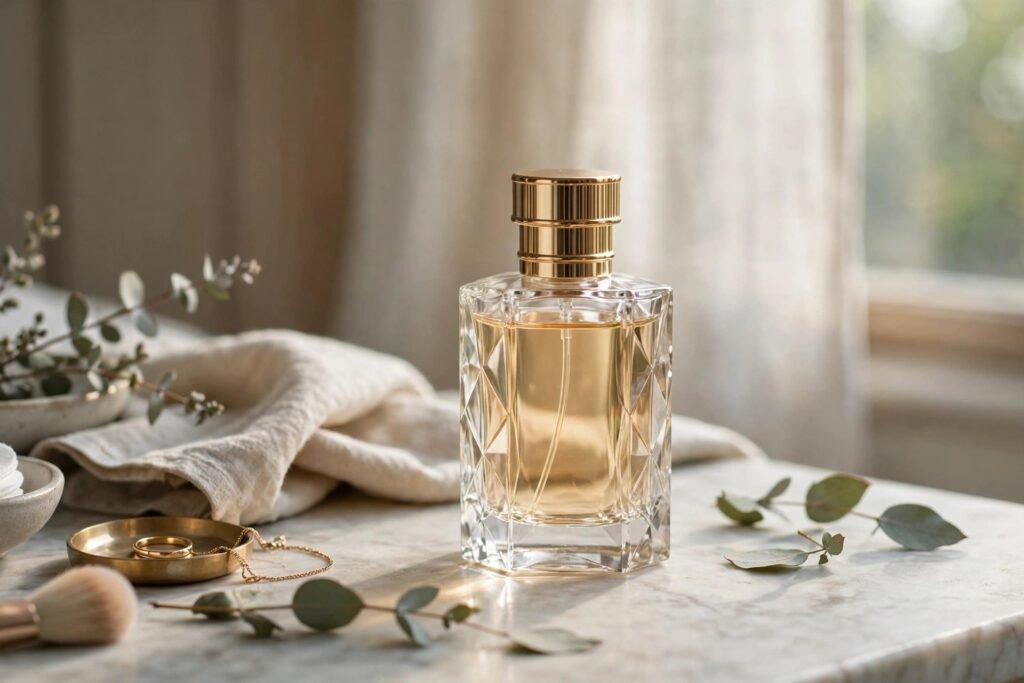
How to Make Your Perfume Last Longer: 12 Proven Pro Tricks
You spray your favorite perfume at 8 a.m.; by noon, it is a memory. Meanwhile your coworker’s scent announces her arrival hours after she has left the room. The difference is rarely the price of the bottle — it is chemistry, application technique, and a handful of professional tricks that most people never learn.
Perfume longevity is a solvable problem. This guide explains the science of why fragrance fades, how to choose long-lasting scents, the application method that maximizes wear time, storage mistakes that kill perfume in months, and the layering system perfumers themselves use.
Why Perfume Fades: The Evaporation Curve
A fragrance is a blend of volatile molecules engineered to evaporate in stages: bright top notes (citrus, herbs) flash off in 15-30 minutes, heart notes (florals, spices) carry the middle hours, and base notes (woods, musk, amber, vanilla) anchor the dry-down for hours. “My perfume doesn’t last” usually means one of three things: the composition is top-note-heavy by design (fresh/citrus scents are inherently fleeting), your nose has adapted (olfactory fatigue makes you stop smelling it while others still can — ask a friend before declaring it gone), or application and skin chemistry are working against you.
Skin chemistry is the wildcard. Fragrance molecules bind to skin oils — dry skin holds scent poorly because there is less lipid layer to anchor it, while well-moisturized skin can double wear time. Diet, hormones, medications, and even hydration shift how a perfume performs on you versus the paper test strip. This is why testing on skin, not paper, is non-negotiable before buying.
Concentration Matters More Than Brand
The same scent name comes in different concentrations with radically different longevity: Eau de Toilette (EDT) — 5-15% perfume oil, lasts 3-4 hours. Eau de Parfum (EDP) — 15-20%, lasts 5-8 hours. Parfum/Extrait — 20-30%+, lasts 8-12+ hours. Eau de Cologne — 2-5%, 1-2 hours. If longevity is the priority, buy the EDP or parfum concentration of a scent you love rather than chasing a “stronger” different fragrance in EDT. The price per wear usually favors the higher concentration.
The Application Method That Maximizes Wear
1. Moisturize first. Apply fragrance to moisturized skin — ideally right after showering, over unscented lotion or body oil. The lipid layer grips fragrance molecules. This single step is the biggest longevity lever most people ignore.
2. Target pulse points — and hair and clothes. Wrists, neck, behind ears, inner elbows: warmth diffuses scent. But skin’s warmth also accelerates evaporation, so the longest-wearing applications are actually hair (mist from a distance — alcohol can dry hair with direct heavy spraying) and clothing. Fabric holds fragrance for days; a sprayed scarf or jacket lining outlasts any skin application. Never spray silk or delicate fabrics directly — test first.
3. Don’t rub wrists together. The classic wrist-rub crushes top notes and generates heat that flash-evaporates the composition’s opening. Spray and let it settle — perfumers consider rubbing a small act of vandalism against their work.
4. Layer the dose. Two to three sprays is standard for EDP; one for parfum. “Spray, walk through the mist” wastes product into the air. For all-day wear, a morning application plus one midday touch-up (a travel atomizer — decant, do not carry the bottle) beats over-spraying in the morning, which just creates a loud first hour and a silent afternoon.
5. Consider the unscented base trick. A thin layer of petroleum jelly on pulse points before spraying gives fragrance oils something to cling to — an old perfumer’s trick that measurably extends wear on dry skin.
Choosing Naturally Long-Lasting Scents
Composition predicts longevity. Longest-wearing families: orientals/ambers (vanilla, benzoin, labdanum), woody scents (sandalwood, cedar, oud), musks, and gourmands — heavy base-note molecules that evaporate slowly. Shortest-wearing: citrus colognes, aquatic/fresh scents, light green florals — built from volatile top notes by design.
When testing, do the full-day wear test: spray on skin in the morning, note when you stop detecting it (asking others), and check the dry-down at hour six — some scents transform beautifully, others turn sour on your chemistry. Never buy from the first sniff; the top notes you smell in the store are gone within the hour. This is the fragrance equivalent of the care you put into any long-lasting choice — like the occasion dressing in our guide to dressing up jeans for dinner out, where the right foundation makes everything last the evening.
The Layering System
Professionals rarely wear a single product. The layering stack — matching scented body wash, then lotion, then perfume, all in the same or complementary scent families — builds longevity geometrically because each layer refreshes the others and the lotion base anchors the perfume. Even layering an unscented rich lotion under any perfume adds hours. Scented lotions in the same line as your perfume are the easiest win; complementary layering (vanilla lotion under a floral perfume) is the advanced art.
Storage: How People Accidentally Kill Perfume
Fragrance is chemistry, and chemistry degrades. The three killers are heat, light, and air. The bathroom counter — humid, warm, bright — is the worst storage spot in the house, yet the most common. Perfume stored in a hot bathroom can turn noticeably off within a year; the same bottle in a cool, dark closet lasts 3-5+ years.
Rules: store upright (minimizes seal contact with liquid), away from windows and radiators, ideally in the original box, at stable room temperature or cooler. Do not refrigerate (condensation risks) unless you live somewhere truly hot — a cool closet beats the fridge. And minimize air exposure: decant into smaller atomizers for travel rather than opening the big bottle constantly, and do not shake bottles (it aerates and oxidizes the juice).
How to tell it has turned: the scent smells sharp, sour, or “off” compared to memory; the color has darkened significantly; it irritates skin it never bothered before. Top-note-heavy citrus scents die fastest (1-2 years); heavy orientals and parfums can last a decade.
Skin-Health Notes
Fragrance is among the most common cosmetic sensitizers — if you develop redness, itching, or rash where you spray, you may have fragrance sensitivity. Strategies: spray clothing instead of skin, choose fragrance-free products for the rest of your routine to reduce total load, and patch-test new perfumes on the inner forearm for several days. The dermatology guidance at AAD covers fragrance allergy management, and the FDA’s cosmetics resources explain fragrance ingredient disclosure rules.
One safety note: never spray perfume on skin that will get significant sun exposure in large amounts — some fragrance ingredients (notably bergamot-derived bergapten in natural compositions) can cause phototoxic reactions. And keep the matching-sunscreen habit from our sunscreen for sensitive skin guide as the non-negotiable base layer — fragrance never substitutes for protection.
Conclusion
Making perfume last longer is a system: buy EDP or parfum concentrations in base-note-heavy families, apply to moisturized skin (and hair and clothes), never rub, layer with matching scented lotion, touch up midday with a travel atomizer, and store bottles cool, dark, and upright. Do all of that and the 8 a.m. spray is still introducing you at dinner.
Frequently Asked Questions
Why can’t I smell my perfume after an hour?
Likely olfactory fatigue — your nose adapts and stops registering it while others still can. Ask someone else before reapplying. True fade is faster with EDT concentrations, citrus/fresh compositions, and dry skin.
What’s the difference between EDT and EDP?
Perfume oil concentration: EDT is 5-15% (lasts 3-4 hours), EDP is 15-20% (5-8 hours), parfum/extrait is 20%+ (8-12+ hours). For longevity, buy the higher concentration of a scent you love.
Where should I apply perfume for longest wear?
Moisturized pulse points (neck, wrists, behind ears), plus hair (misted lightly) and clothing — fabric holds scent for days. Apply right after showering over unscented lotion for maximum grip.
Should I rub my wrists together after spraying?
No. Rubbing crushes top notes and generates heat that accelerates evaporation. Spray and let the fragrance settle undisturbed.
How should I store perfume?
Upright, in a cool dark place (not the bathroom), ideally in the original box, away from heat and light. Properly stored, most perfumes last 3-5 years; heavy orientals can last a decade. Citrus scents degrade fastest.