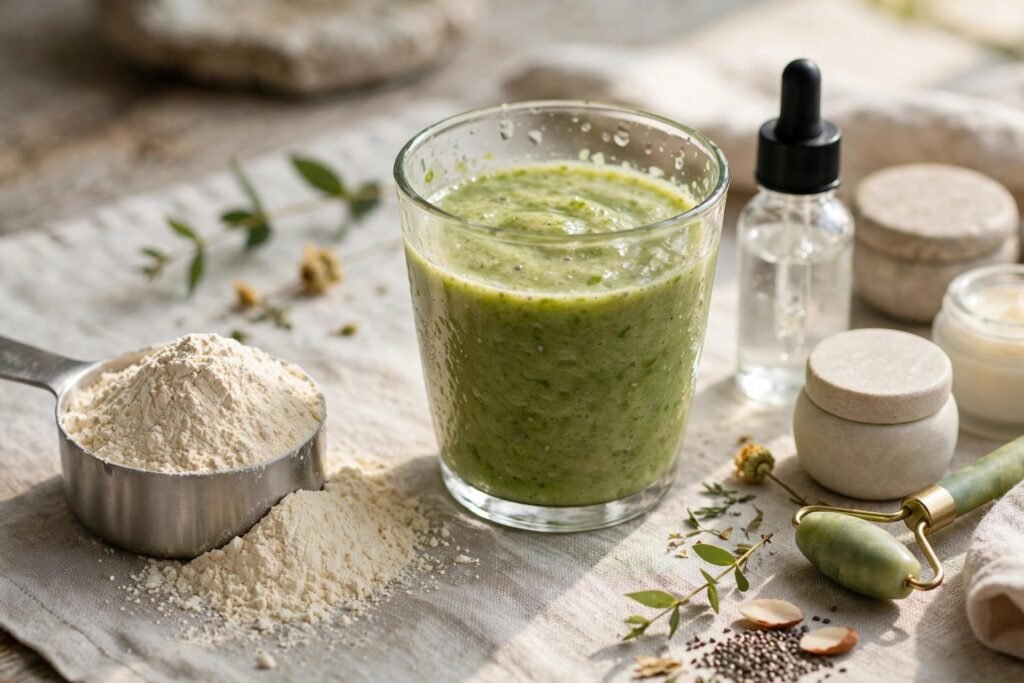
Is Collagen Powder Worth Taking for Skin? Evidence Review
Collagen powder is a $2-billion industry built on an irresistible promise: drink this tasteless powder and your skin gets firmer, your wrinkles soften, your hair thickens. It is in coffee, smoothies, protein bars, and creamer — endorsed by celebrities and wellness influencers with suspiciously poreless skin. The marketing is flawless. The science is… more complicated.
So is collagen powder worth taking for skin? The honest answer sits between the hype and the dismissal: there is genuine, peer-reviewed evidence of modest benefit — and a much larger cloud of overclaim. This guide reviews what the studies actually show, what they do not, how to choose a product if you try it, and what matters more for your skin.
What Collagen Powder Is (and Isn’t)
Collagen is the most abundant protein in the human body — the structural scaffolding of skin, tendons, and cartilage. After about age 25, natural collagen production declines roughly 1 percent per year, accelerating after menopause. Collagen powder is typically hydrolyzed collagen (collagen peptides) from bovine hides, fish skin, or chicken — broken into small peptides that dissolve in liquid and survive digestion better than intact collagen.
The key mechanistic question: when you eat collagen peptides, does any of it reach your skin as collagen? The answer is nuanced. Digestion breaks peptides into amino acids and di/tri-peptides; some specific peptides (notably prolyl-hydroxyproline) do appear in blood after ingestion and have been shown in lab studies to stimulate fibroblasts — the cells that make skin collagen. So the pathway is biologically plausible, not magical thinking. But “plausible mechanism” and “visible results” are different bars.
What the Research Actually Shows
Multiple randomized controlled trials — the gold standard — have tested hydrolyzed collagen against placebo for skin outcomes. A 2021 systematic review and meta-analysis in the International Journal of Dermatology pooled 19 studies with over 1,100 participants and found that collagen supplementation improved skin hydration, elasticity, and dermal collagen density versus placebo, with effects typically appearing after 8-12 weeks of daily use (2.5-10g doses).
That sounds decisive — until you read the caveats, which are significant. Study quality is mixed: many trials are small, short, and funded by collagen manufacturers — an industry-funding pattern that correlates with positive findings across supplement research. Effect sizes are modest: we are talking measurable improvements in elasticity readings, not visible transformations; no well-designed study shows collagen erasing wrinkles. Populations are narrow: most trials enroll middle-aged women; data on men, younger adults, and diverse skin types is thin. Comparisons are weak: few studies test collagen against an equal-protein placebo — some of the benefit may simply be extra protein intake, which supports skin generally.
Dermatologists’ consensus, summarized in AAD guidance (aad.org), is cautiously open: collagen peptides appear safe for most people and may modestly improve skin hydration and elasticity — but they are not a substitute for sun protection, retinoids, or any evidence-based skincare, and the marketing claims far outrun the data.
What About Hair and Nails?
Evidence here is thinner still — mostly small, uncontrolled studies and anecdote. Biotin has better (though still limited) data for brittle nails. For hair, no quality trial shows collagen regrowing or thickening hair; the plausible benefit is limited to the amino-acid building blocks also available from any complete protein.
The Math: Cost vs. Benefit
A quality collagen peptides tub runs $25-$50 for a month’s supply at 10-20g daily. Annual cost: $300-$600. For that you get, per the best evidence, a modest improvement in skin hydration and elasticity after 2-3 months — roughly comparable to what a good moisturizer and adequate protein intake achieve. Frame it honestly: collagen is a premium-priced marginal gain, not a skincare cornerstone.
The opportunity-cost comparison matters. That $400/year buys: a year’s supply of broad-spectrum sunscreen (the single highest-ROI skin intervention in existence), a prescription retinoid copay (the best-evidenced anti-aging topical), or simply more dietary protein — which provides the same amino acids. If your budget forces a choice, sunscreen and retinoids win on evidence by orders of magnitude.
If You Try It: Choosing Wisely
Type: hydrolyzed collagen peptides (type I and III for skin) — this is what the studies tested. “Undenatured” collagen is a different product studied for joints, not skin.
Source: bovine, marine, or poultry all appear in trials; marine is often marketed as superior for skin but head-to-head evidence is lacking. Choose based on dietary restrictions and contaminants testing.
Third-party testing: look for NSF Certified for Sport, Informed Sport, or USP verification — the supplement industry is lightly regulated, and independent analyses have found heavy-metal contamination and label inaccuracies in some collagen products. Third-party seals are the only quality signal that counts.
Dose and duration: studies showing benefit typically use 2.5-15g daily for at least 8-12 weeks. One scoop in occasional coffee does nothing; consistency at studied doses is the minimum for any effect.
How to take it: it dissolves in hot or cold liquid with minimal taste — which is why it ends up in morning coffee and quick breakfast smoothies. Vitamin C co-ingestion is often recommended (vitamin C is a cofactor in the body’s own collagen synthesis) — a reasonable, cheap synergy.
What Matters More for Skin (The Unsexy List)
If skin is the goal, the evidence hierarchy is clear: 1. Sun protection, daily. UV radiation destroys collagen faster than any supplement rebuilds it — up to 80 percent of visible aging is photoaging. 2. Not smoking. Smoking devastates dermal collagen. 3. Retinoids. The best-evidified topical for stimulating collagen production. 4. Adequate protein. Your body cannot build collagen without amino-acid raw materials; most Americans get enough, but dieters and older adults often do not. 5. Sleep and stress management. Growth hormone (released in deep sleep) drives tissue repair. Collagen powder sits somewhere below all five — a possible incremental addition to a foundation, never the foundation.
The NIH’s supplement fact sheets (nih.gov) and the Mayo Clinic’s evidence reviews both land in the same place: possibly helpful, modest effect, safe for most — and no replacement for the basics.
Who Should Skip It
People with kidney disease (high protein loads), those with alpha-gal syndrome or beef/fish allergies (source-dependent), anyone expecting dramatic results, and anyone for whom $300-$600/year strains the budget. Pregnant and breastfeeding women should check with their OB — data in these populations is essentially nonexistent. And if you are already meeting protein needs with a solid diet, the incremental amino acids from collagen add little.
Conclusion
Is collagen powder worth taking for skin? The evidence supports a modest “maybe”: quality trials show small improvements in hydration and elasticity after 2-3 months of daily use, with a good safety profile — but industry funding, small effect sizes, and marketing overclaim should temper expectations. If you have the budget, choose a third-party-tested product, take a studied dose consistently, and keep perspective: sunscreen, retinoids, protein, sleep, and not smoking will do more for your skin than any powder. Collagen is the garnish, not the meal.
Frequently Asked Questions
Does collagen powder really improve skin?
Modestly, per meta-analyses of randomized trials: improved hydration, elasticity, and dermal collagen density after 8-12 weeks of daily use (2.5-10g). Effects are measurable but not dramatic — no quality study shows wrinkle erasure.
How long does collagen take to work for skin?
Studies showing benefit typically run 8-12 weeks minimum. Occasional or short-term use has no evidence of effect; consistency at studied doses is required.
Is marine or bovine collagen better for skin?
No quality head-to-head evidence favors one for skin outcomes. Both appear in positive trials. Choose based on dietary needs, allergies, and third-party testing rather than marketing claims.
Are there side effects of collagen powder?
Generally well tolerated; mild digestive upset is the most reported issue. People with kidney disease, meat/fish allergies, or alpha-gal syndrome should avoid or consult a doctor. Contamination risk makes third-party testing important.
What works better than collagen for skin aging?
Daily sunscreen (prevents collagen destruction), prescription retinoids (stimulate collagen production), adequate dietary protein, not smoking, and good sleep — all with far stronger evidence than collagen supplementation.